A 17th-century estate, combining heritage and modernity, with stables, a guest cottage and other outbuildings, near Agen - ref 177243
A 17th-century estate, combining heritage and modernity, with stables, a guest cottage and other outbuildings, near Agen.
Located in the heart of Nouvelle-Aquitaine region, the property enjoys a strategic position in the Lot-et-Garonne department, while Agen is approximately ten kilometres away as is the A62 motorway, which provides access to Bordeaux or Toulouse, as well as their international airports, in less than 1.5 hours. Today, Paris can be reached in three hours and ten minutes via train, but the future high-speed rail station in Agen will soon reduce this amount of time to two hours and forty minutes.
In addition, the proximity of the department's administrative centre as well as major infrastructures, such as a university hub (an annexe of Bordeaux University, I.U.T.), the National School for Penitentiary Administration, upper secondary schools, universities and shops, a hospital and a medical clinic all add to the drawing power of this part of Gascony, whereas the interest for the region is also supplemented by its rich heritage, renowned gastronomy and mild climate.
The private lane, which leads to the property, ascends the wooded hillside overlooking the alluvial plain, traversed by the Garonne Canal and ideal for growing grain as well as fruit trees thanks to the local temperate climate featuring hot summers and plenty of rain, before running alongside a substantial retaining wall and the property's initial buildings.
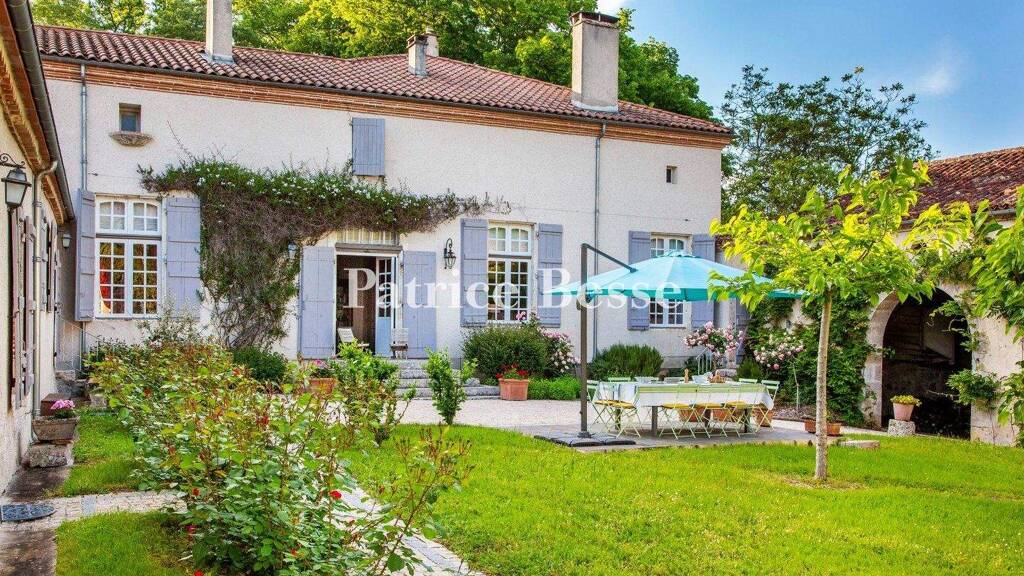
Constructed on the side of the hill, the dwelling provides a panoramic view of the Garonne River valley, which defines the border with Gascony. Historically incorporated with a farm and protected from flooding, the estate provides a typical example of a noble dwelling from this region around Agen, while the two-storey dwelling, built over a basement level and bordered by a patio to the northeast, is composed of three buildings arranged around a courtyard, all with understated, plaster-coated stone exteriors, which are cadenced by rectilinear windows and doors surrounded by ashlar stone and topped with brick genoise cornices.
Like the main dwelling, completely renovated, all the other edifices are operational, in accordance with the current owners' wishes, and arranged around a private enclosed garden. As for this rectangular interior courtyard, covered in both cobblestones and lawn, it provides access to both the dwelling and agricultural buildings, the latter of which feature rendered or pointed rubble stone exteriors, genoise cornices as well as their brick entablatures, evidence of some architectural revisions that date from the Restoration period, while all the buildings are topped with either gabled or hipped roofs covered in barrel or interlocking tiles.
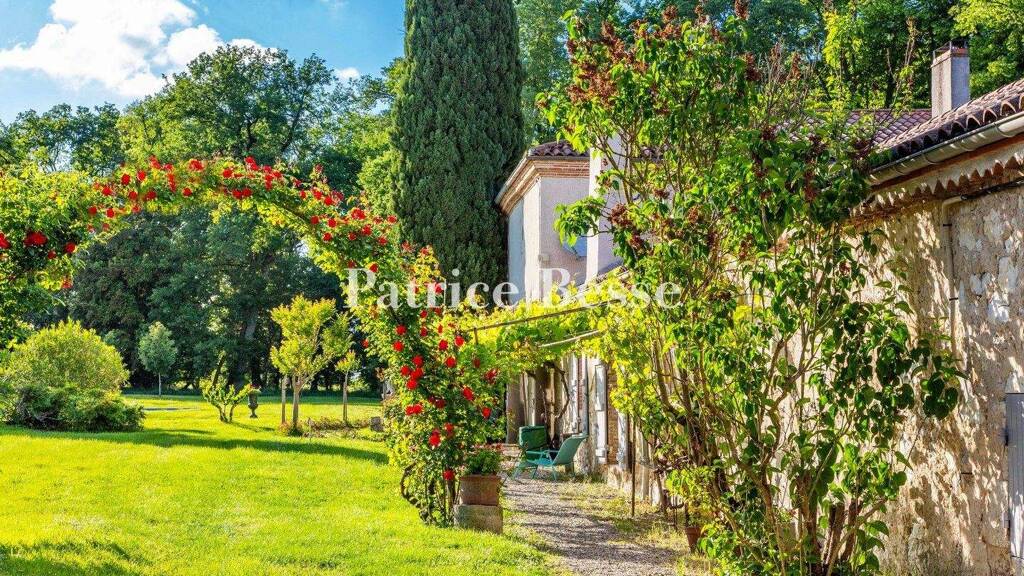
Set back from the building complex, a large barn with its long gallery has been converted into a guest cottage, whereas the grounds, blanketed in lawn and planted with many different varieties of trees, feature a central swimming pool and its pool house, a half-timbered dovecote to the north, an orchard to the southeast and a small grove of trees to the west.
The Main DwellingFacing a verdant interior courtyard to the east, the house is accessible via several entrances: from the south, one opens on to the kitchen, which overlooks the grounds, while its glass double-door main entrance, as well as two other doors, also provide access to the ground floor.
As for the northern side, a small carriage entrance communicates with the interior courtyard, whereas the dwelling's stone front steps, to the east, provide access, via a large entranceway, to this level's living areas. In addition, tall glass double doors topped with glazed fanlights open on to the immense patio, while, on the garden level, two large doors communicate with the cellar.
The ground floor
From the interior courtyard, the front steps ascend ...