A 19th-century family dwelling, its immense terraced garden and wooded area on 1.5 hectares in the middle of a town within the Pays de Lorient urban a
A 19th-century family dwelling, its immense terraced garden and wooded area on 1.5 hectares in the middle of a town within the Pays de Lorient urban area.
A few kilometres from the beaches near Lorient in southern Morbihan, the former of which is known as the city of five ports, the property is located in a town of approximately 4,000 inhabitants, recognised as a "Small Town Full of Character". Here, the recreational activities offered in the vicinity are many: pedestrian hiking trails and cycling paths are nearby as well as a number of fishing spots thanks to the proximity of a river that runs alongside part of the property. In addition, schools and shops are easily accessible, while, in Lorient, the high-speed rail station provides service to Paris in three hours or one hour via the Bretagne Sud airport.
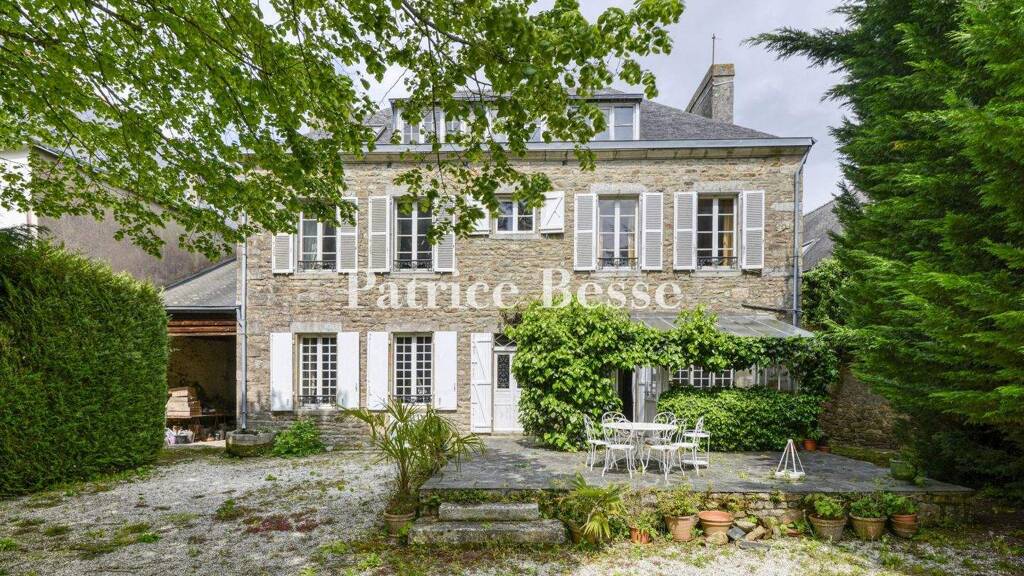
The property consists of a freestanding house built in the 1830s, which faces the town to the north and 1.5 hectares of gardens and forest in the back, sheltered from view. Access to the back of the property, where an enclosed ornamental terraced garden was created, is possible via an entrance on either side of the house: a pedestrian door on one side and a carriage entrance on the other, the latter of which opens onto a covered porch topped with an attic, which is used for storage, while the property also has a third entrance, which leads directly to the garage. Partially built over the site of a 17th-century timber-framed house, the vestiges of its foundations still visible in the cellar, the current three-storey rectangular dwelling was constructed out of granite rubble stone with ashlar granite stone quoins and cornices over a basement level. As for the house's main façade, classically and symmetrically arranged with two horizontal and five vertical rows of windows and doors, on the ground floor, two windows flank either side of the front door with its glazed fanlight, while five windows punctuate the first floor under a hipped roof cadenced by three dormer windows crowned with arched pediments. As for the back of the house, it was noticeably reconfigured in the 20th century with a few modifications to the windows as well as the back side of the roof, where a series of dormer windows were added in order to provide abundant sunlight for the second floor partially built underneath the house's eaves.
The DwellingHaving preserved its overall layout, the house's interior is symmetrically arranged on either side of the house's central axis formed by the entrance hall and stairwell.
The ground floor
The entrance hall provides access, on one side, to a former dining room, today used as a study, the décor of which has been meticulously conserved: a Second Empire-style, red-veined marble fireplace, wainscoting, hardwood floors and a ceiling rose adorned with edible motifs. On the other side of the entrance hall, a dining room with another Second Empire-style fireplace and a hardwood floor is extended, via an open archway, by an adjacent living room with a fireplace and a carpeted floor, both of which are topped with coffered ceilings.
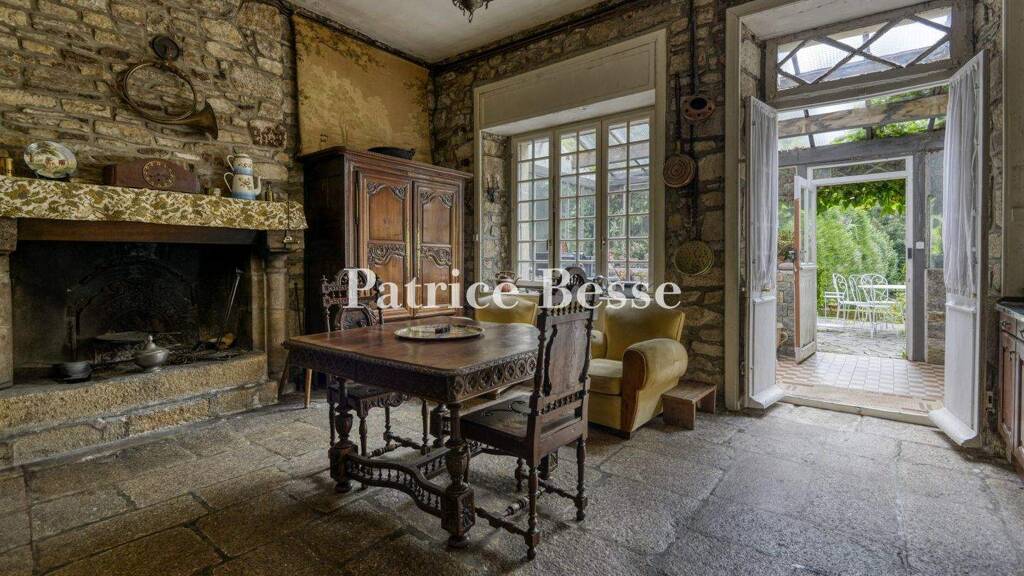
Following on from the entrance hall, the stairwell area provides access, via a small corridor, to a kitchen with a fireplace and a flagstone floor, the stones of which came from an old chapel, which is, in turn, extended by a conservatory facing the garden, while the small corridor continues on to a lavatory. In addition, the stairwell area provides access to the garden, directly opposite the entrance hall, as well as the cellar, the door to which is located under the stairs.
The first floor
This floor is accessible via a central staircase safeguarded by a cast-iron and wooden bannister where a double landing provides access to four bedrooms and a bathroom. With either straight-plank hardwood or carpeted floors throughout, this level has successfully ...