Only 10 minutes from Montreuil-sur-Mer, an authentic, 19th-century flour mill, with a manor house and many outbuildings - ref 692130
Only 10 minutes from Montreuil-sur-Mer, an authentic, 19th-century flour mill, with a manor house and many outbuildings.
The mill is located on the outskirts of an authentic village in the southwest reaches of the Pas-de-Calais area and the western part of the Hauts-de-France region. The locality boasts all essential everyday shops. It only takes 10 minutes by car to reach Montreuil-sur-Mer, a former major seaport and one of the main tourist attractions in the region with its 13th-century and 16th-century ramparts. Le Touquet, often considered to be the pearl of the Côte d'Opale coastline, can be reached in 30 minutes. Lastly, a motorway junction on the A16, which virtually runs along the coast, is only a few kilometres away from the property, on the way to Étaples.
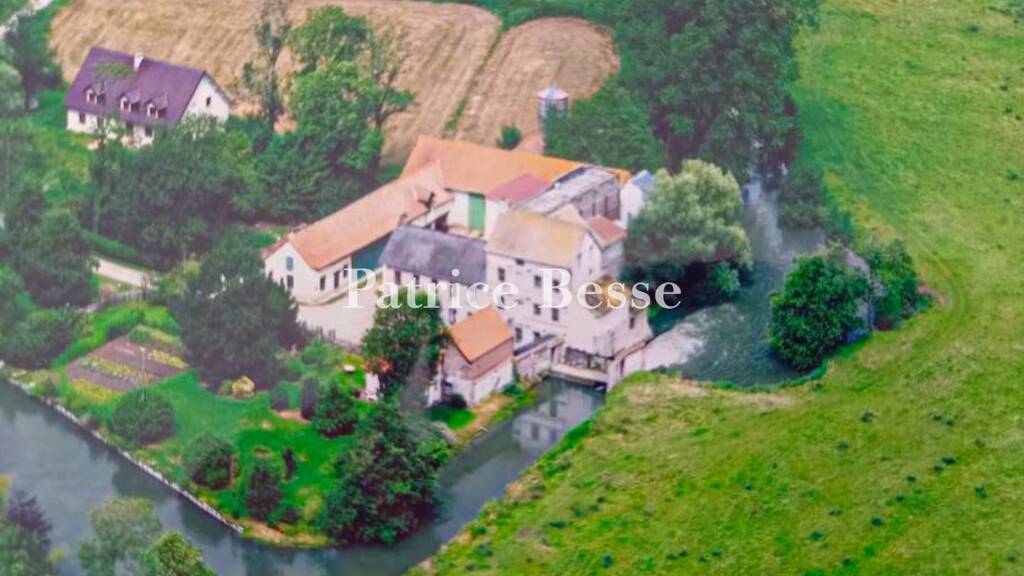
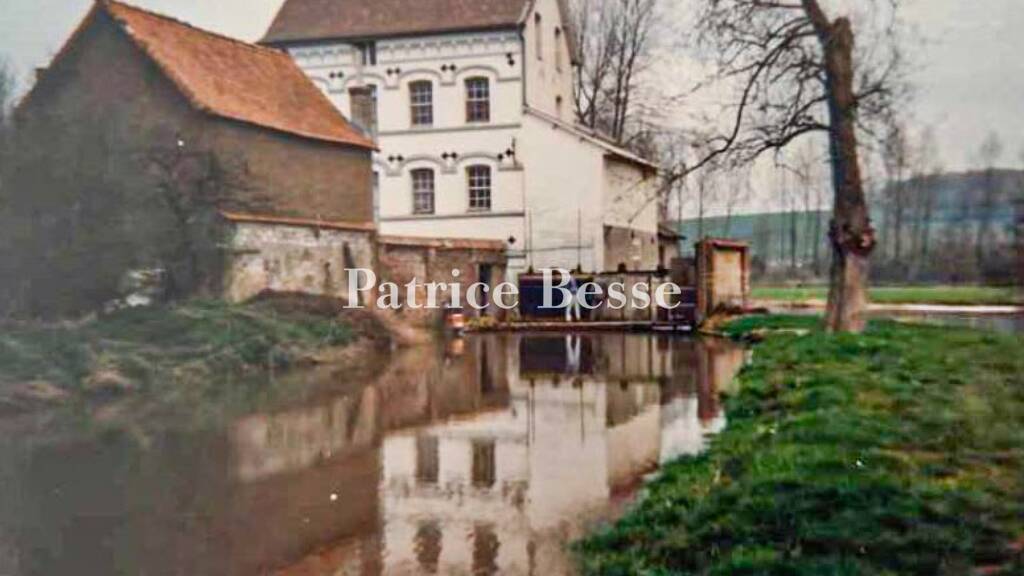
This Picardy mill, standing in green pastureland, emerges into sight after crossing a small bridge over the waterway running past the edifice and heading up a drive bordered by meadows. The main courtyard can be reached through a wrought-iron gate. The property is made up of the former mill building, an adjoining manor house, as well as extensive outbuildings that form a second courtyard to the rear. A renovated pavilion standing opposite opens onto the garden which stretches down to the river.
The current mill was preceded by other older ones, which belonged to the lords of the realm, who took part in the crusades and, for some of them, perished at the battle of Agincourt. Their castle, which has since disappeared, was located in the meadows on the other side of the mill race, behind the mill building. All that remains of it is the castle mound where it was built.
Though the mill was probably out of use during the French Revolution, there are traces of its activity during the 19th century, as recounted in the "Annuaire du Pas-de-Calais" directory dated 1867, then in a newspaper published in 1883, in which the miller posted an advert for an "able mill caretaker". In 1890, the mill burned down but was rebuilt that same year. The current manor house dates from that time. In 1933, the technological advances of the time saw the water wheel replaced by a turbine. The mill remained in activity until 31st March 2024.
The manor houseThis three-storey building has a gabled slate roof. Its symmetrical, rendered façades boast moulded cornices, windowsills as well as door and window frames made of cement. Like the windows on the first level and the base of the wall, the large, arched entrance door frame, with a moulded keystone, is in imitation bossage. The ground floor is set around the main entrance, which has two windows on either side. The upper floor has five small or large paned windows.
The ground floor
The wooden entrance door with its wrought-iron grill leads into a hall paved with cement tiles. Through a door to the left, there is a lounge boasting a brick fireplace. The room has a neo-Gothic feel to it, thanks to the tiled floor and half-timbered walls. To the right of the entrance hall, there is the former kitchen, whose floor is also paved with cement tiles. It houses a monumental fireplace, whose hearth has been tiled, with a wooden mantelpiece. Either side of the fireplace, there are wooden cupboards. A glazed door with coloured panes of glass leads into a room with a glass wall that looks out to the rear of the house. At the end of the entrance hall to the left, there is a former laundry room in which there is still a sink. Lastly, opposite this room there is a wooden staircase, with cupboards underneath, leading to the upper floor. The staircase is bathed in light through a bullseye window.
The upstairs
The wooden staircase leads to a landing which in turn leads to the various bedrooms. The first of them has straight wood stripped flooring, cupboards, a wardrobe and an en suite bathroom with a lavatory. Nearby, ...