A 19th century manor house near to Saint-Nom-la-Bretèche in the Yyvelines area with 250 m² of floor-space and an outbuilding on a 1,900-m² plot - ref
A 19th century manor house near to Saint-Nom-la-Bretèche in the Yyvelines area with 250 m² of floor-space and an outbuilding on a 1,900-m² plot.
This residence was built in 1860 and has kept its name, "La Sucrerie", from that period, when it belonged to farm operators and sugar producers. It is located on the outskirts of the village, away from the hustle and bustle of the traffic. The primary school, a small supermarket and the village's sports facilities are nearby.
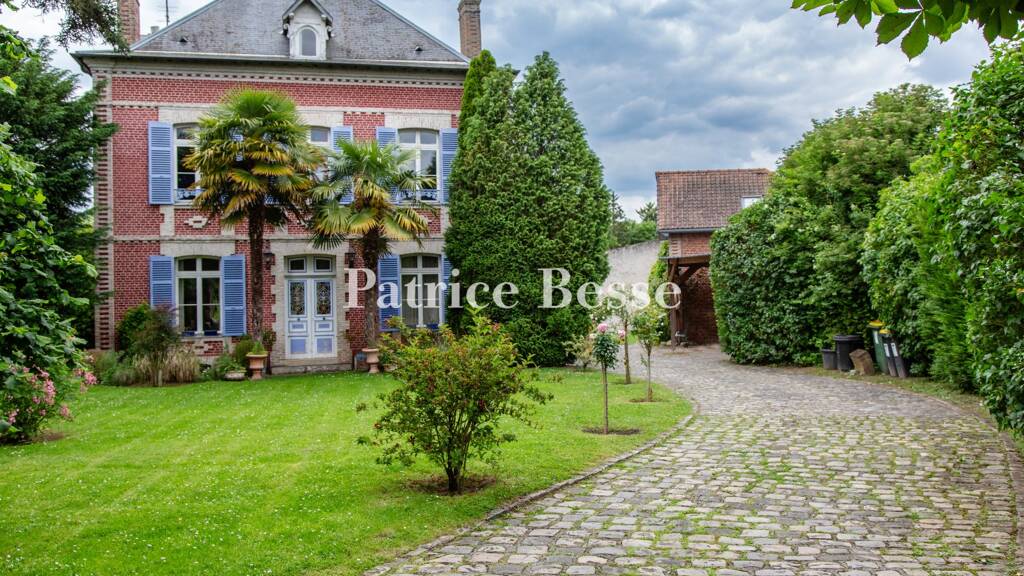
The property stands in a plot measuring more than 1,800 m² and is enclosed on one side by a wall topped with wrought-iron railings and on the other side of the garden by an annexe. It is made up of the main house with almost 250 m² of floor-space, an annexe measuring almost 150 m² and a car port for two vehicles. The garden covers approximately 1,500 m².
After entering through the wrought-iron entrance gate, framed by brick pillars, a paved drive leads up to the house.
In total, the main house has almost 250 m² of living floor-space, with seven bedrooms and the possibility of another after conversion. It is possible to convert the approximately 150-m² annexe into four other bedrooms.
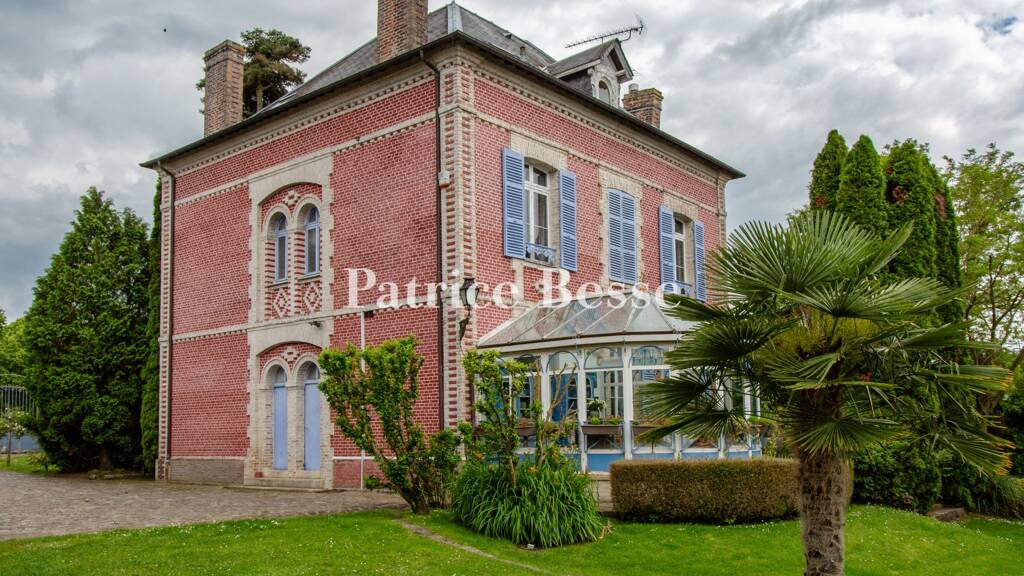
The main houseThis square, three-storey manor house also boasts an almost 18-m² conservatory extension on the rear façade as well as a basement.
The exterior elevations are made of brick with light-coloured pointing. The hipped slate roof has a gabled dormer window on either side.
The façades of the ground floor and first floor are punctuated with uniformly sized large windows, bathing the house's rooms with light.
Above the double-leaf entrance door there is a glazed fan-light window that floods the large entrance hall and its chessboard tiles in plenty of light.
With its moulded ceilings more than 3.3 metres high, to the left of the entrance on the ground floor there are two lounges joined together to form a vast reception room. On the same level to the right, there is a former study transformed into a bedroom with en suite shower room, the guests' lavatory, a staircase leading to the upper levels, as well as the steps down to the basement and a door to the kitchen, which opens onto the conservatory housing the dining room. The double living room occupies an entire side of the house and the floor is made up of solid oak floorboards. Four double-leaf windows flood the room with light.
The former office has identical flooring to the reception room. It has recently been transformed into a bedroom with en suite shower room but could easily be returned to its original function.
In addition to the one in the former office on the ground floor, there are seven bedrooms evenly spread through the two upper levels, which can be reached by a flight of winding stairs with a wrought-iron balustrade. The first floor boasts a ceiling height of almost 4 metres, giving a spacious feeling to the landing and three rooms. One of them is the master bedroom with en suite bathroom, including a bath as well as a shower, and a walk-in wardrobe. The two other large bedrooms on this level share a bathroom.
Each of them is bathed in light through the high, double-leaf windows, equipped with a wooden and wrought-iron guard rail, and have solid wood floors. There is a separate lavatory on this level.
On the top floor, a landing leads to three bedrooms and a shared bathroom. The gabled dormer windows flood the rooms with light.
In the roof space, a seventh bedroom with a skylight is akin to a secret eyrie.The annexeThis brick building with a slate roof has two sections. One of them is made up of two large, old garages. The first section plays host to a utility and laundry room, while the second is used for storage, notably for the garden furniture and tools, bicycles, etc. The second adjacent section is ...