An 18th-century winegrower's house on 1 hectare of land, close to the Rhône, on the border between the Ain and Haute-Savoie departments - ref 300627
An 18th-century winegrower's house on 1 hectare of land, close to the Rhône, on the border between the Ain and Haute-Savoie departments.
Between the foothills of the Jura massif and the mountainous foothills of the two Savoy departments, where the first Alpine ranges can be seen, the property, with its far-reaching views over the Rhône valley, stands below a village, at an altitude of around 270 m. The surrounding area is lush and green, with gentler slopes and numerous plots of vines facing south, benefiting from the mild, low-lying climate that is both continental and southern. The first neighbouring village, which is just 6 minutes away, has all shops and health facilities you might need, as well as schools and a train station. Geneva and Grenoble are 45 minutes away, Annecy is 50 minutes away. Geneva Cointrin international airport is 1 hour away.
The house is set on the edge of a single plot of land in a quiet environment, at the end of a local road, it is the last property in the village. The municipal road continues on as a farm track, right where the woods mark the boundary of the vineyard, which is being converted to organic farming. The road and the property access is via the courtyard. The land to the north follows on from this. Ideally exposed, the house enjoys the sun from sunrise to sunset, and views over the valley on both sides, with the neighbouring vineyards and the Rhône. The property does not have any encumbrances or easements and has no immediate neighbours.
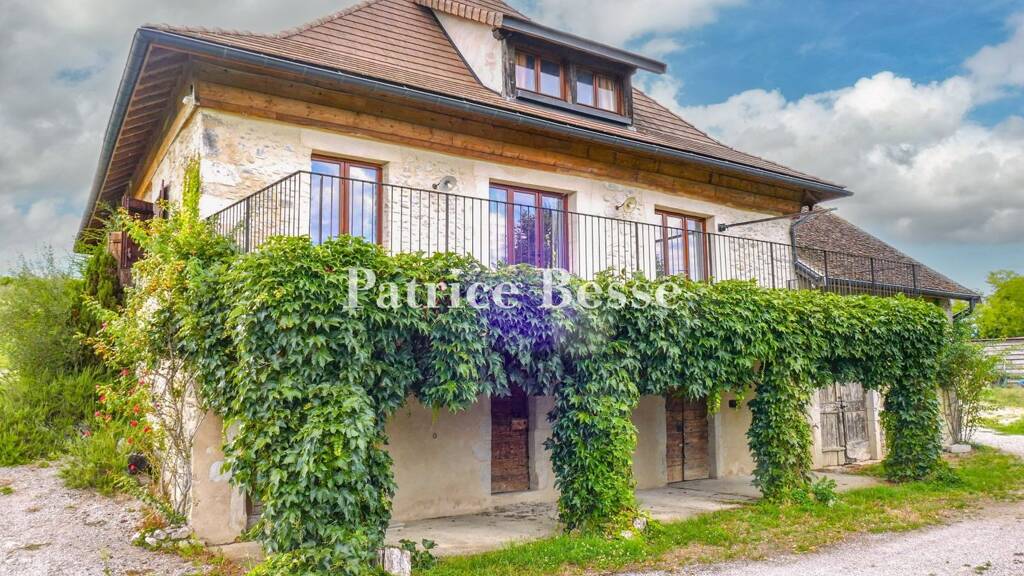
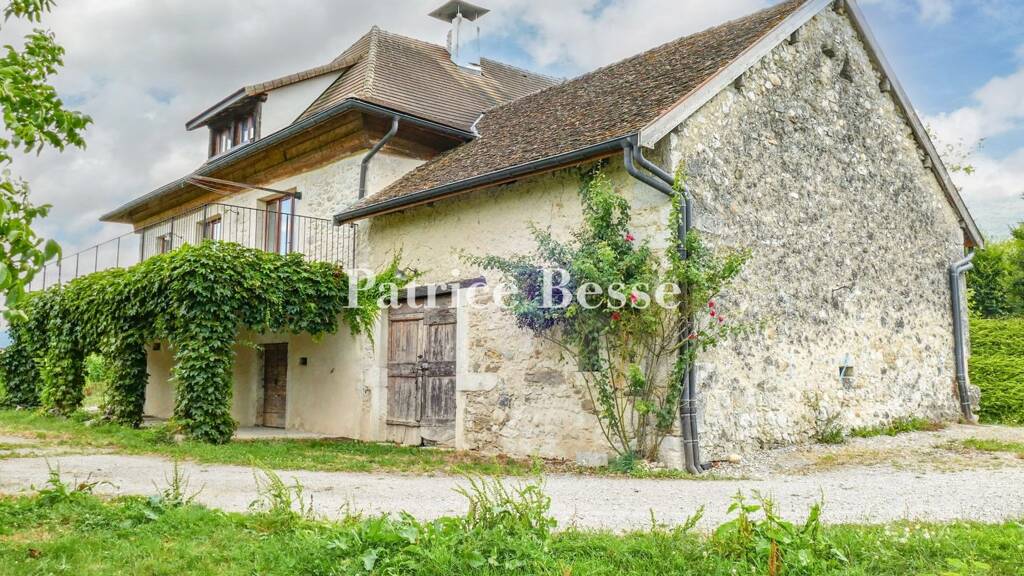
The houseAn inscription engraved on a stone lintel indicates that the house dates back to the 18th century. Its surroundings and cellars show that it must originally have been a winegrower's house. By the 10th century, there were already written references of vines in the area and, in the 14th century, the monks of Arvière developed the vineyards, which had their heyday in the 19th century, which has never ended. Built with a rectangular layout, the house is three storeys high. These consist of the cellars on the ground floor, the living quarters on the ground floor and the attic space. It has a hipped roof with a recently re-laid mechanical tile roof. Three large skylights have been created to let light into the attic space. The façades, in lime-stuccoed stone, emphasise the quoins or stone surrounds of the many large windows, which provide plenty of natural light. The east-facing façade has a terrace running its entire length, which is accessible from the ground floor, and which also serves as a shelter for the entrance to the three cellars. The living quarters were completely restored in 2012 by the current occupants.
The ground floor
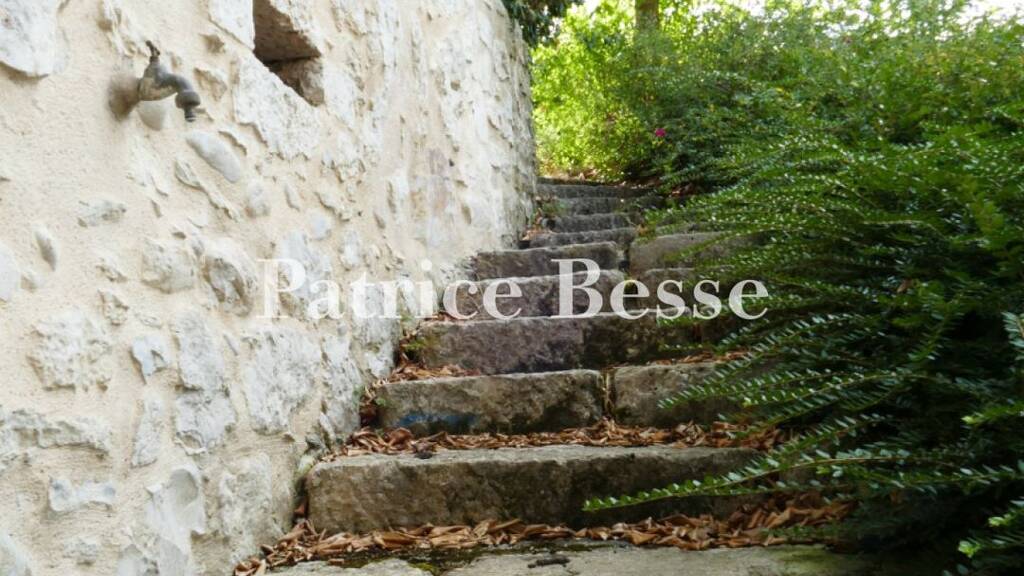
On the south side, the main entrance is accessed via a flight of stone steps. A large living space, with an open-plan kitchen, receives natural light from numerous windows. White walls alternate with stone walls. A rounded masonry heater located under the straight metal and wood staircase leading to the attic, completes the room. This is extended to the west by the gravelled terrace, protected by the vegetation of a small ornamental garden. The floor also includes three bedrooms, opening onto the east-facing terrace, as well as a storage area, laundry room and bathroom. At the end of the hallway, a door leads to the hayloft, which could be converted.
The attic
This is an 82 m² open space with parquet flooring, which receives an abundance of natural light from the roof dormers. Near the stairwell, a second masonry heater breaks up the space. The white of the straight walls and mansard roof highlights the complexity of the exposed framework. A shower room is tucked away in a corner of the room and the storage and technical cupboards go unnoticed under the sloping roof.
The street-level floor
Under the shelter of the east terrace, there are three vaulted cellars in a ...