An elegant, comfortable chateau with outhouses, nestled in seven hectares of grounds in eastern France, between Lyon, Dijon and Geneva - ref 905664
An elegant, comfortable chateau with outhouses, nestled in seven hectares of grounds in eastern France, between Lyon, Dijon and Geneva.
The property is easy to reach via the A6 and A40 motorways. You can get onto these roads in five minutes from the chateau. The city of Lyon is an hour away, Dijon an hour and a half away and Geneva under two hours from the property. The Mâcon-Loché high-speed train station is a 10-minute drive away. From there, you can get to Paris by rail in an hour and 40 minutes. The city of Mâcon is very close to the property. Mâcon is the administrative centre of France's Saône-et-Loire department. Its urban area has 80,000 inhabitants and offers many shops and amenities. The property also neighbours a renowned golf course on the edge of the Bresse province, beside the Mâconnais and Beaujolais vineyards.
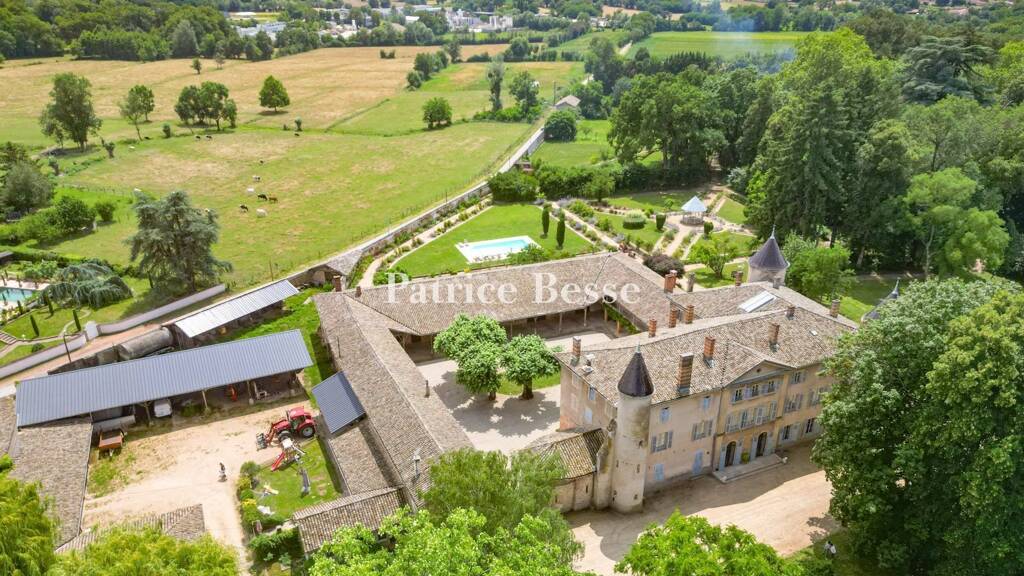
You reach the property from a secondary road. It is hidden behind tall walls and the thick groves of its grounds. The design of these grounds drew inspiration from English-style gardens, which were in vogue at the end of the 19th century. The buildings stand around two large courtyards. The main courtyard is enclosed by two residential wings - the north wing, probably built in the 18th century, and the west wing, built in the mid-19th century - and by former farming outhouses on its south and east sides, as well as a chapel beside the entrance to the court. The second courtyard is more recent. It is enclosed by a warden's lodge and storage buildings that are used for technical aspects of the property.
A Gallo-Roman settlement is thought to have stood here. The place was a Knights Templar commandery from the 12th century to the 16th century. Then the Knights of the Order of Malta ran the property up to the French Revolution. Over the past three centuries, only two different families have lived in the chateau. This has given it the harmonious appearance that you can admire today. The whole property has been maintained very well and is currently in a perfect state.
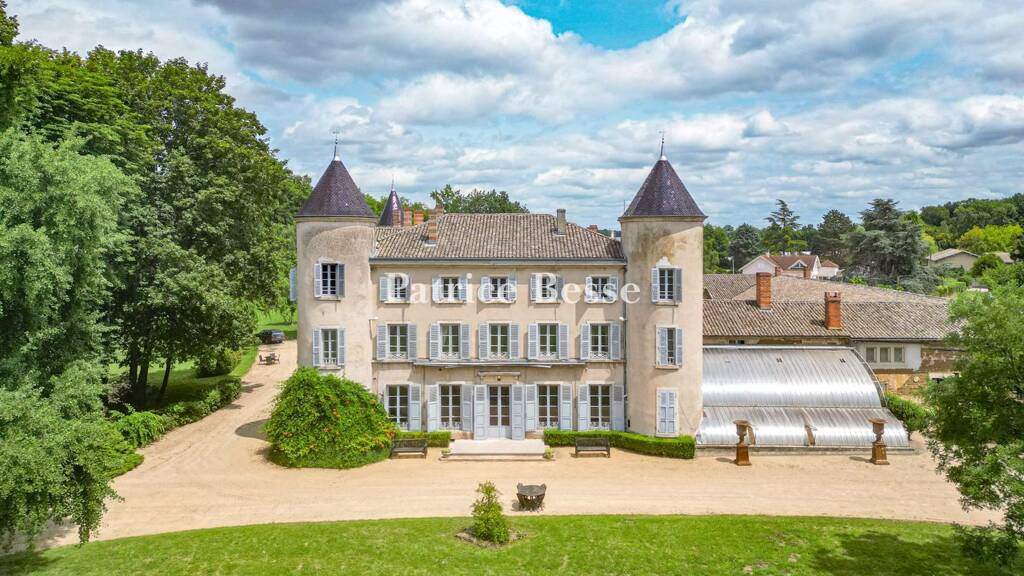
The chateauThe chateau's architecture bears witness to changes in the property between the 17th century and the 19th century. On its court side, pillars rise up to a remarkable stone gallery of columns that links the dwelling to the outhouses. This gallery is thought to date back to the 17th century. The north wing was probably built in the first half of the 18th century. It reflects the architecture of its time with a symmetrical facade divided into three thirds that includes a central section outlined with dressed stone and crowned with a large triangular pediment. The west wing was built in the middle of the 19th century. A neat layout of windows adorns its facade, which is flanked with two tall round towers with cone roofs of glazed tiles. Monk-and-nun tiling covers the roofs of the other sections. All 21st-century comforts have been added inside, including a lift, an alarm, a bathroom or shower room in each bedroom, and central heating with thermostatic valves, so you can enjoy a pleasant life here all year round.
The ground floor
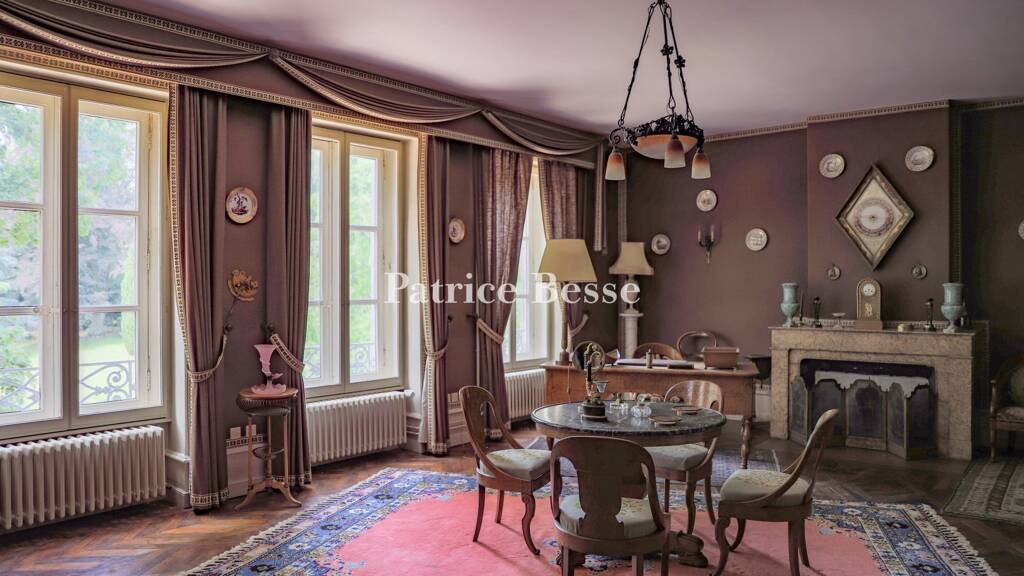
You enter a vast entrance hall from the courtyard. This hallway has a floor of tiles in a checked pattern. It takes you to an elegant stone staircase with a wrought-iron balustrade that leads upstairs and down to the cellars. Four reception rooms lead out to the grounds northwards and westwards. A billiards room is adorned with a marble fireplace, dado panelling and a beautifully patterned parquet floor. Beyond it, a reading room with a fireplace and inside shutters looks out at the greenhouse. The dining room, which includes a pantry, has kept a 19th-century spirit with red tones on the wall, dado panelling, a splendid wooden fireplace and a floor of hexagonal tomette tiles. There is also a lounge with a resolutely modern design. It is embellished with a stone fireplace and ...