An elegant riverside house from the 17th century, partly listed as a historical monument, nestled in an old Venice-like town in Brittany's Trégor prov
An elegant riverside house from the 17th century, partly listed as a historical monument, nestled in an old Venice-like town in Brittany's Trégor province.
The property is ideally located in a quaint town. In the 15th century, this charming town was a trade hub. Indeed, it was the main port north of the town of Guingamp. The thriving industry of that period has since given way to a wealth of elegant architecture here. Around 50 little washhouses were added in the 19th century. The town has been nicknamed the Venice of the Trégor province for its riverside charm. From the house, you can reach shops and amenities for everyday needs on foot. From the town's train station, which is less than five minutes away, you can get to Paris in 3 hours and 30 minutes by rail. There are beaches of fine sand only 25 minutes away. And the N12 trunk road, which is 30 minutes from the property, takes you to Brittany's main cities quickly.
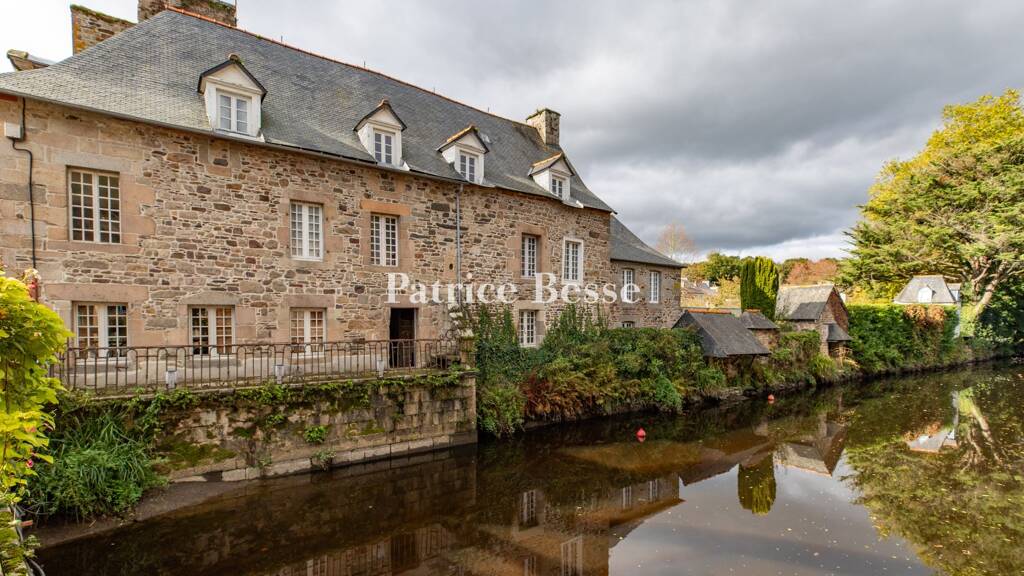
The property lies just a stone's throw from the village's picturesque square and paved streets. The dwelling and its garden stretch alongside the River Trieux. You reach the house via an elegant wrought-iron gate that takes you onto a long riverside balcony, which leads up to an old stone bench. The house's year of construction is engraved on a wall here. You can admire a sweeping view of several traditional riverside washhouses, which are often embellished with flowers in spring and summer. Passersby can also admire these quaint washhouses on boat rides from a nearby quay. There are many shops along the neighbouring street. On this street, each old house with exposed stonework or timber framing bears witness to the town's rich past. There used to be a street-facing shop in the edifice, which was entirely renovated in 2010 to become a home. At the back, the property includes an industrial-style building, a court and a garden, though they are separated by a tall wall. You reach these parts from the street, via an adjoining house.
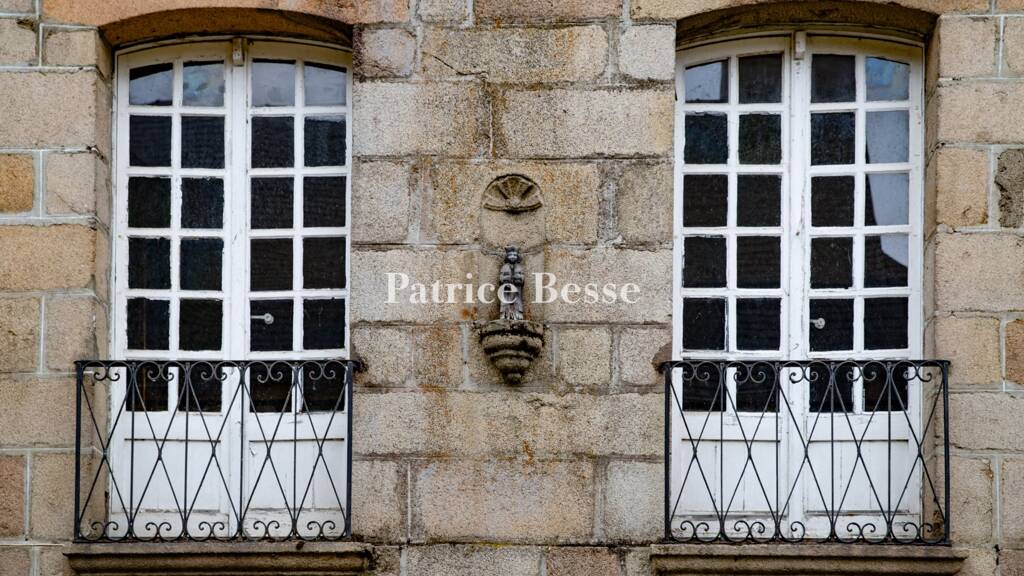
The houseThe house is rectangular in shape and crowned with a hipped slate roof that gently flares out at the bottom. The street-side end is entirely made of granite ashlar. Large small-paned windows punctuate the facade. The first-floor windows have balconies with wrought-iron balustrades. This balconies rest upon ornamental corbels. In the wall there is a niche dedicated to Saint Ivo. A dormer with an arched pediment, mouldings and sculpted volutes stands above the facade. On the ground floor, two greyish-blue wooden shutters add a touch of elegance. The riverside elevation stretches a long way. It is made of rubble granite and ashlar with neat window surrounds. Four dormers with triangular pediments punctuate the roof and many tall, broad windows with small panes dot the elevation. There is also a tiny bull's-eye window in the wall.
The ground floor
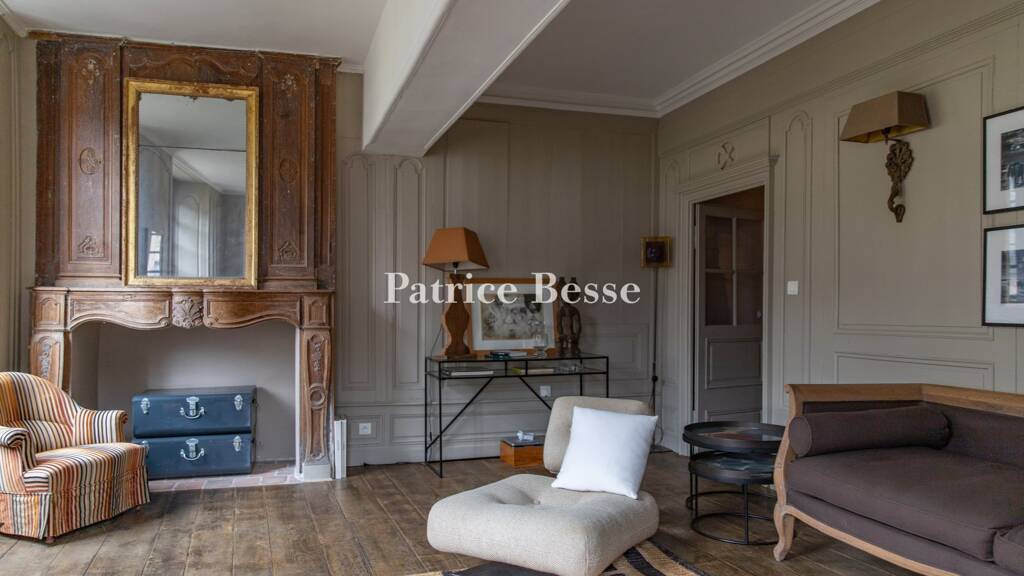
The entrance hall has kept its granite floor slabs dating back to the time of construction. It connects to a lavatory, to a bedroom with an en-suite shower room, and to a lounge with a kitchen. Pale Burgundy stone slabs adorn the floors of the different rooms. And exposed beams, some of which are imposing and monumental in size, add true character to the interior, as do the walls of exposed stonework with lime pointing. The rooms are spacious. The lounge features a granite fireplace in which a pellet-burning stove could be installed. The kitchen is fully fitted. An arched doorway leads out onto a granite terrace that takes you straight to two quaint riverside washhouses. The general atmosphere on the ground floor is hushed. Stonework is showcased through niches, steps and columns. Exposed timber can be seen everywhere too, sometimes painted in a greyish tone and sometimes left in its raw state. Several windows are fitted with indoor wooden shutters.
The first floor
A straight staircase leads ...