A 16th-century manor house and its heated swimming pool, in the foothills overlooking the Ardèche River, upstream from the town of Aubenas - ref 66738
A 16th-century manor house and its heated swimming pool, in the foothills overlooking the Ardèche River, upstream from the town of Aubenas.
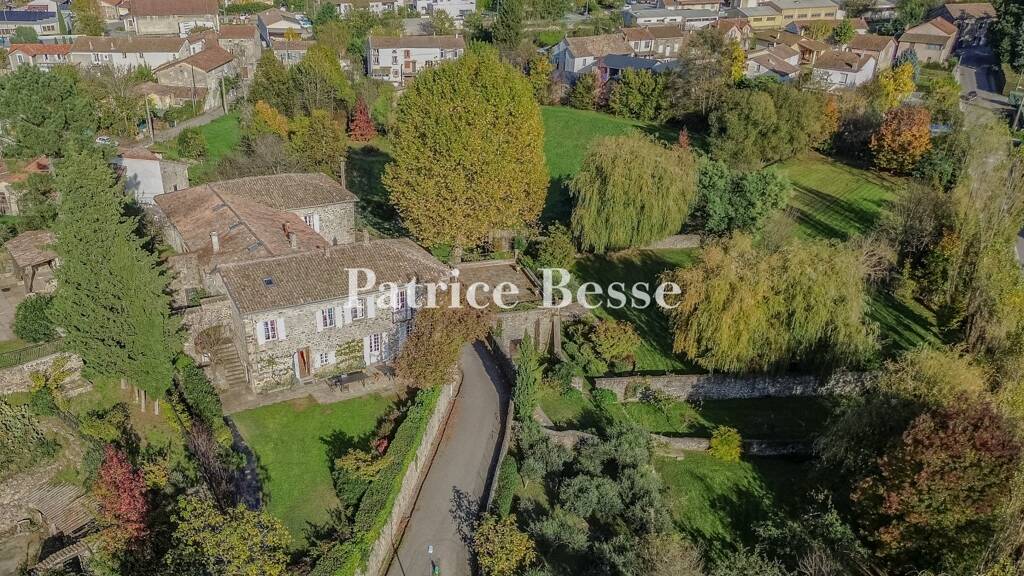
Within the Ardèche River valley, in the west of the Auvergne-Rhône-Alpes region, the 16th-century manor house is perched in the foothills and enjoys unobstructed views of the lush valley where the department's main river flows. Straddling two villages and at the crossroads between the Auvergne Mountains and the Rhône River valley, the farmhouse is about ten kilometres away from the town of Aubenas, which contains all shops and services, and 52 kilometres away from Montélimar.
First mentioned as of 1414, the Fabrias fiefdom is part of a long history: built on behalf of the Lord of Chanaleilles, who made it his stronghold until 1735, it was constructed over the vestiges of a ruin, as attested by a construction note from 1610. It was then passed into the hands of Cappendu de Remeuil, architect to the King and a prominent figure in the region, before becoming the residence of Agnès Perrin-Lacroix in 1986, who eventually sold it to its current owners in 2005.
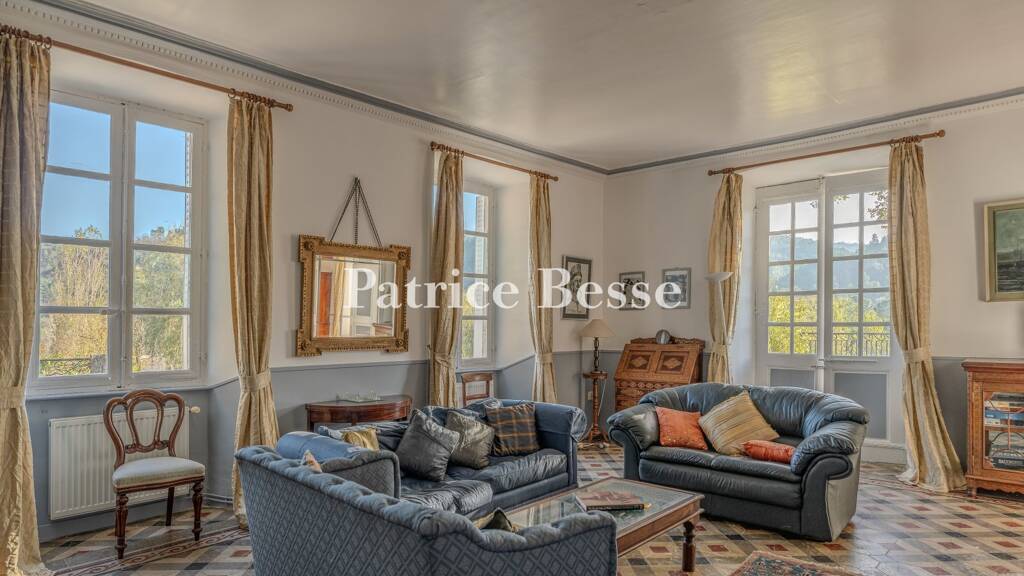
Appearing to have been built mostly over the same time period, the house's walls, the thickness of which varies between 0.98 and 1.3 metres, bear witness to a solid and long-lasting construction. As for its interior, chestnut ceiling beams cadence the space, while the floors juxtapose hardwood and original terracotta tiles, some of which are hand painted.
In addition, behind the house, an immense cistern hollowed out of the rock, visible in certain areas, collects rainwater, whereas, higher up and sheltered from view, a swimming pool, heated by the sun, is supplied with the white water of the surrounding natural springs. Built into the rock itself, the property, in perfect harmony with its environment, also comes with a former threshing platform located on the other side of the small street and facing the house's front door, which is now used as a patio overlooking a garden in which a stream snakes its way through olive and fruit trees as well as other vegetation native to the South of France.
The Southern WingThis wing is accessible via two separate entrances: one leads directly from the interior courtyard to an immense dining room; the other, on the garden side and facing full south, provides access to the house's different living spaces, while a covered balcony seamlessly connects this wing to its northern counterpart.
The basement
Under the southern wing, this level, with ample volumes that make it possible to imagine a number of different possibilities for this space, extends under the entire house.
The ground floor
This floor contains the house's living areas, whose overall rustic, but sophisticated charm is revealed through its exposed stone vaults and ancient terracotta floor tiles. A foyer, which could also be used as a small dining room with floor tiles that match the colour of its walls, communicates with a large living room, followed by a staircase to the upstairs floor. In addition, an immense open kitchen and large dining room contain a massive wood-fired oven and provide access to the interior courtyard, while, at the back of the latter, is a laundry room, a lavatory and a machine room for the distribution of hot water and heat.
The first floor
At the top of the staircase, a small central corridor provides access to three bedrooms as well as an immense living room of 90 m², the volumes of which are highlighted by two mezzanines on either side, currently used as libraries. From the living room, direct access to the balcony overlooking the interior courtyard is an invitation to take in the breath-taking panorama, while the bedrooms each abut their own bathroom and the floors alternate between tiles for the shower rooms, recent hardwood for the bedrooms and dark green ...