A 17th-century dwelling and its outbuildings, some of which are inhabitable, on nearly 12 hectares of pastures and woodlands, thirty minutes from Tour
A 17th-century dwelling and its outbuildings, some of which are inhabitable, on nearly 12 hectares of pastures and woodlands, thirty minutes from Tours.
In the northwest of the Indre-et-Loire department, the town is located along the banks of the Loire River, the valley of which is a Unesco World Heritage Site. Surrounded by historic monuments and noteworthy landmarks, this town, with its towering chateau, is close to shops, services and schools and easily accessible from the city of Tours with its high-speed rail station, which makes it possible to reach Paris in 55 minutes. The hamlet, 8 kilometres away from the centre of the aforementioned town, is nestled within an environment scattered with woods and pastures, ideal for long walks through the countryside. In addition, there is a golf course and an equestrian centre 15 minutes away by car, while the closest shops are less than 5 kilometres away.
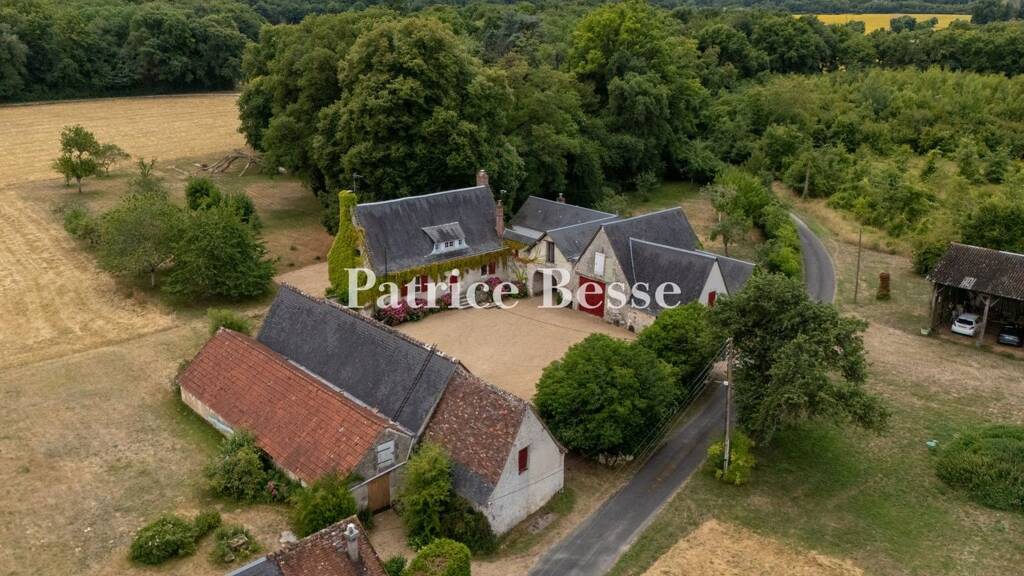
From town, the road traverses fields and forests up until it reaches a no-through road, which provides access to several dwellings. Facing an immense pasture bordered by woods, included within the property, a wide gravel courtyard is surrounded by a group of buildings on three of its sides: a 17th-century dwelling, in the middle, is flanked on one side by a barn and outbuildings and, on the other, by a covered carriage entranceway, a former press room and a garage. A few metres away, a second entrance to the property leads to another group of buildings, which have been transformed into dwellings, while, behind the main dwelling, a gravel patio faces a second pasture and the surrounding countryside.
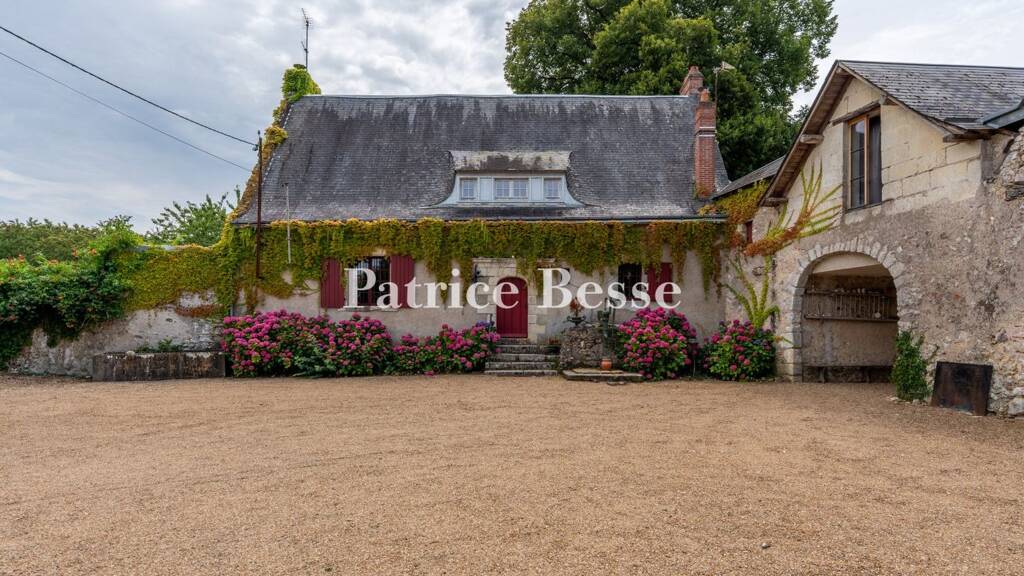
The Main DwellingBuilt out of plaster-coated rubble stone, like all the edifices on the property, the main dwelling faces north-south and is topped with a slate gable roof, punctuated by a trapezoidal dormer window on its courtyard side. With windows in a variety of shapes framed by tuffeau stone, the house's arched front door is accessible after ascending a few stone steps and topped with a straight pediment and cornice into which is chiselled the date of the house's construction in the 17th century.
The ground floor
The front door opens onto an entranceway with Périgord stone floor tiles and painted walls, which leads to a living room on one side and a kitchen and lavatory on the other. Opposite, a second door, also arched, leads to the garden, while an oak staircase provides access to the first floor, built under the eaves. The living room, with plaster-coated walls and terracotta floor tiles, is bathed in light thanks to its windows, while a tuffeau stone and brick fireplace contains a wood-burning stove and the room's vast floor-to-ceiling height is highlighted by its exposed ceiling beams painted in a light cream colour. As for the kitchen, also with Périgord stone floor tiles, it is large enough to fit a table for eating meals and, although mainly lit by a window above the sink and a glass door to the outside, is quite luminous thanks to its white walls, kitchen fixtures and exposed ceiling beams. In addition, it also contains a tuffeau stone fireplace fitted with a wood-burning stove as well as a cupboard with ancient moulded doors, while, in the back, a door communicates with a utility room, which is also used as a laundry room.
The upstairs
The landing provides access to a bedroom on one side, while, on the other side, a hallway leads to a shower room, a lavatory, a wardrobe and a second bedroom. With hardwood floors in the bedrooms and hallway, terracotta floor tiles in the shower room and wardrobe as well as Périgord stone floor tiles in the lavatory, all the walls are painted white and the shower room was recently renovated. In addition, the bedrooms are bathed in light by dormer windows as well as windows on their gable ends, while, in one of the bedrooms, off to one side, a ...