An 18th-century villa listed as a historical monument with 6,000m² of grounds, nestled in the heart of Bordeaux in a highly sought-after village-like
An 18th-century villa listed as a historical monument with 6,000m² of grounds, nestled in the heart of Bordeaux in a highly sought-after village-like district.
The property lies in Bordeaux city centre, in France's Gironde department in the Nouvelle-Aquitaine region. It is nestled between the famous road Rue Judaïque and the prestigious sports club Villa Primrose. The home is tucked away in the Caudréran district of Bordeaux. This district is like a delightful village with its community, shops and amenities that families truly appreciate. There is much greenery nearby, including the 28 hectares of the Parc bordelais public park with its animals and puppet theatre. This lush oasis offers a beautiful environment and a harmonious balance between suburban calm and the vibrant city centre. Nearby, sports lovers can enjoy one of France's oldest golf courses - Le Golf bordelais - and the prestigious sports club Villa Primrose: a renowned tennis club with 17 tennis courts and three hectares of grounds. And Paris is only two hours away by high-speed rail.
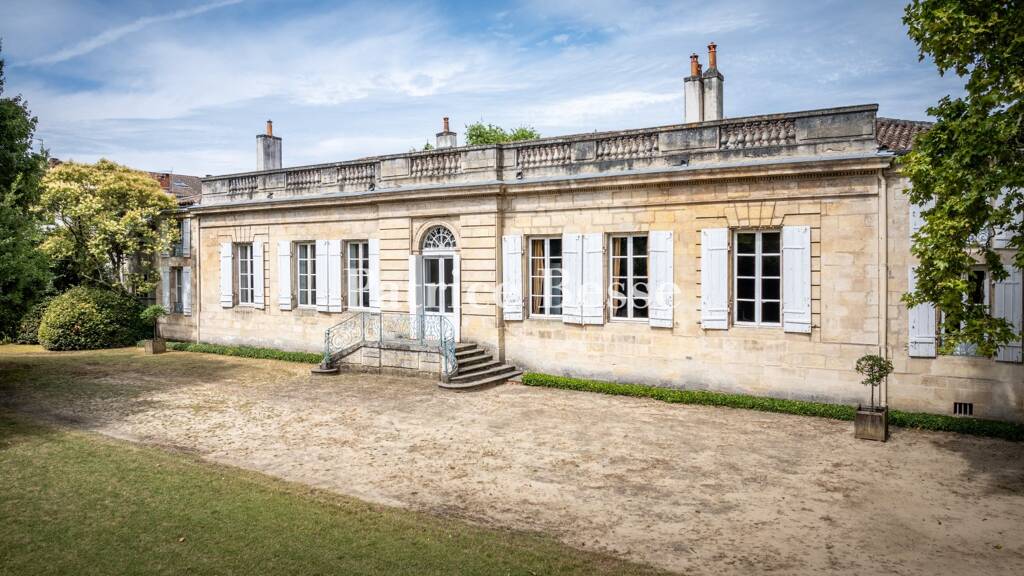
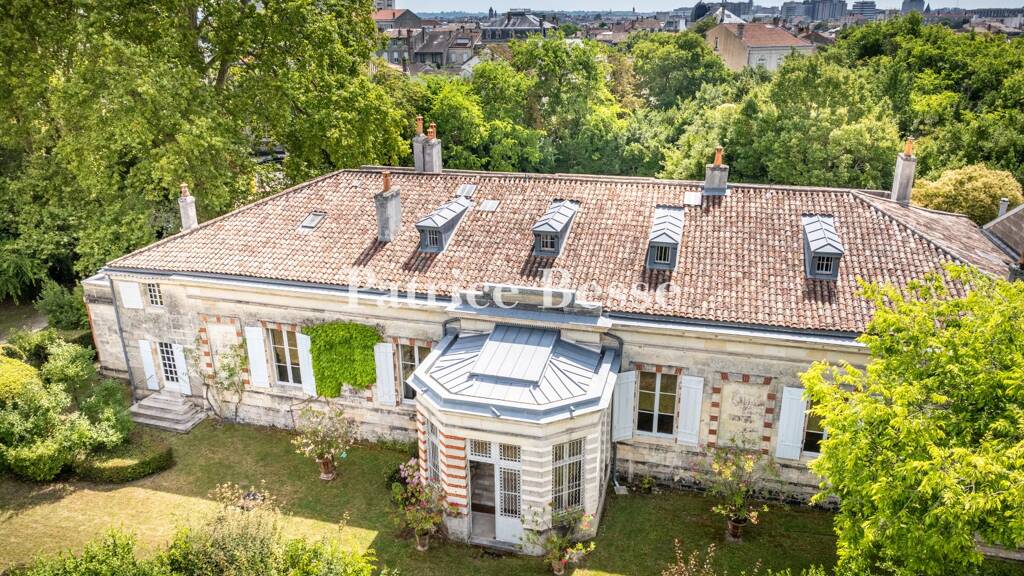
In 1775, Jean-Pierre Labat de Serene, a shipowner and wheat and flour merchant, purchased the Mirande estate and built this villa there between 1784 and 1785. The villa was built in a context of transformation in architectural art in the Bordeaux region, under the influence of the architect Victor Louis. The dwelling is set back in grounds that are enclosed with an elegant wrought-iron fence that runs alongside the road from which the entrance gate leads into the property. A hipped roof of red barrel tiles crowns the villa. This roof is punctuated with zinc dormers and five chimney stacks. At the end of the grounds, a covered swimming pool and a garage lie in absolute privacy. At the villa's north end, there is a cellar with several compartments.
The 18th-century villaThe main entrance is on the house's east side. A double flight of front steps with wrought-iron balustrades leads up to the door. The entrance door stands beneath an arabesque-patterned fanlight. The house has a ground floor and a first floor in the roof space. The facade's symmetrical design is centred upon the entrance door. A row of balusters and a cornice of dentils crowns the facade. Large, evenly spaced rectangular windows punctuate the facade. The shutters and window frames with pane bars date back to the time of construction. This facade, made of Bordeaux stone, faces east. On the south side, there is a conservatory with a zinc roof. And on the west side, a bay window protrudes from the elevation. Two extensions, respectively on the north and south ends, stand upon cellars.
The ground floor
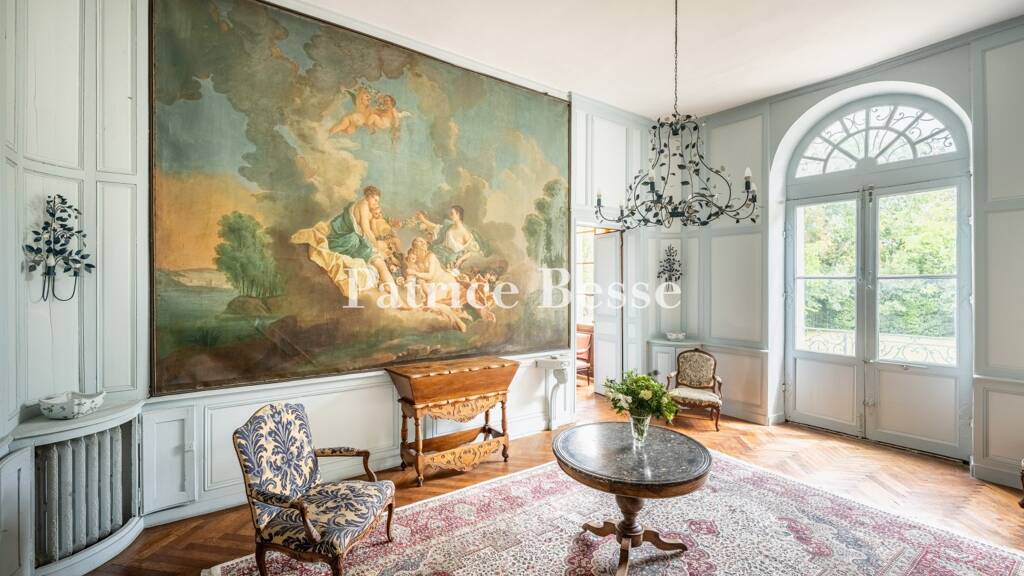
From the front flight of steps, you step into the entrance hall. This hallway connects to a large lounge, which is the central space in a series of connecting rooms, five of which are listed for their historical interest. These rooms form the house's reception areas and they structure movement around the interior from the east-facing facade. Heading southwards, you reach a listed dining room decorated with paintings by Jean-Baptiste Butay. Next, there are three more lounges. The first of these lounges is listed for its Louis XVI style fireplace. Heading northwards, the row of connecting rooms offers a smoking lounge and a bedroom - both are listed for their historical interest. A last bedroom with a shower room completes this series of spaces. Opposite the main lounge, there is a tall gallery with wooden panelling. It leads out to the garden via steps and the bay window. These two rooms running from one side of the house to the other provide a transition from public life to private life within the villa. And the long central corridor that cuts through them from north to south, with floor tiles laid in a black-and-white checked pattern, connects to the villa's private western rooms. ...