An eighteenth-century Provençal house 15 minutes from Orange TGV station, in the historical county of Venaissin with 2.4 hectares of wooded grounds an
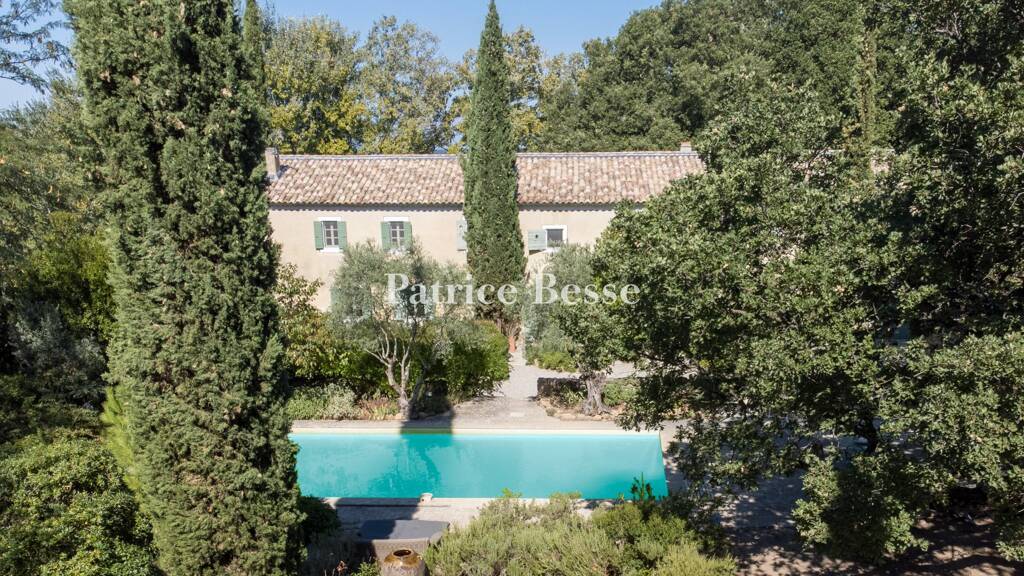
An eighteenth-century Provençal house 15 minutes from Orange TGV station, in the historical county of Venaissin with 2.4 hectares of wooded grounds and a view of Mount Ventoux.
To the north of Carpentras, near the town of Aubignan, in the midst of the old "Comtat Venaissin", one of the Papal States which was founded in 1274 and dissolved in 1791. Looking out over the panoramic view of Mount Ventoux, extended by the detrital piedmont of the Dentelles-de-Montmirail mountain range, this land particularly favours vines, hence the many great wines classified AOC Ventoux and Côtes-du-Rhône. The very rich alluvial plain is still predominantly occupied by farming activities, notably the growing of olive trees and saffron.
25 minutes from Avignon (TGV train station and airport), 15 minutes from Orange (TGV train station), 10 minutes from Carpentras and 1½ hours from Marseille-Marignane airport.
This property was once part of a vast, plain, farming estate, of which it still has 2.4 ha of land. The constructions stand on the north-east side of its land on a knoll, circumvented by a meander of the Carpentras canal, marking the northern limit.
The main entrance, leading to a courtyard, is provided by gates on the south-west side, facing the estate's land. On the north-east side, a high wall, lined with unsquared surface limestone, encloses the courtyard; a little door in this perimeter wall makes it possible to reach an outstanding stand of oak trees, on the north slope, bordered by the canal.
The main building is a traditional Provençal country house, constructed at the end of the 18th century, even the beginning of the 19th century, probably on the foundations of an earlier construction, notably visible in the enclosed courtyard courtesy of the vestiges of old blocked up windows. It spans two levels and faces southwards over the courtyard. It is symmetrically and harmoniously composed and topped with a triple overhanging cornice, forming the eaves. Its lime-rendered walls feature aligned openings, framed with painted surrounds, enhanced with red edging. The north-east corner of the country house features a wide, d-rop arch, carriage door, topped with a virtually square opening, indicating a probable reconstruction of the country house's east gable or a vestige of an earlier construction.
A square, single-storey pavilion, topped with a roof terrace, bears witness to an earlier building, possibly a 2-storey dovecote. Reached via steps on the west facade, it marks the southern limit of the country house. It is extended by a terraced area, supported by a dry-stone wall, containing a swimming pool that closes the courtyard.
And lastly, the parklands extend over the top of the open area to the south of the courtyard. Planted with Mediterranean species, notably convoluted pine trees, they still include some decoratively trimmed boxwood and a masonry well, topped with a local limestone dome.
The traditional Provençal country houseThe courtyard gives access to an entrance vestibule, housing the stairway that leads to the upstairs of this traditional country house.
Spanning a total of approx. 450 m² of living space, the building comprises twelve main rooms and miscellaneous other rooms. Their interior organisation follows two separate layouts, marked by an east-west alignment of impressive sculpted stone pillars. Nine in number and approx. 3.5 m in height, they undeniably form the particularity of this traditional country house. All different, they integrate some reused features, with diverse contours and outlines (frieze, pediment fragments and even column bodies). In addition to their ceiling support function and with their ancient Roman appearance, they create a very spectacular and unexpected decorative feature in this somewhat refined country house.
The ground floor
On the left of the vestibule, the ...