A 12th-century medieval residence, listed as a historical monument, in the former capital of the old Vivarais province, on the banks of the River Rhôn
A 12th-century medieval residence, listed as a historical monument, in the former capital of the old Vivarais province, on the banks of the River Rhône.
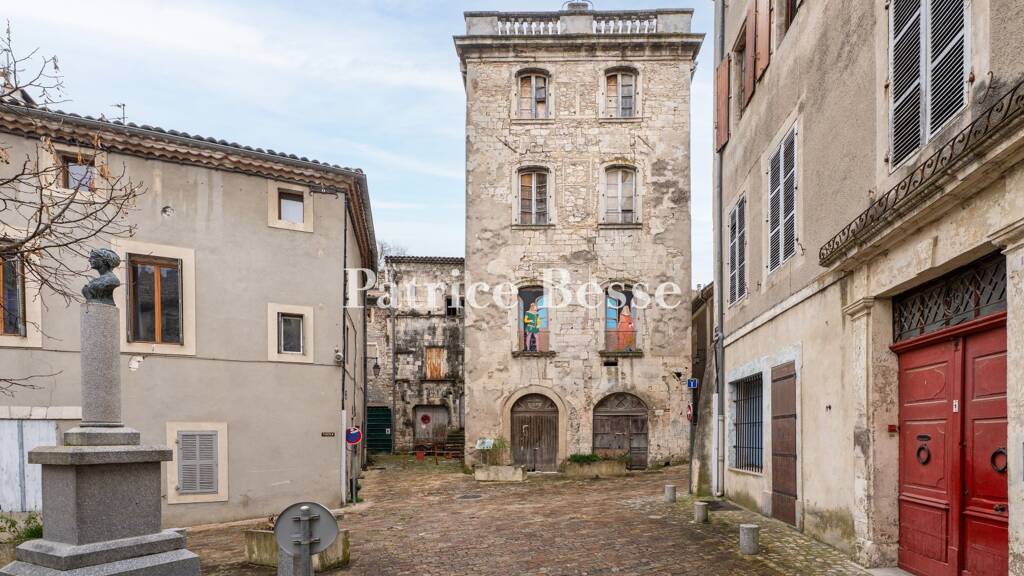
This property is located in the south of the Auvergne-Rhône-Alpes region and the southeast of the Ardeche area, in the old part of a town that once was the capital of the former Vivarais province. It looks onto the former Place des Olles, which went on to be Place du Marché and then Place de la République.
All the amenities necessary for everyday life can be quickly reached within around 20 km, especially Montélimar and its high-speed TGV railway station, via the A7 motorway. Nearby, major road or rail routes put the south of France as well as Lyon, Paris and Marseille within easy reach. The first is 1 hour 30 minutes by train from Montélimar, the second is 3 hours away and the last is 1 hour 50 minutes away.
Until the French Revolution, the property was the residence of rich owners, before accommodating the town hall for two centuries until 1947, when it was sold to private owners. The house underwent various alterations and restorations as the years passed by, particularly in 1563, 1855 and 1856.
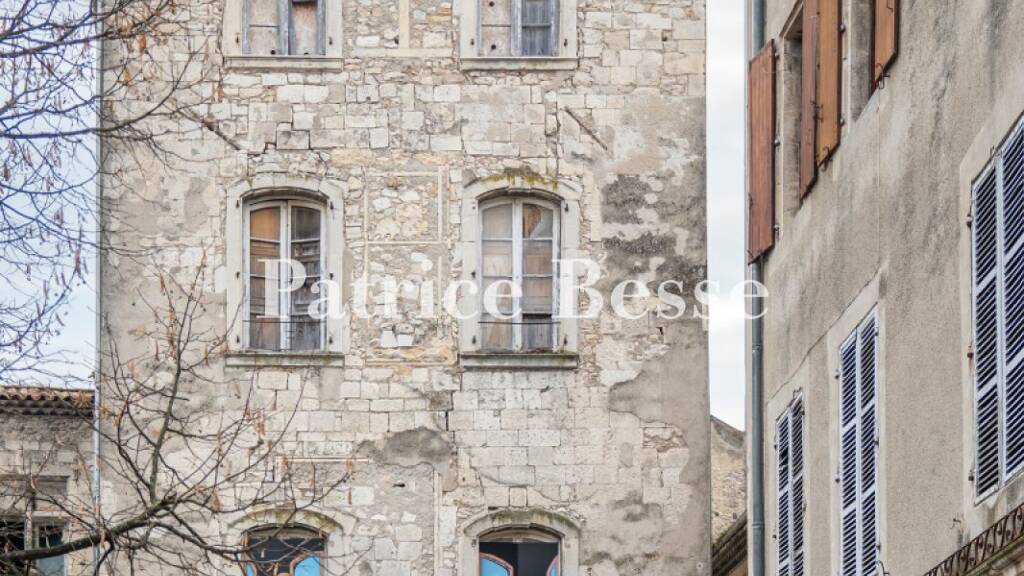
Today it has a rectangular layout made up of two parts linked by a central, stone, spiral staircase leading to the three upper floors that make up the edifice. The western façade, which overlooks the square, was transformed in the 17th century. This narrow section with two vertical rows of openings is the 'public' part of the house, facing the square. There are windows on each of its four levels.
The façade is crowned by a moulded cornice and a stone balustrade behind which the roof is hidden.
The southern façade is the house's longest. It looks onto the street called Rue du Château leading to the episcopal district. A third of the wall has no windows and in the centre, the entrance door with a basket-handle arch is framed by moulded splaying. Directly above it, there are four windows with moulded frames dating from the Middle Ages, through which the spiral staircase is bathed in light. On the right-hand side of the façade, the windows with mostly moulded frames, above two bayonet-shaped drip stones following the slope of Rue du Château, allow the living rooms to be flooded with light. The eastern half of the façade still has traces of older openings. On the second floor, there is still a gemelled window whose central column is adorned with chevron fluting and whose chapters are carved with stylised acanthus leaves. Other Romanesque origin openings are still visible.
Lastly, since the northern and eastern façades are secondary elevations, they have much less openings.
A complete architectural study has been carried out (seen attachment in annex).
The first part of the houseThe front part of the house facing Place de la République, boasts three upper floors over the ground floor, as does the second part.
The ground floor
Each of the two spaces on this level has a lancet arched ceiling of a specific height. The one to the left of the building boasts access to a cellar, via a small staircase. This cellar has a small window looking onto Rue du Château, while the other space has none. During the 20th century, this level was occupied by two shops.
The first floor
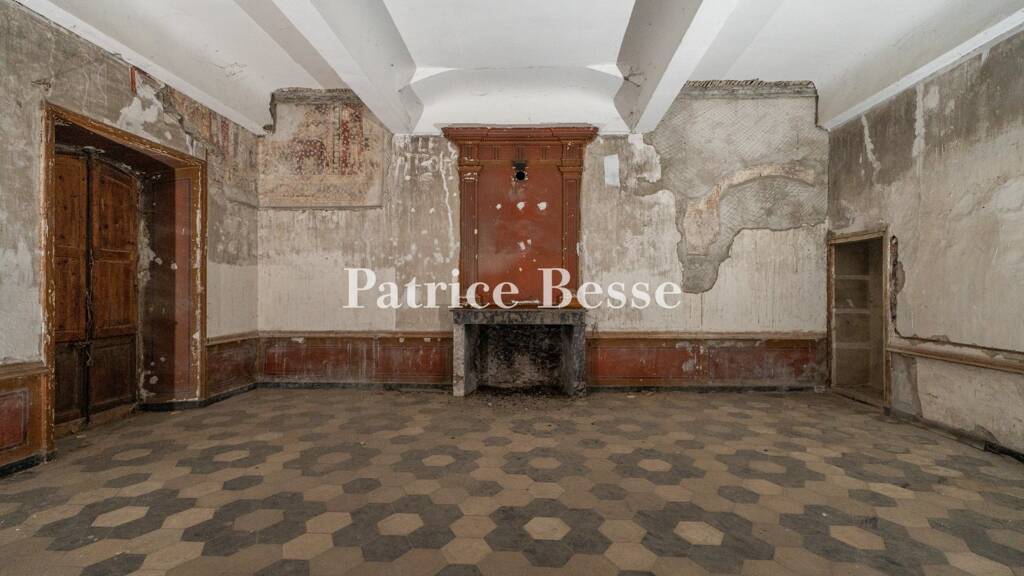
On the second level, an impressive state room overlooking the square is decorated with multi-coloured paint dating from the 14th century. The beams on the ceiling are cased and painted white, the floor is paved with black and grey tiles in floral patterns, the walls have low wooden wainscotting and a black and grey marble fireplace with a painted wooden trumeau stands in the centre of one of the room's walls.
The second floor
The third level is made up of a large state room and a modestly sized bedroom with a small north facing window. As on the level below, the beams on the ...