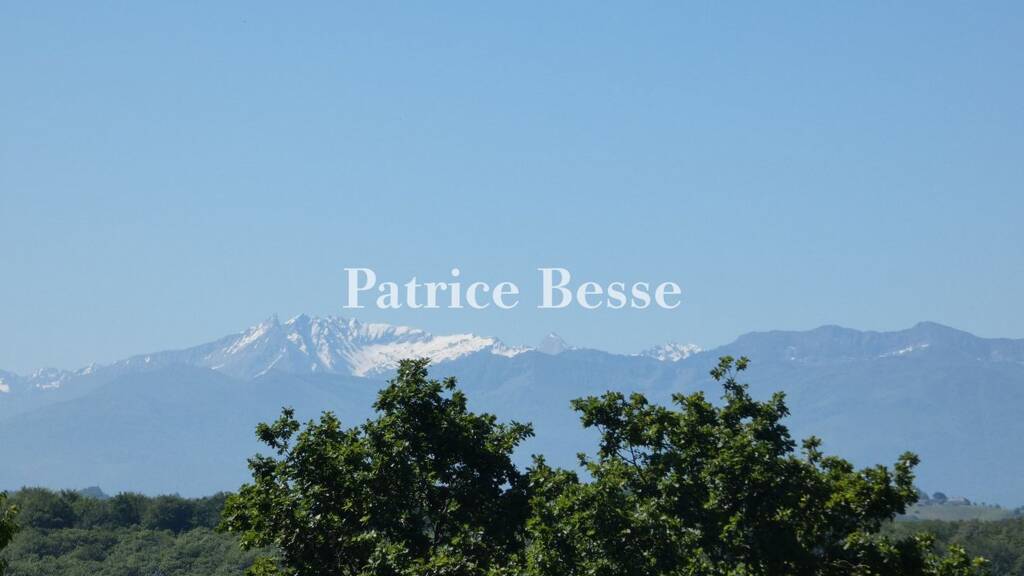
A 300-m² sumptuous flat in a 19th-century Italianate palace, with exceptional views of the Pyrenees Mountains, in the capital of the historical region
A 300-m² sumptuous flat in a 19th-century Italianate palace, with exceptional views of the Pyrenees Mountains, in the capital of the historical region of Béarn.
Located in the west of the Occitanie region and the east of the Pyrénées-Atlantiques department, between the ocean and mountains, Pau, an elegant city full of history and contrasts, as well as the administrative centre of the department and former capital of the historical region of Béarn, provides a rare living environment combining history, nature and modernity.
With its prestigious past, famous as the birthplace of Henry IV, King of France and Navarre, its royal chateau, meticulously preserved, overlooks the city from its natural promontory facing the mountains, while, all around extends the city's historical centre, with its cobblestone lanes, half-timbered houses and 19th-century façades. As for the palace in question, it is only a stone's throw away from Pau's downtown area with its many shops and schools.
In addition, Bayonne is one hour and 15 minutes away by car or train, Toulouse is approximately 2 hours and 10 minutes away, as is Bordeaux, whereas the Spanish border can be reached in 30 minutes.
The palace, built out of stone between 1880-1886 and rectangular in shape, faces south and is flanked by a tower to the west as well as an immense greenhouse to the east. Italianate in style and influenced by neo-Renaissance architecture, like the Osborne House, a summer residence for Queen Victoria, the central building has four storeys, while the tower has five. With a colonnade running along the top storey of the central building's southern and northern exteriors, it is topped with a rooftop terrace safeguarded by a stone balustrade.
As for the southern exterior, facing the garden, a double staircase (added in the 1910s) in Carrare marble, provides access to the peristyle terrace, supported by four caryatids depicting the seasons. Completely symmetrical in appearance and cadenced by tall rectangular windows surrounded by ornately sculpted décor, as well as columns, pilasters, friezes and other types of exuberant ornamental details, its southern exterior also features a gently protruding central row of windows, preceded by the peristyle.
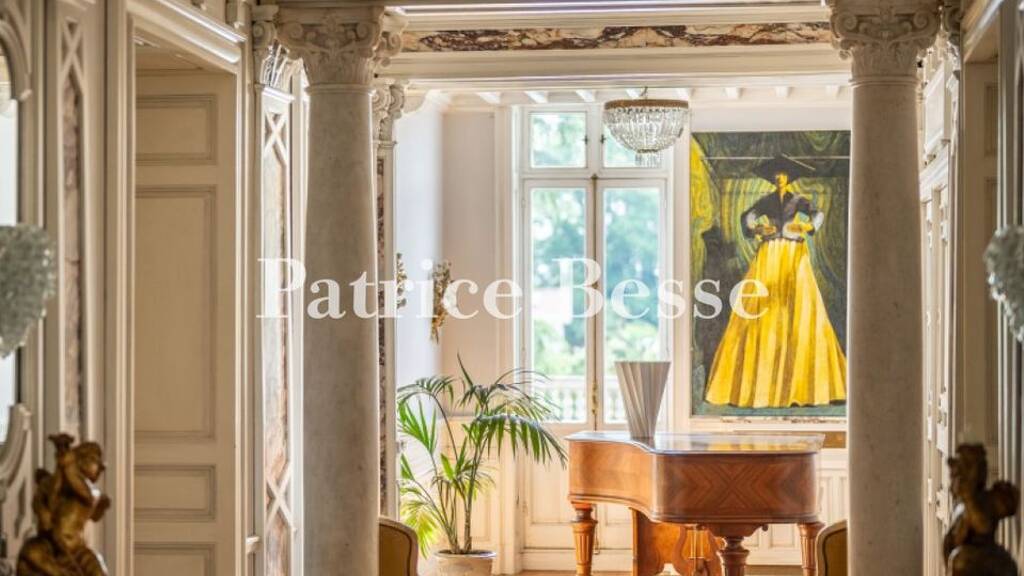
Originally with 4.6 hectares, the estate is enclosed by tall stone walls and accessible via two immense gates - one of which is decorated with bronze statuettes - each one located next to a caretaker's cottage. Between 1902 and 1905, the architects Martinet and Rigault added a couple of follies throughout the property, such as an artificial spring and a temple to Diane, built out of reinforced concrete, whereas, in 1954, the grounds were divided up in large part in order to create a housing estate, the villa was split into magnificent flats and its garden was reduced to 8,200 m². Among these flats, the property in question, located on the first floor, is extended by a terrace and a balcony facing south and includes an entrance hall, four bedrooms, two living rooms, a study, a kitchen and two bathrooms, all featuring noble materials and meticulously decorated in a one-of-a-kind style, from the floor to the ceiling.
Last, but not least, the common areas mainly include an entrance hall and a massive staircase in Carrare marble, with balustrades and columns also in white marble.
The FlatThe flat's wide double door entrance, with moulded wooden panels and topped with a glazed fanlight, opens onto an immense entrance hall, which announces the refined atmosphere that reigns throughout the premises. With majestic volumes, floor-to-ceiling heights surpassing 3.5 metres and abundant natural light in each room, mitred Herringbone hardwood floors, with honey and tobacco highlights, decorate the entrance hall and reveal the artisanal know-how of the 19th century, while the walls are cadenced by wood panelling, ...