An 18th-century mill, outbuildings and millstream which can be swum in near Beaune and Dijon, at the intersection of the Morvan and Auxois regions - r
An 18th-century mill, outbuildings and millstream which can be swum in near Beaune and Dijon, at the intersection of the Morvan and Auxois regions.
At the intersection of the Morvan and Auxois regions, 5 minutes from Arnay le Duc, the mill, set in some 2 hectares of grounds, is 35 minutes from Beaune and 45 minutes from Dijon and its TGV station, which takes you to Paris in 1.5 hours. Paris can also be reached in 3 hours via the A6 motorway, Lyon in 2.5 hours and Geneva in 2 hours 45 minutes. All the services and amenities needed to live a comfortable day-to-day life are just 5 minutes away by car: schools, a health centre, a pharmacy, supermarkets, bakeries, butchers and the weekly Thursday morning market in Place du Craquelin. Arnay-le-Duc, with the remains of its medieval castle, its 16th-century Saint-Laurent church and its town houses, bears witness to a rich past when the town was a trade crossroads between the north and south of Burgundy.
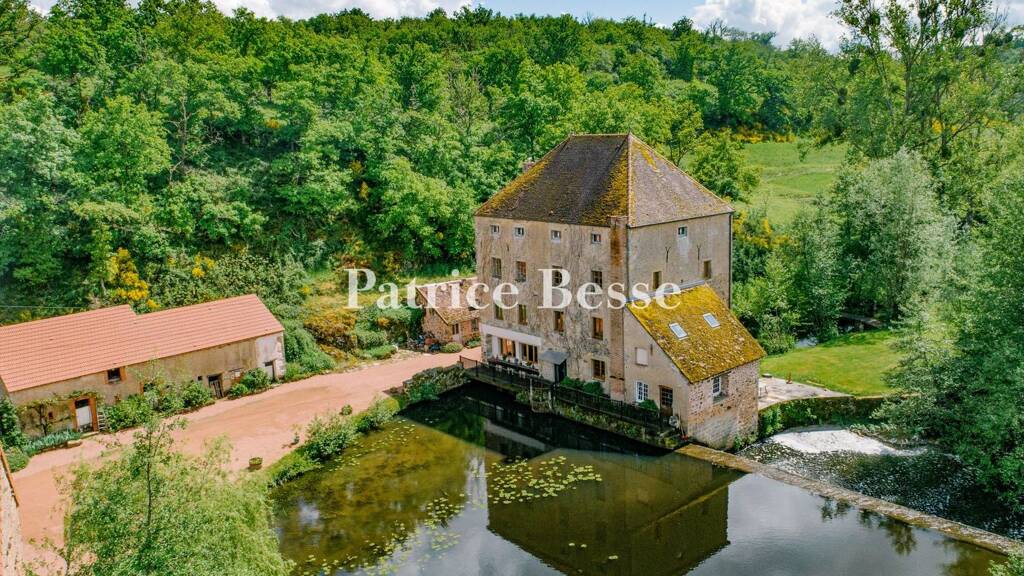
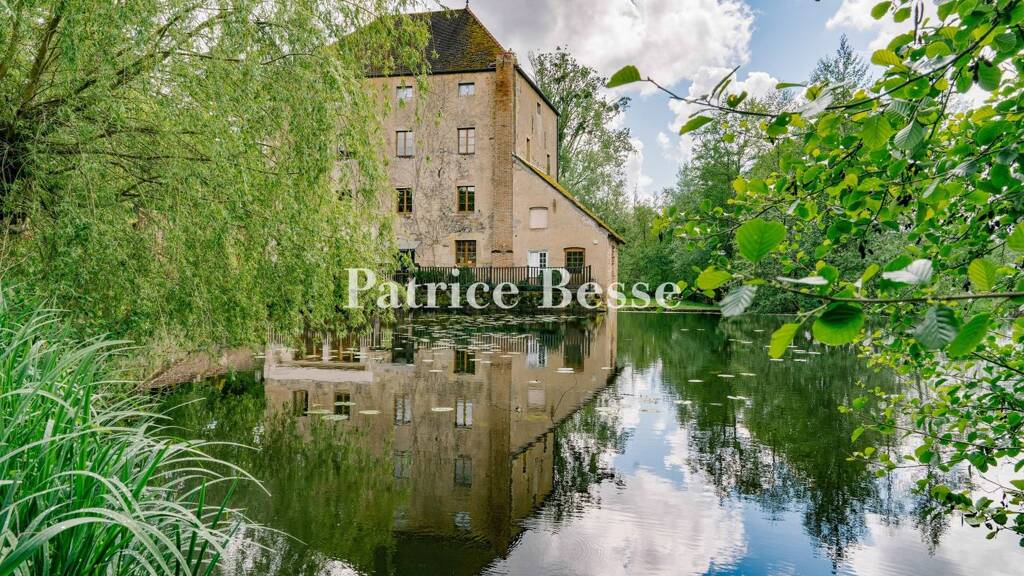
Accessed via a private driveway, the property is set in more than 15 000 m² of wooded grounds that stretche discreetly between the Arroux river and wooded foothills. The entrance opens to reveals a group of buildings neatly arranged around an inner courtyard, with an 18th-century water mill at the back, the central feature of the estate and now the main building, that opens onto a peaceful pool of shimmering water. The reflection of the sky and the waterfall bring the estate to life throughout the day. Around the courtyard, the outbuildings are vestiges of its past farming activity: a cowshed, a barn, a miller's house, a stable, a set of sheds including a henhouse and an old pigsty. The mill has full water rights, a legal status inherited from the Ancien Régime, which attests to its existence prior to 1789 and grants the owner privileged use of water resources without any administrative constraints.
The millIts architecture is sober with its rectangular stone building, which is partly vaulted and covered with flat roof tiles. A footbridge over the mill stream provides access to the sluice gates and the two entrance gates. With its two millstones, it is unusual in that it used to be powered by a water turbine that is still under the building. The entire mechanism and its grinding wheels have been preserved inside. It has still been possible to convert the building into a contemporary residence despite this. In the northern corner there is a tall brick chimney, a reminder of its industrial past, and a space that once housed the oven, then the generator, steam power and then later electric. The building is two storeys high on top of a ground floor, with an attic above. The windows, four per floor and identical on the east and west façades, provide the interior spaces with abundant natural light.
The ground floor
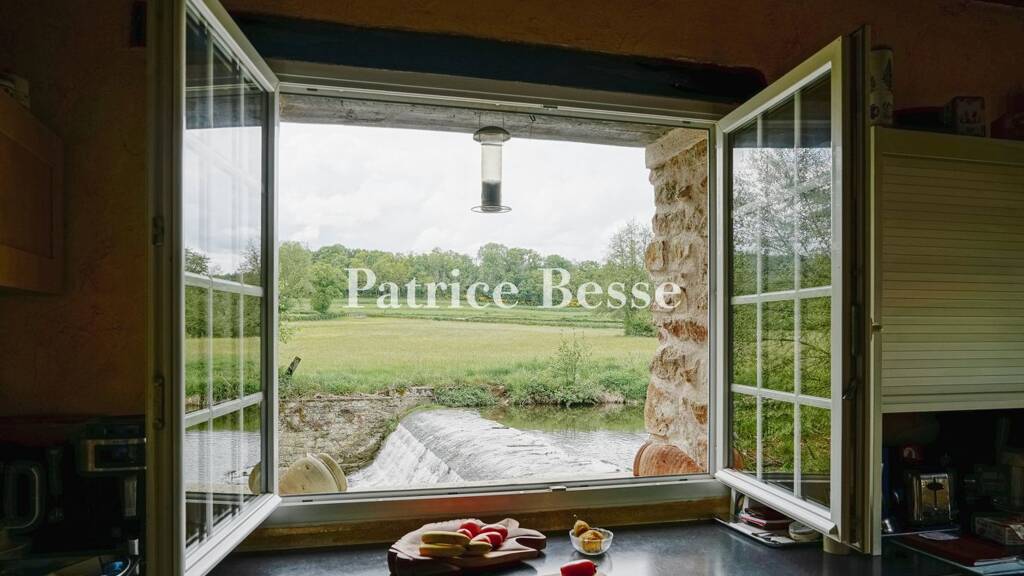
At the end of the front door, a room opens onto the terrace, the garden and the river. Once a gear room, it now houses a bar and a dining room, organised around the mill's transmission mechanism, a cast-iron sculpture and a souvenir of the site's industrial past. With its French-style ceiling and floor made from two distinct materials - Burgundy stone tiles and oak strip parquet flooring - this cosy room leads to the first floor on the right, via a simple oak staircase, as well as to the space that housed the former bread oven, where a shower room and toilet have been built, and, through a stone archway, to the kitchen with its Comblanchien stone floor, which has wide views over the pond to the east and the water to the north. To the left there are two recently refurbished rooms: a lounge graced with a large Louis XV fireplace in carved stone, with a log-burning stove in it, large windows and an oak-framed French window opening on to the courtyard, as well as storerooms including the cellar and boiler room, and then a bright bedroom with a ...