A unique, 18th-century mill, with a fully restored house, outbuildings, more than 55 hectares of grounds and a 16-hectare fishing lake, in the country
A unique, 18th-century mill, with a fully restored house, outbuildings, more than 55 hectares of grounds and a 16-hectare fishing lake, in the countryside of the former Nivernais province.
The mill is tucked away in a discrete small valley, standing in the peaceful countryside around a village in the former Nivernais province, in the Bourgogne-Franche Comté region. The undulating and wooded surrounding landscape forms a countryside canvas that is away from major roads but still easily accessible. The town of Decize is located 17 kilometres away and possesses the full range of essential shops and services as well as a railway station. Nearer still, at a distance of just 9 kilometres, the station in Cercy-la-Tour puts the Gare de Lyon in Paris within 3 hours' reach.
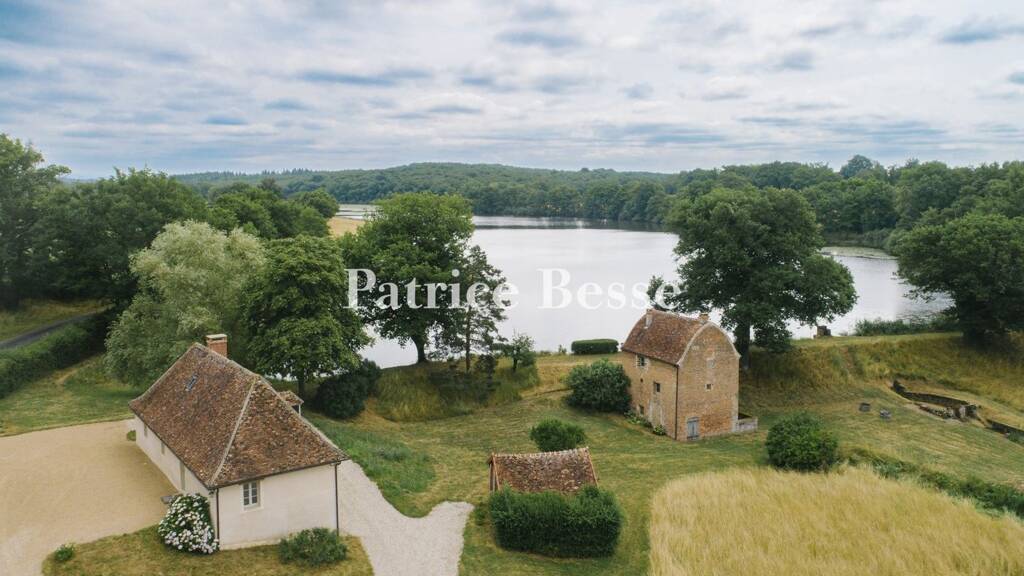
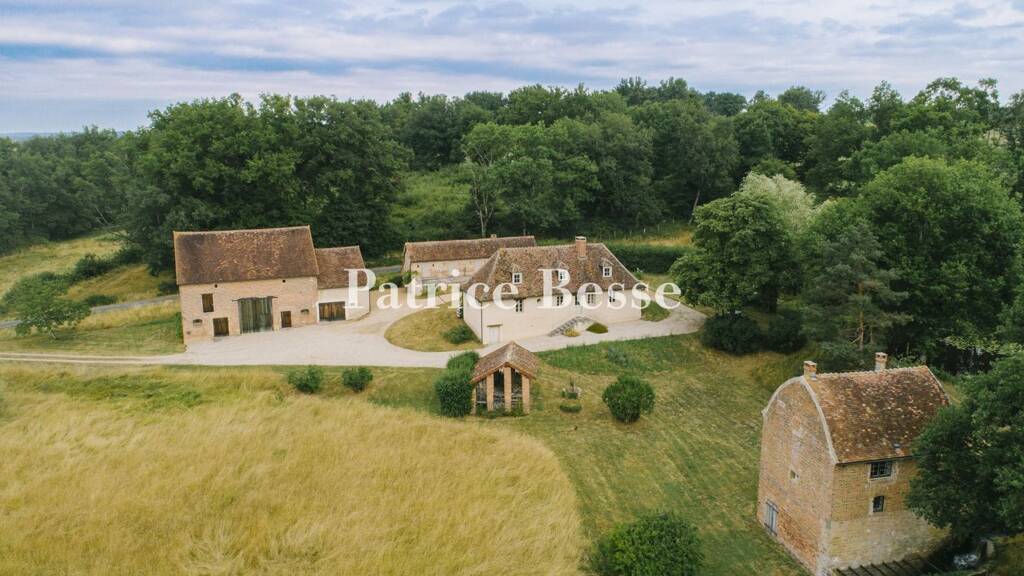
The property stretches over 55 hectares on either side of a vast, approximately 16-hectare lake through which flows the River Cressonne. This water mirror forms the natural crossroads of the estate, around which the different buildings are set. A drive winds through the grounds up to a two-storey, fully restored manor house with a cellar. The limewash rendered façades are dotted with regularly shaped windows on either side of an elegant south facing entrance that can be reached via a central, double-flighted set of stone steps. To the north, the main entrance onto the garden level stands opposite the former pigsty, a witness to the estate's rural past. The edifice is topped by a sober, dark, slate roof. A former barn stands slightly set back to the northwest.
The mill building stands below the house, to the south. Its red brick façades reflect in the water of the lake on whose shores it stands. It was constructed as a grain mill and previously figured among the Nièvre area's many water-powered buildings, whose activity was gradually abandoned with the rise of industrialisation. Its distinctive feature is its roof frame like an upturned ship's hull.
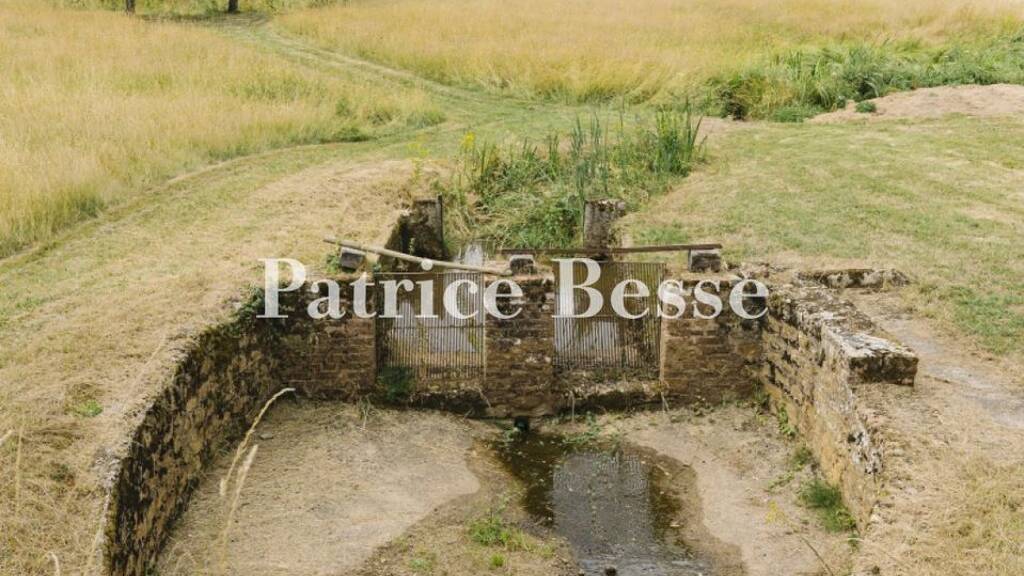
The structure is made up of light pieces of flat wood assembled using an ingenious wedge system and did not require the use of large lifting machines. It is covered with small, flat terracotta tiles that are typical of the region. This type of roof frame, known in France as a 'Philibert Delorme' roof frame after the architect whose technique became widespread in the 16th century, is directly inspired by the shape of a ship's hull and enabled the entirety of the attic space to be used for storage of commodities. The waterwheel is no longer in place but it is still possible to see the tailrace and the where the water previously passed.
The houseThis two-storey house, with cellars, has a surface of approximately 109 m². It boasts cladded façades and a roof made of flat tiles punctuated by several hipped dormer windows. It was entirely restored in 2009.
The ground floor
Behind the main entrance on the north side of the building, from the hall a wooden staircase climbs upstairs. The floor is tiled and the limewashed walls have been doubly insulated, with a layer of glass wool in between the outer wall and brick partitions. The house's temperature efficiency is further enhanced by underfloor heating. On one side, a wooden door opens into a fully fitted kitchen with a dining area. On the other side, another wooden door leads to a lounge with a functional stone fireplace and sanded then limewashed exposed beams on the ceiling. A glazed door leads out to the south onto a double-flighted set of stone steps leading down into the garden. After the lounge, a door opens into a bedroom into which light streams through two windows. An adjacent shower room with a lavatory can also be reached via the lounge.
The first floor
A wooden staircase that is bathed in light through a bullseye window climbs upstairs to a landing leading to a space with straight wood stripped flooring currently used as a ...