A 15th-century house listed as a historical monument with a timber-framed facade of masterfully carved beams, nestled in the historical heart of Blois
A 15th-century house listed as a historical monument with a timber-framed facade of masterfully carved beams, nestled in the historical heart of Blois, opposite the city's cathedral.
The city of Blois lies on the banks of the River Loire, two hours from Paris and 30 minutes from Tours. It is listed as a UNESCO World Heritage Site for its royal chateau that towers in its historical centre with its splendid parkland. The countryside is not far away. With its 100,000 inhabitants, the urban area is a vibrant hub. The property stands out for its emblematic facade of timber framing, opposite the city's Saint-Louis Cathedral.
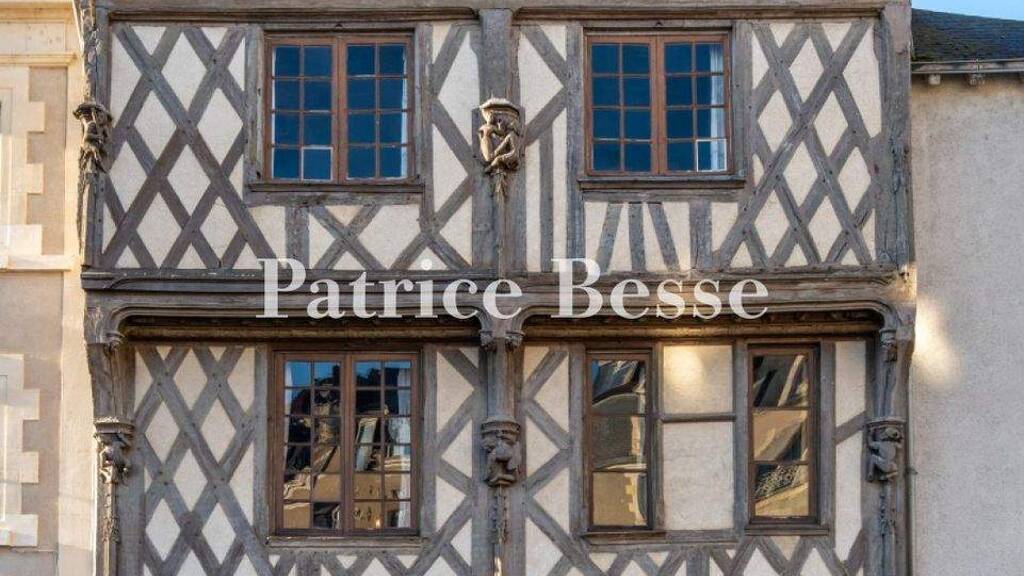
The centuries-old house - "La Maison des Acrobates" - is listed as a historical monument. It is doubtless the oldest civil dwelling that still stands in the heart of Blois. It combines timber-framed architecture with expressive sculptures and subtle symbolism. Its remarkable facade of wooden beams with cob filler and brick is typical of the 15th century. There is a ground floor, two upstairs floors with corbelling and a third floor in the roof space. A spiral staircase links the levels together. Apart from the top floor, each level is taken up by a single room. On the ground floor, there is, on one side, a large front window - the token of a former shop here. And on the other side, there are two studded wooden entrance doors: one leads straight to the house and the other one leads to a corridor that takes you to the neighbouring house at the back. Small-paned casement windows, probably enlarged in the 18th or 19th century, bring natural light into the upstairs floors. On the third floor, two gabled dormers frame a hipped dormer, which is bigger, upon a slate roof. The back windows look out at the court of a neighbouring townhouse.
The facadeThe remarkable facade features a timber decor of sculpted figures on corbel bases, small columns, and horizontal beams embellished with foliage stringcourses. The overhangs have mouldings and rest upon mid-height corbels carved with acrobatic figures - which is where the house gets its name from ("La Maison des Acrobates" means "The Acrobats House"). The figures - warriors, minstrels, jugglers, some men and others women - wear clothing from the time of King Louis XI of France. The whole sculpted decor is an interpretation of the moresca - a medieval dance - in an allegory of human passions. The timber doors on the ground floor have kept their original studs.
The house
The ground floor
You step into the only room on the ground floor, which has remained a shop. Hexagonal terracotta tiles cover the floor. A monumental fireplace stands against one of the walls with a plain entablature beneath several levels of elegant cornices, supported by built-in columns crowned with capitals. A corridor that leads to the neighbouring townhouse runs behind another wall. The staircase that takes you upstairs is absolutely remarkable. It is made entirely of wood and winds up around a central sculpted twist that serves as a handrail. The steps are made of wood all the way up to the third-floor landing. The walls are timber-framed with a filling of plaster or small bricks.
The first floor
A large room for everyday living takes up the whole floor area. Square terracotta tiles cover the floor. The interior walls are made of rubble stone and plastered, sometimes with plasterboards added. Like on the ground floor, an imposing beam supports the ceiling joists. Three windows - one double window and two single windows - look out at the square Place Saint-Louis, with an unrivalled view of the cathedral, the 18th-century facades opposite and a townhouse. There is a monumental stone fireplace with an entablature with mouldings, supported by thin columns crowned with capitals that are ...