A 14th-century collegiate church listed as a historical monument, with an apartment, in 1.3-hectare grounds, in Burgundy, at the gateway to the Auxois
A 14th-century collegiate church listed as a historical monument, with an apartment, in 1.3-hectare grounds, in Burgundy, at the gateway to the Auxois region, at the top of a hill.
In the illustrious Auxois part of Burgundy, between the Morvan hills and foothills, the region boasts outstanding medieval heritage, paying witness to the splendour of the Dukes of Burgundy, who left their architectural imprint on this area. The hamlet of Maison-Dieu and the collegiate church perched on a hillock, nicknamed 'the look-out of the Auxois' by André Malraux, dominate the Armaçon Valley to the east and Serein Valley to the west. The former ducal town of Semur-en-Auxois, boasting many shops and services, is 20 minutes away, as are Saulieu and Vitteaux. It is easily accessible, via the high-speed TGV railway stations in Montbard or Dijon, putting Paris within less than 2 hours' reach. Lyon can be reached in 2 hours 35 minutes via the A6 motorway, while Paris is 2 hours 50 minutes away and Geneva is 3 hours away by car.
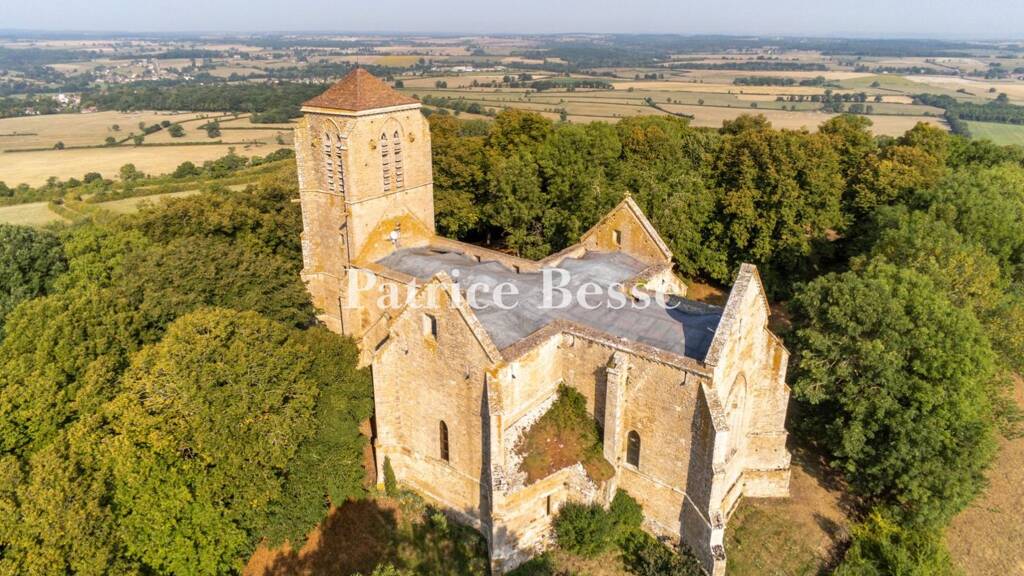
This collegiate church boasts a dominant position with panoramic views of the surrounding countryside. It is encircled by grounds of more than 1 hectare and is far from any neighbours, apart from Thil Castle, built in the 12th century by Jean II, lord of Thil and a constable of the Duchy of Burgundy. By a deed dated 10th March 1340, he founded the current collegiate church. The edifice was built between 1341 and 1344. It was consecrated on 12th August 1344 by the bishop of Autun, under the patronage of the Trinity of the Virgin Mary.
This two-storey collegiate church is made of Auxois stone in the shape of a Roman cross, boasting a single nave with three bays, from which a two-bay radiating chapel extends to the east, and crossed by a transept with two protruding arms. Two chapels open onto the northern and southern arms of the transept.
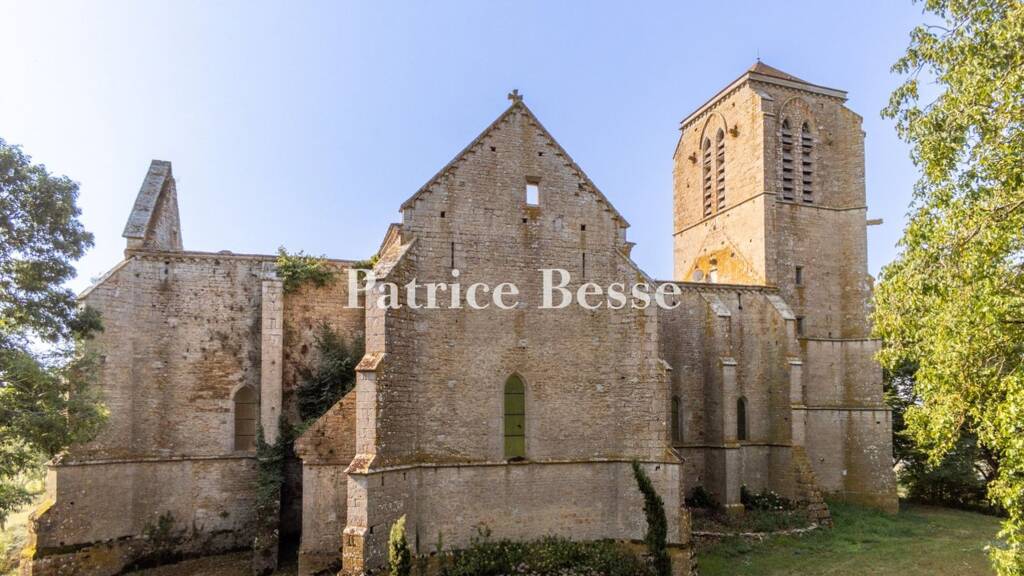
To the west, the bell tower stands above the entrance to the edifice, adorned with four pointed-arch tori resting on small columns with foliage decorated capitals.
The gables of the northern and southern arms of the transept as well as the remains of the drip stone on the bell tower allude to the former steep roof made of flat tiles then of lava rock that was destroyed by a lightning strike in 1893. A waterproof cover was installed in 1926 on the extrados of the vault to protect the building from water damage. Solid buttresses bear the outward force of the vaults and are more noticeable on the southern façade where they also supported the weight of the now disappeared entrance porch's roof structure. Modillon cornices underline the levelling off of the roofs. There are a reduced number of openings: one small, pointed arch opening per bay and a triple one on the flat radiating chapel. Arrow windows punctuate each bay from the former rampart walk and, as with certain elements on the bell tower, point to the church's military and defensive nature.
The four-storey, square bell tower, supported at each corner by projecting corner buttresses, is topped by a low-slung, hipped roof made of flat tiles. Only the top floor opens onto all of the building's faces, via two ribbed windows separated by a pilaster topped by a protruding paved gutter. The openings boast a horizontal mullion and are flanked by four sculpted gargoyles.
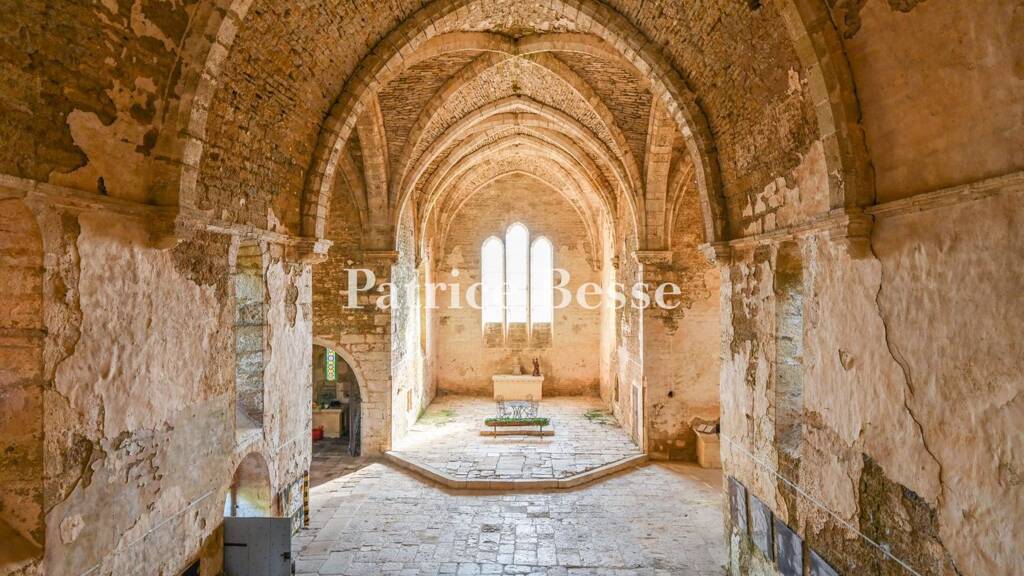
The churchThe interior of the church is made of small rubble stone that was originally rendered, on all the walls and vaults. Only the nave and southern arm of the transept still have traces of painted decorative features. There is a single figurative mural remaining in the southern arm of the transept, depicting the beheading of Saint John the Baptist and the Virgin Mary accompanied by Saint John and Jesus Christ. The inner periphery of the nave includes the remains of a funeral urn decorated with unidentified coats of arms. Most of the flooring is ...