A 225m² first-floor apartment in a 19th-century edifice in Nîmes in southern France, near the city's UNESCO-listed Roman temple - ref 815385
A 225m² first-floor apartment in a 19th-century edifice in Nîmes in southern France, near the city's UNESCO-listed Roman temple.
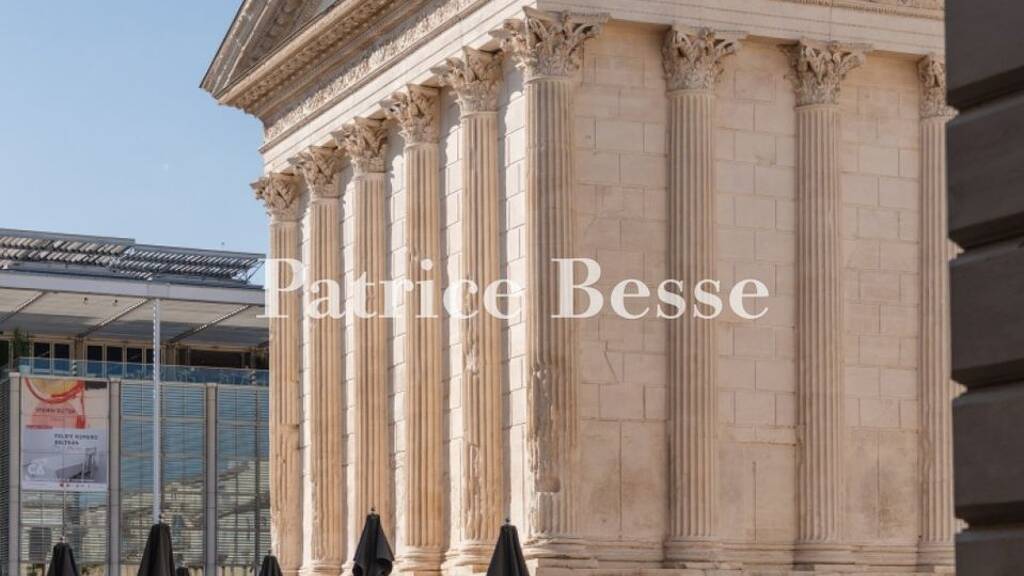
The property is just a stone's throw from the famous "Maison Carrée" - a masterpiece of Roman architecture that bears witness to the imperial cult of Emperor Augustus. This Roman temple in Nîmes was listed as a UNESCO World Heritage site in 2023. The district around this monument is rich in built heritage and is culturally vibrant. Here you find a former Roman amphitheatre, the beautiful public park Jardins de la Fontaine, and Nîmes Cathedral, as well as the Carré d'art - a museum of contemporary art. The soul of this neighbourhood can be felt strongly. Each street corner is steeped in history. Nearby, there are renowned schools, good shops and a lively covered market, giving the property a practical dimension and a family feel. A new tram network makes it easy to get around the city centre and even out towards the edge of the city. The city's central train station is just a 15-minute walk away. And you can drive to Nîmes-Pont-du-Gard high-speed rail station in 20 minutes. From the latter station, you can reach Paris in three hours by rail. Nîmes international airport is only 20 minutes away too. And the beaches, lakes and unspoilt landscapes of the natural Camargue region are only around 30 minutes from Nîmes.
The edifice has three levels and a basement. It is part of a 19th-century series of adjoining buildings that enjoys a remarkable location beside the street Rue de l'Horloge. It links the square Place de l'Horloge, on its east side, to the Roman temple, on its west side. The facade blends into its paved street in the historical heart of Nîmes. Its is coated with beige rendering and has 19th-century architectural features that are typical of France's Bourbon Restoration period. This facade is plainly classical in style, crowned with a cornice with modillions and rosettes, which runs above the next cornice down, which only has mouldings, as well as a simple stringcourse that marks the top of the ground floor. The first floor is punctuated with four tall windows that combine colours and time periods, with bluish metal frames, large panes, double glazing, fanlights with the same materials, ashlar surrounds and pilasters. The windows along the top floor are smaller and their surrounds plainer. The roof is covered with barrel tiles, which is typical of the local region. A large entrance door framed between two shopfront windows - one for a florist, the other for a hairdresser's salon - stands in the middle of the facade on the ground floor. This double door of solid oak with a patina of time has panels with mouldings and bronze fittings that include a door knocker. The door is set in a surround with a semicircular arch and limestone blocks in relief - the mark of an architectural style that is at once simple and elegant. Above the door, there is a glazed fanlight fitted with a wrought-iron grate with a radial pattern. This remarkable feature is a token of high-quality craftsmanship and an embellishment that bears witness to a time when an entrance to an edifice had to be at once reassuring and ceremonial. A broad staircase of stone steps leads up to the first floor where the apartment lies. Its wrought-iron balustrade has bars forming a remarkable neo-Gothic motif of pointed arches - a typically 19th-century design - and a handrail of oak with a patina of time.
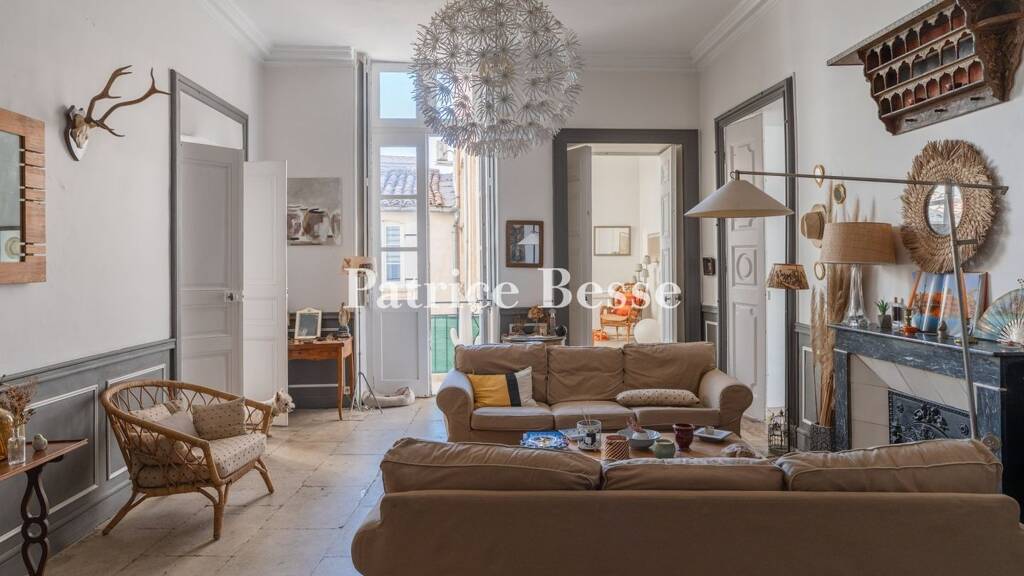
The apartmentThe apartment lies on the first floor. It offers a 225m² floor area and has eight main rooms. It is laid out around an inner court, which makes it very bright inside. A 27m² sun-kissed terrace covers part of the ground floor below and looks down at the inner court. This calm L-shaped terrace, edged with a wrought-iron balustrade, connects to the different parts of the apartment. In the different spaces ...