An elegant 19th-century manor house with a tree-filled garden, 5 minutes from the centre of Albi - ref 532781
An elegant 19th-century manor house with a tree-filled garden, 5 minutes from the centre of Albi.
This property is located in Albi, the administrative hub of the Tarn area, in a landscape shaped by history and dominated by the monumental silhouette of the Saint Cécile Cathedral with its red colour, identical to the surrounding brick houses, which earned the Episcopal City inclusion on UNESCO's World Heritage list in 2010. The edifice is situated in a residential neighbourhood to the north of the city, in a calm area overlooking the river. Albi city-centre can be reached from the house in 10 minutes by bicycle or 5 minutes by car. Toulouse-Blagnac airport is 55 minutes away.
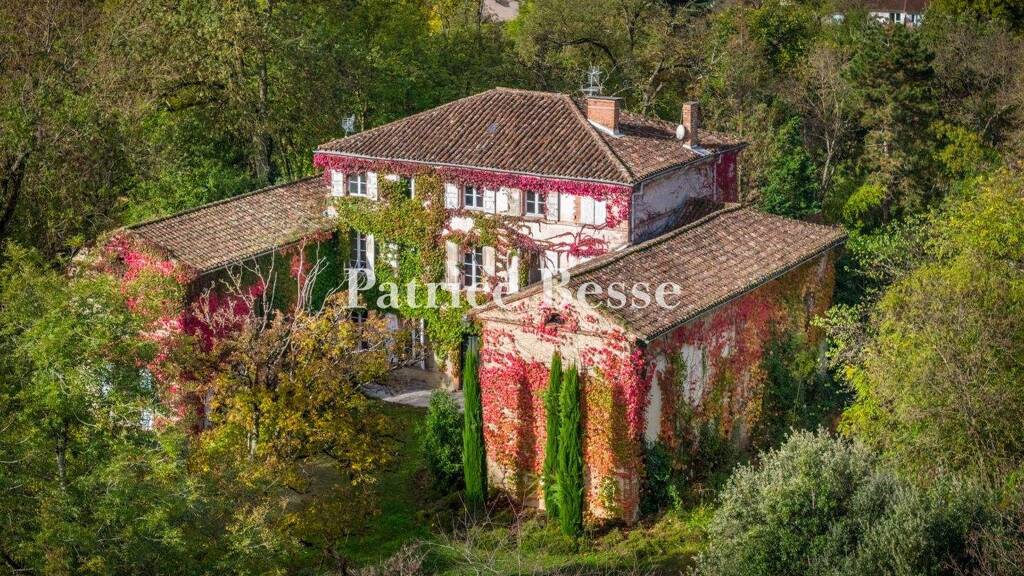
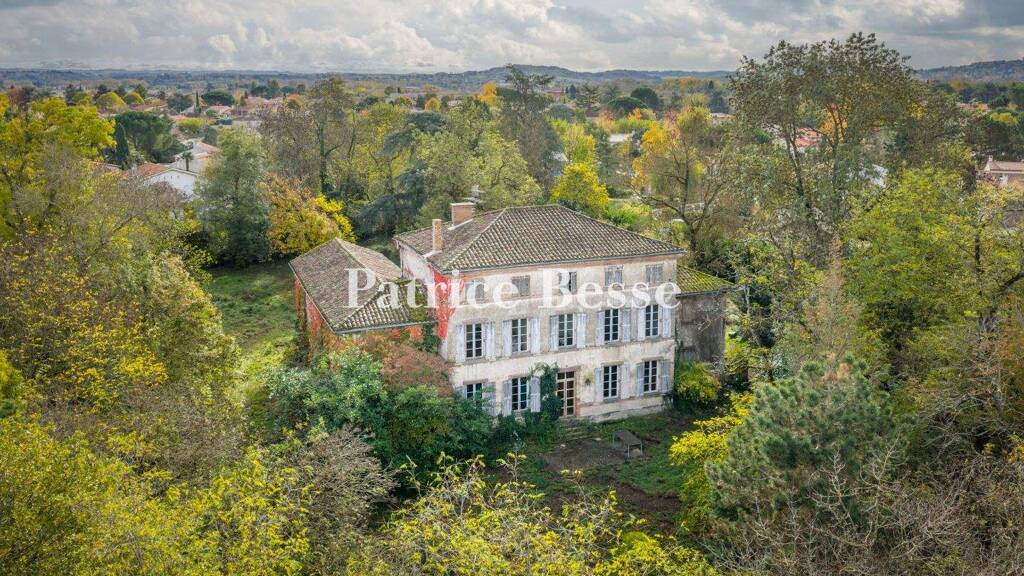
The house appeared in a more modest format on the Napoleonic land registry of 1810, in simple cuboid form surrounded by a garden and crops. Its current appearance is a result of the successive transformations carried out in the 19th century. It is now an imposing and balanced manor house, whose presence on the edges of a now urbanised sector can be explained by its former estate that originally occupied the area. It is located on the south bank of the River Tarn, which it overlooks from a steep slope, almost in a belvedere style position. In the approximately 5,500-m² plot, the edifice is nestled among a wide variety of tall and old trees whose branches provide shade and privacy that is rare within a city. It occupies the centre of the garden, which spreads out all around, like a protective barrier of vegetation.
The manor houseThe building boasts a symmetrical layout, with a southeast/northwest oriented main section flanked by two equally sized wings. The central section possesses a ground floor, first floor and top floor beneath the rafters, with a facade punctuated by five aligned vertical rows of openings, each of which is underlined by brick surrounds, creating a mixture of materials specific to the architecture of Albi. As the seasons pass, the Virginia creeper partially enveloping the elevations bestows changing hues on the facade, from gentle green in the spring to deep red in the autumn. To the rear, a small, paved patio expands outward towards the garden as a natural extension of the residence. The two wings, which were formerly for farming usage and drying out the harvest, are more sober in character, with fewer openings, solid facades and a less strict layout. On the two southeast facades, a brick double belt course stretches from one side of the gable end to the other to form a discrete tympanum punctuated by a half-moon bullseye window. Their relative austerity echoes the rigour of the central section, forming, together with the courtyard between them, a coherent whole.The central section
The ground floor
A large hall runs through the edifice, linking the main entrance with the exit to the rear. On one side, there is a recently renovated kitchen combining simplicity and functionality, opening onto a utility room and storeroom. Next to the kitchen, a dining room faces the rear garden. This room boasts a generous ceiling height, a classical fireplace on one of the walls and dual-coloured terracotta floor tiling, providing the space with a vibrant warmth.
On the other side of the hall, in the lounge there is still some of the original 19th-century wood panelling. It also looks out onto the garden to the rear. The adjoining stairwell is one of the house's more remarkable features and is typical of the 19th century: a glazed door with hexagonal panes alternating between translucent and coloured glass, an original wooden frame and railings, plus a finely decorated stair stringer.
The first floor
The landing leads to a bathroom, with a lavatory, overlooking the courtyard. On one side, a glazed door similar to the one on the ground ...