A comfortable 19th-century townhouse that has been masterfully renovated, nestled in a calm district of Nantes - ref 303573
A comfortable 19th-century townhouse that has been masterfully renovated, nestled in a calm district of Nantes.
Since antiquity, Nantes has been a gateway to the Atlantic Ocean and a historically and economically important city. In the late 18th century, industrial growth transformed the city, at the instigation of Jean-Baptiste Ceineray and Mathurin Crucy. At the beginning of the 19th century, in the west of the city, Parc Launay gave rise to a new district set around Place Mellinet. This octagonal public space lined with townhouses designed by the architects Étienne Blon and Louis Amouroux is at the crossroads of thoroughfares linking the city-centre to the Saint Anne district and the Zola district to the quays along the River Loire. The address is in a calm setting, sheltered from the urban hustle and bustle. It hosts the lifestyle of a pleasant neighbourhood, with many shops, cafés and restaurants. Thanks to the Chronobus C1 line, the centre of Nantes is only a few minutes away. By car, the railway station can be reached in 12 minutes and the airport in 16 minutes.
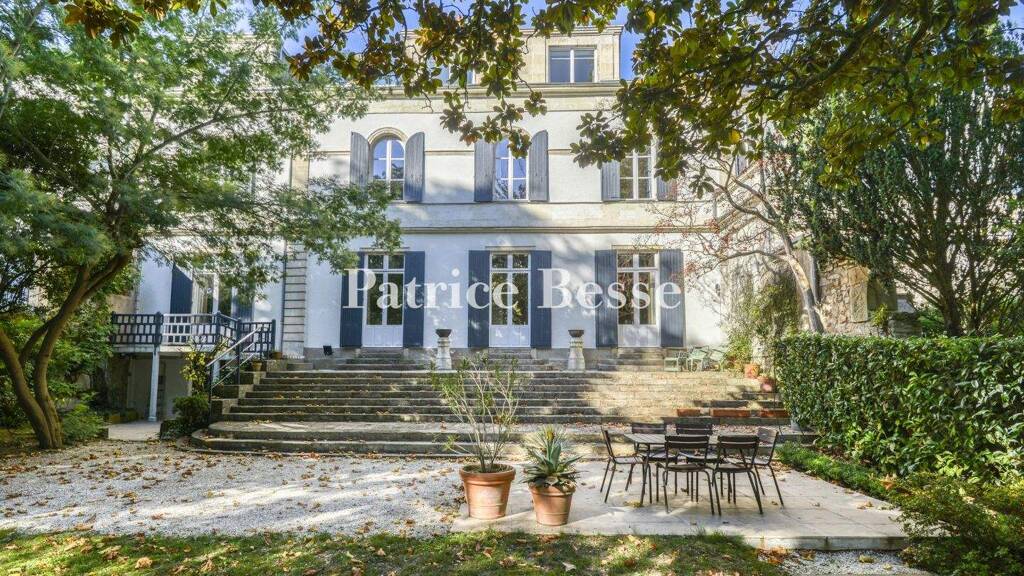
This townhouse was built in the middle of the 19th century, on creation of the Mellinet district, in a provincial neo-classical style, characteristic of the period's architectural codes. The property can be found on one of the large boulevards that had recently been created at the time. The four-storey main building stands among others, with a tree-filled garden to the rear. At the end of the plot, the property's garage can be reached via an adjacent street. The townhouse's garden storey is on the basement level. The edifice boasts a symmetrical layout that is typical of its time, giving the property a feeling of balance and rigour. On the façade overlooking the street, the windows are rectangular with straight lintels, or with semi-circular arches on the upper floor. They possess limestone frames with bevelled edges, topped by slightly moulded sills. The façade is crowned by a sober entablature, including a slightly protruding cornice, underlined by an interplay of striking shadows, which elegantly completes the composition. The neutral, off-white cladding highlights the natural colour of the limestone on the window and door frames as well as the sleeper wall. The garden façade is similarly arranged but is also enhanced by several features, such as slate-grey painted wooden shutters, a simply edged cornice underlining the separation between the levels and, particularly, an imposing double-flighted set of stone steps, weathered by time, descending into the garden. It serves as a veritable transition between the house and the surrounding vegetation, in the style of grand holiday homes or country manors. Two ornamental urns on stone and cast-iron pedestals can be found on the stoop to which the steps lead.
The residenceThe initially austere-looking street façade reveals the utmost in rigour and subtlety of urban neo-classical design to the watchful eye. The building's base, made of dressed stone with recessed pointing, provides the edifice with stability and durability. At the top of several steps, the main entrance, framed by a moulded stone plinth line with a straight lintel, houses a deep black, wooden door with a large-paned, glazed upper half, giving a certain solemnity to the doorway.
The ground floor
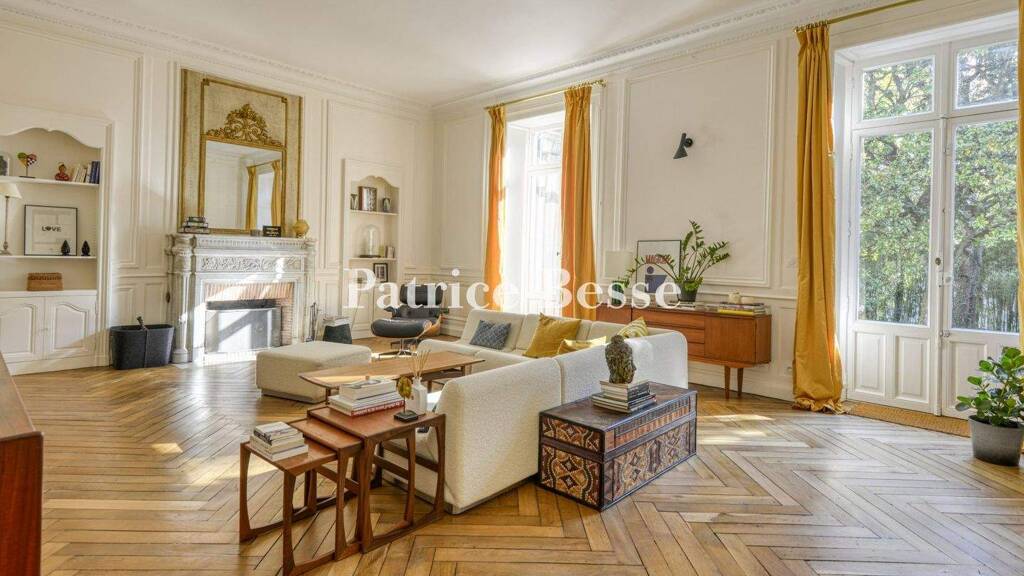
This storey is the noble level of the edifice. The ceiling height of approximately 3.60 metres provides vast volumes, into which light streams through generously and neatly arranged windows, reflecting the desire for the interior to open out onto the garden. The entrance houses a remarkable stone suspended staircase. After the first several curved steps, the rounded stringer is majestic, topped by an ironwork guard-rail. The light colour of the staircase is echoed in the entrance hall's geometrically patterned floor tiles, ...