A well-preserved, approximately 600-m² elegant manor house with an enclosed garden and outbuildings, in the Minervois sector, in the southwest of the
A well-preserved, approximately 600-m² elegant manor house with an enclosed garden and outbuildings, in the Minervois sector, in the southwest of the Hérault area.
The village in which the property is located, in the Occitanie region, in the west of the Hérault area, in the heart of the Minervois sector, bordering on the Aude area, is surrounded by undulating landscapes of vineyards. The municipality enjoys a Mediterranean climate and hosts a large weekly market. It also boasts a high number of convenience stores. In addition, the Haut-Languedoc Regional National Park is only several kilometres to the north.
The municipality, between the Canal du Midi and the village of Minerve, is situated 30 kilometres from Narbonne, 36 kilometres from Carcassonne, 43 kilometres from Béziers, 122 kilometres from Montpellier and 130 kilometres from Toulouse. All the above cities possess stations with high-speed TGV train connections, while the last four also have international airports nearby.
The property can be found in urban environment and is made up of several buildings erected during the third quarter of the 19th century, by a family who made a significant fortune in vinegrowing, like other vineyard owners in the Minervois sector and near Béziers. The property is made up of a manor house, a perpendicular extension, a former superintendent's lodgings and a hen coop, bordered by the garden to the east.
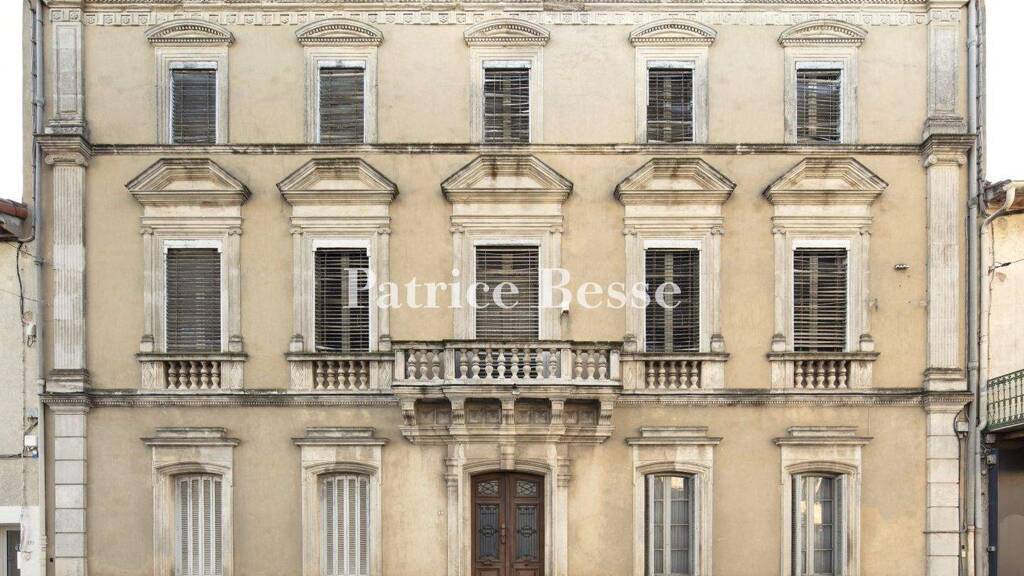
The three-storey manor house is topped by a long-sloped and wide gabled roof made of half-round tiles. The frieze underlining the denticulated cornice on the facade overlooking the street is inspired by ancient rose-shaped bas-reliefs. This ashlar-built, west-facing elevation is perfectly symmetrical, with five vertical rows of openings arranged in an opulent neo-classical architectural style. On the contrary, the facade overlooking the garden is characterised by its stringent sobriety. The entrance door from the street, in the centre of the facade, is topped by a stone balcony. Its guard-rail made of balusters is echoed on the four windows either side of it on the first floor. The windows on the ground floor are fitted with metal louvred shutters, while the ones on the upper floors are fitted with wooden slatted blinds.
The 20th-century extension is made up of a rectangular building on the garden side of the house. It includes a basement and a ground-floor topped by a roof terrace. Light streams into it through three windows and a French window, fitted with sash shutters.
A circular pond can be found in the reasonably sized garden lying to the east of the manor house. A zinc-roofed aedicula previously housed an outside lavatory.
Lastly, the former superintendent's lodgings located at the bottom of the garden is today a two-storey guests' house, standing next to a wooden gate opening out onto a narrow street to the rear of the property.
The manor houseThe main elevation is adorned with a rich décor inspired by classical architecture. The first level is framed by bossed pilasters and crowned with a moulded denticulated cornice, bordered by the capitals of the pilasters. The segmental arched windows boast moulded surrounds as does the entrance door, which, in the centre of the facade, is framed by pilasters and topped by an entablature with a curved frieze. The cornice on the latter extends further thanks to three offsets that act as the base for the first-floor balcony, which rests on five modillions alternating with lozenge tips.
The first floor, framed by ribbed pilasters with ionic capitals, is topped by a moulded belt course. The windows feature architectural decorations made up of ionic pilasters, an entablature and a polygonal pediment. Their apron walls include balusters between tables with geometrical patterns that are also featured on the balcony in front of the central window.
Lastly, the second floor is ...