A 17th-century charterhouse, its converted outbuildings and small hamlet of dwellings, to be restored, to the north of Périgueux, within the greater D
A 17th-century charterhouse, its converted outbuildings and small hamlet of dwellings, to be restored, to the north of Périgueux, within the greater Dordogne region.
In the Green Périgord part of Dordogne, the landscape alternates between verdant hillsides and small valleys crisscrossed by many rivers - the Dronne, the Isle, the Auvézère as well as the Bandiat. As for this historical and rocky region, it seamlessly blends architecture with nature and invites one and all to discover its many characteristic sites, such as Excideuil, Hautefort, Brantôme - the Venice of the Périgord - Jumilhac, Thiviers, Bourdeilles as well as Saint-Jean-de-Côle.
In addition, only ten minutes away from a small city/stopping off point along the Way of Saint James, a lively village features all amenities, a rich architectural heritage as well as a weekly green market that attracts quite a crowd thanks to its reputation. Last, but not least, the property is 2.5 hours from Bordeaux, approximately 1.5 hours from Bergerac and its international airport, as well as Angoulême and its high-speed rail station, while the estate is also about thirty minutes from Périgueux and the A89 motorway.
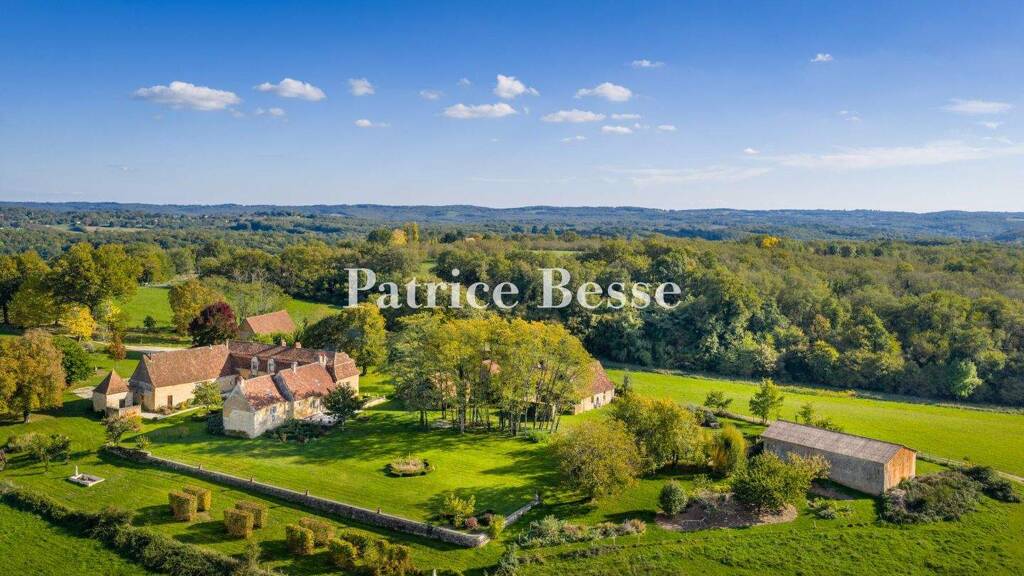
Nestled within verdant countryside, the immense property, with approximately 1.7 entirely enclosed hectares, is surrounded by meadows and woods, which envelop the property within luxuriant vegetation. Accessible via a semi-circular gate, flanked on either side by fencing and supported by four stone pilasters, which opens on to a lane lined with catalpas, multi-century oaks and plane trees, the U-shaped charterhouse is located in the middle of meticulously maintained landscaped grounds planted with a wide variety of trees and shrubs.
As for the estate, it also includes several annexe buildings, grouped together like a small hamlet, while the local stone walls, in a palette of white, yellow and pink, help structure the whole by sectioning off the various spaces, buttressing the large patio, demarcating the different entrances and encircling the ponds.
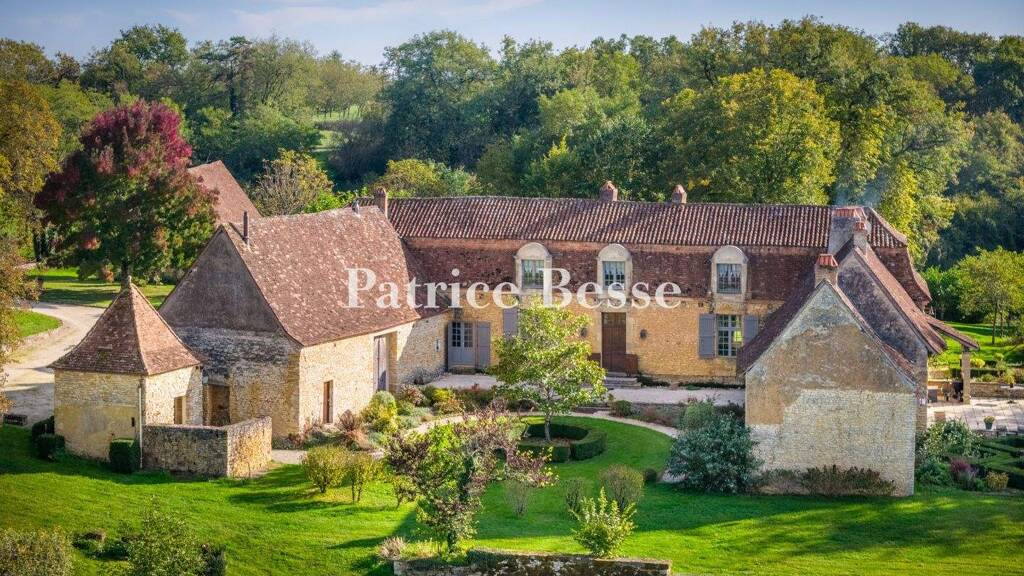
The CharterhouseAn initial wing, which corresponds to the western part of the dwelling, built over cellars, was erected under the reign of King Henry IV, while the charterhouse, in its current configuration, dates back to the era of King Louis XV. As if to emphasise the building's historic connection to these bygone sovereigns, their portraits, painted on wooden panels, are proudly displayed in the study.
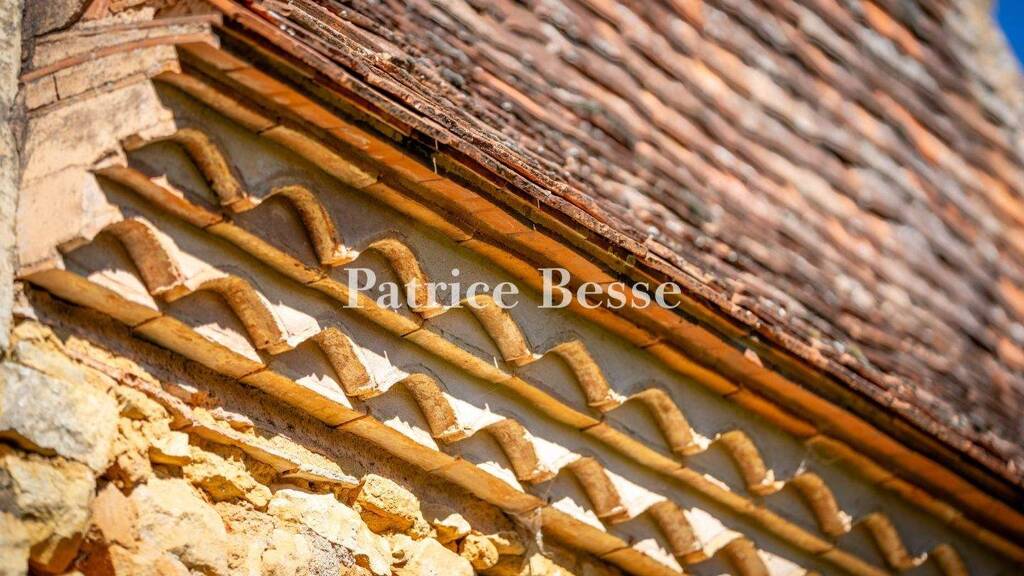
Entirely built out of pointed stone, the U-shaped dwelling was constructed with one storey in addition to its attic level, the latter of which was converted during the renovations undertaken by its penultimate owners. As for the main dwelling, rectangular in shape (35 x 7 metres), it is topped with a mansard roof, with barrel tiles on its upper portion and flat tiles on its lower, steeper section. In addition, two side wings, more modest in appearance, feature steep gable roofs, also covered in flat tiles, whereas the main building's exteriors are cadenced by wide dormer windows, placed on either side, which bathe the main rooms and bedrooms with dual-aspect light.
The ground floor
The front door, located in the middle of the main wing, opens on to a dog-legged, half-turn stone staircase, which cleverly conceals a shower room with a lavatory at its base. In addition, the staircase marks the separation between a study-library and an immense living room, which both look out on to the verdant grounds thanks to a number of tall windows, composed of two superimposed small-paned, wood-framed, double-glazed windows, one placed atop the other, guaranteeing plenty of light. As for the walls, they are sponge-painted in warm hues, while trompe-l'oeil rusticated stonework lends additional volume to the stone fireplace. Lastly, visible ceiling beams, decorated with a floral pattern inspired by the ...