A 17th century stately manor house, its outbuildings and chapel surrounded by 1.8 hectares of grounds in the "Hauts du Beaujolais" region - ref 833847
A 17th century stately manor house, its outbuildings and chapel surrounded by 1.8 hectares of grounds in the "Hauts du Beaujolais" region.
The property is close to a rural village classified as one of the least densely populated in the region, very committed to its heritage but also to meeting the challenges of environmental issues in a farming environment. Set apart from the village, the manor house slightly rises above an undulating landscape of grasslands and pastures closer to those of the Monts du Lyonnais mountains than those of the Beaujolais vineyards. 27 km from Roanne, its TER station and amenities. 49 km from Villefranche-sur-Saône, 70 km from Lyon TGV train station and 94 km from Lyon-Saint-Exupéry international airport.
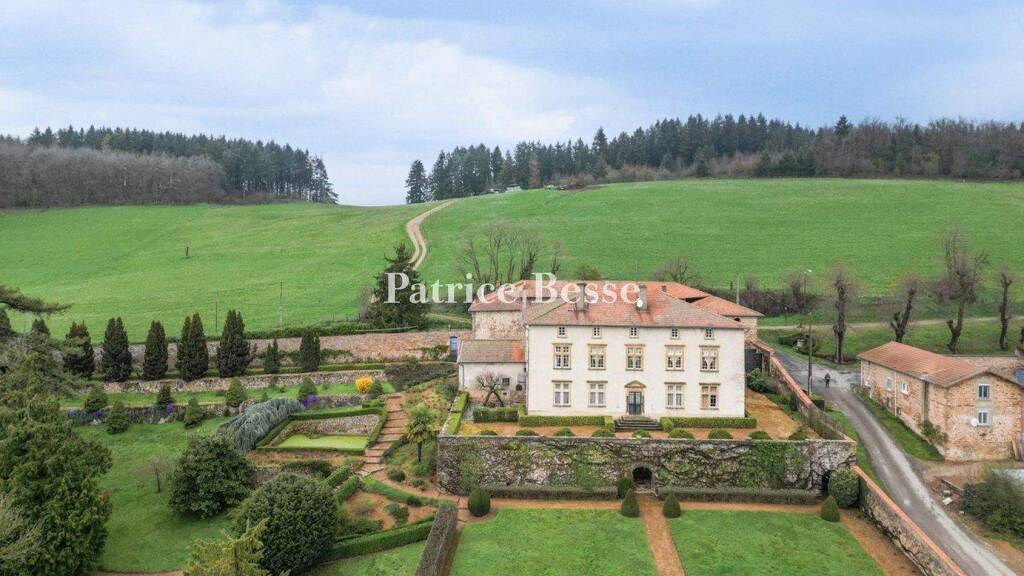
The property, completely enclosed by high stone walls, comes into view at the end of a country lane, half-way up a hill crowned with woodland. This vast rural space is shared with a group of 19th century farm buildings and greenhouses that used to form an integral part of the property.
The high, golden stone walls typical of the nearby Beaujolais region protect the 1.8 ha of grounds, which form two different parts of the estate. On the one hand, in the immediate vicinity of the manor house, there is a parterre with a geometric Latin cross pattern emphasised by angular topiaries, leading to a lateral access ramp to the terrace of the residence known as "the chateau". On the other hand, taking up the rest of the grounds, there is an English-style landscaped garden bordered on one side by a small canal and a dormant orchard below.
A majestic bicentennial Lebanese cedar dominates the landscaped garden, towering over most of the other conifers and the lime trees. A very large pool, which could be converted into a swimming pool, appears at the bend of the ramp leading to the terrace of the manor house, next to the unpaved track leading to a votive chapel at the far end of the grounds.
To the north, a group of outbuildings is arranged in a U-shape around the residence. Together with the rear elevation of the manor house, it forms a carriage courtyard, accessed via a service gate. These vast outbuildings, which include a caretaker's cottage, a stable and barns, are in need of complete restoration.
The family, who lived here from the beginning of the 18th century until 1943, with a tragic incident during the French Revolution, left numerous remains, testimonials and archives. The estate was dedicated exclusively to agriculture. Over the centuries, this has protected the authenticity of the original materials that make up the buildings, witnesses of a number of traditional skills, many of which have now disappeared.
The "chateau"The south-facing manor house was built in 1621 on the foundations of an earlier smaller structure, of which nothing remains.
It has two main levels plus one in the roofspace. The front elevation has five windows on each of the upper floors and four on the garden level, symmetrically arranged in pairs on either side of the entrance door. Accessed via a raised terrace, the garden level cannot be seen from the park at the back.
Although it was built in the 17th century, the "chateau" has retained many of the architectural features of Renaissance buildings. These include in particular the mullioned windows, which have retained their original style while having been adjusted to a more modern way of capturing the light at the turn of the 19th century.
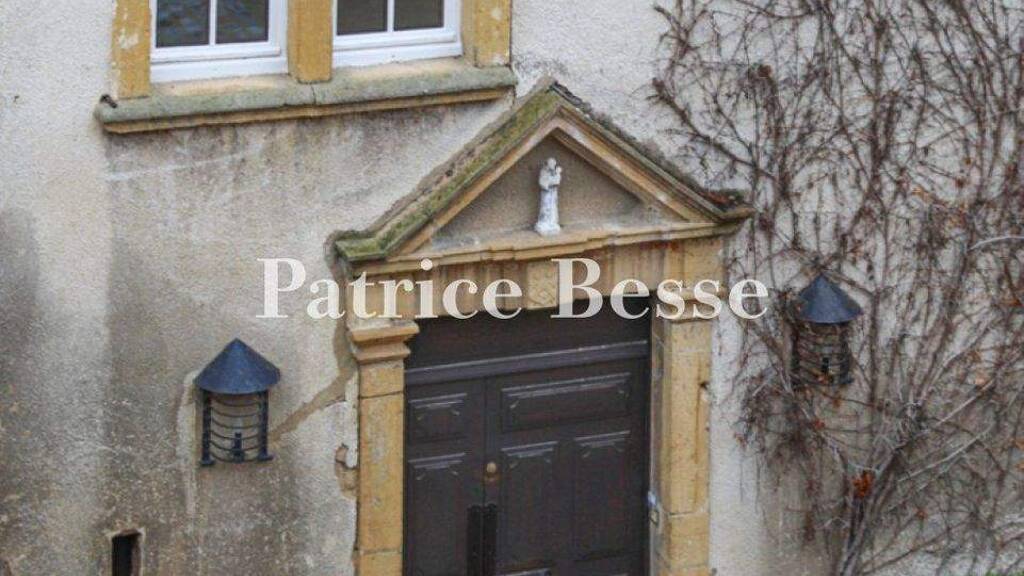
The facades are all rendered with the same smooth finish. In the rural areas, this was seen as a sign of wealth, a distinctive feature of country homes built of exposed stone. This is how the noble residence stands out from the outbuildings that surround it to the north. The smooth render does not cover the dressed stone openings, nor does it conceal the triangular Doric pediment of the entrance door or, ...