A large, luxurious home, its guest house and its annexe buildings set in pleasant parklands in Narbonne, first daughter of Rome - ref 216453
A large, luxurious home, its guest house and its annexe buildings set in pleasant parklands in Narbonne, first daughter of Rome.
Narbonne, the oldest Roman colony in Gaul, is in the Occitania region, in the French department of Aude. Near to the coast, the region has a very good tourist trade.
Discover the generosity and authenticity of Narbonne's pleasant inhabitants, with their resilient characters and their gravelly accents, when shopping for local produce in the covered market, hundreds of years old, or in the bustling markets held alongside the canal. The growing of vines has always governed the local way of life, fashioning the region's identity. Mount Clape is covered with vines and vast pine groves, where scrubland dominates the Mediterranean Sea. Fifteen minutes by car and residents are transported from the edge of town to the heart of the wetlands, with the sound of the waves and the beach for as far as the eye can see.
The A9 and the A61 motorways meet near Narbonne, putting Toulouse 150 km away, Montpellier 94 km away and Barcelona 250 km away. Narbonne TGV train station provides links to Paris in 4½ hours and to Barcelona in just under 2 hours. It can be reached from the following airports: Perpignan in 45 minutes, Montpellier in an hour, Toulouse in 1½ hours and Girona in Spain in 1¾ hours.
Seen from above, the buildings are laid out in an L-shape. They include the main house, spanning approx. 280 m² with 8 bedrooms, an adjoining outbuilding, set out as an 80 m² guest house with 3 bedrooms, a garage and a shed.
This property, just a stone's throw from the centre of Narbonne, is kept out of sight of onlookers by approx. 4,630 m² of wooded parklands. These grounds shelter a large swimming pool, with a pool-house, and a vegetable garden.
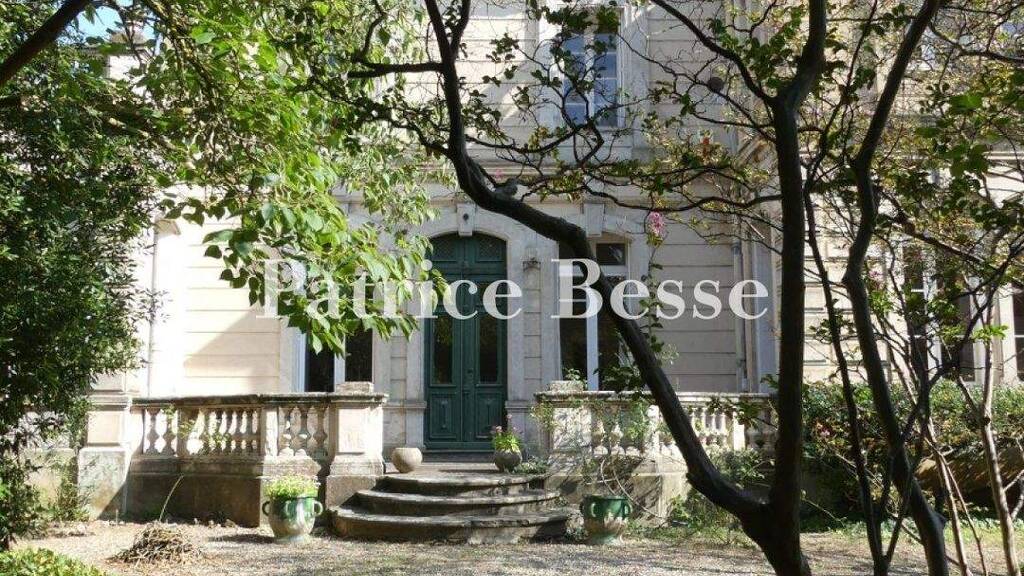
The main building spans up to four levels in the right-hand wing, giving it the appearance of a tower with a slate roof. The other buildings have tile roofs. In front of the facade, an age-old magnolia and cypress trees stand tall in Mediterranean-style parklands, enhanced with large, natural, versatile areas, bordered by immaculately trimmed hedges. An ornamental pool with aquatic plants, colonnades and Art Deco style ornaments embellish the garden. Tall entrance gates and a driveway leading from the main road are not currently used, the owners preferring to access the house via a side entrance in the parklands.
Originally the holiday home of a wealthy merchant, this residence is now in the town, despite initially having been secluded, surrounded by vines and fields. Its impressive facade made it possible to conceal the wine storehouses at the back.
The large, luxurious home
The ground floor
A stone porch flanked by local pottery leads to a vast vestibule, unused by the current owners who prefer to keep this area as a music room. They therefore enter the house via a door on the south side, adjoining the kitchen facing the horseshoe-shaped wooden stairway which goes up to the three levels from this wing. The stairwell is illuminated on each half-level by loop-hole windows. The "official" entrance hall provides access to a bright lounge (all the ground floor rooms have large windows and are all paved with cement tiles, featuring floral or geometric motifs) and, adjoining, a toilet, a dining room, looking out over the natural setting, the stairwell and the kitchen, fully fitted with wooden units and featuring a corner fireplace. Adjoining the kitchen, the back door used on a daily basis opens out into the stone-lined courtyard. Heating is provided by a heat pump installed in the shed. Air vents diffuse air at the required temperature throughout the entire house.
The first floor
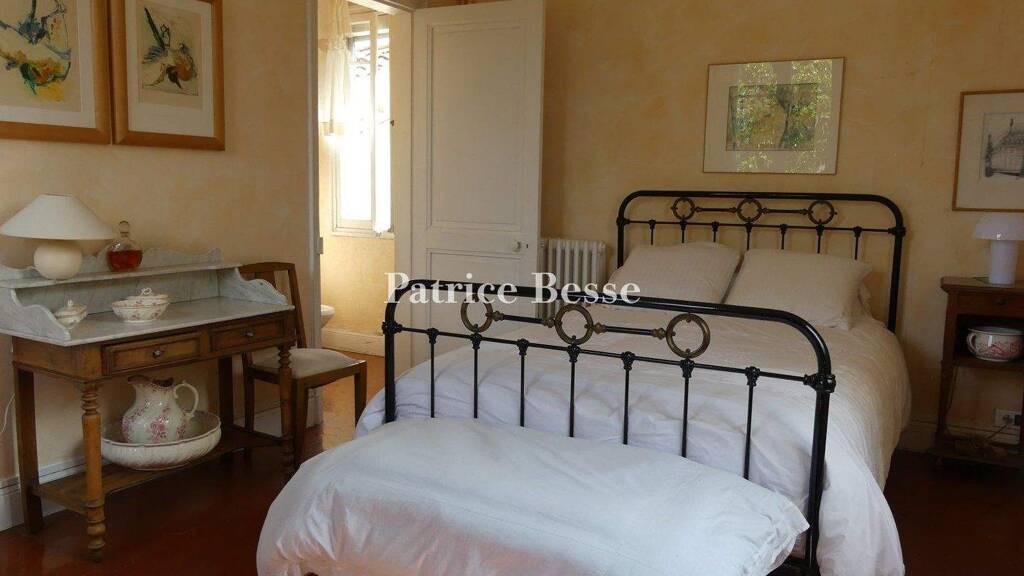
A few steps go up to the first floor. On a mezzanine, a first bedroom is currently laid out as a workshop-study. Another flight of steps continues up to an anteroom, ...