A 19th-century chateau and its wooded grounds, nestled within the Lacaune Mountains - ref 825729
A 19th-century chateau and its wooded grounds, nestled within the Lacaune Mountains.
The property is located in the Lacaune Mountains, the highest range of peaks in the southern part of the Massif Central highland region. Situated in the east of the Tarn department, this mid-mountain region is known for the breadth of its waterway network, including both lakes and rivers, as well as its rolling and wooded landscapes, ideal for outdoor activities and hiking.
As for the chateau, it was built on the outskirts of the town of Lacaze, which includes many essential shops as well as a medieval chateau that has now become a centre for art and history, while its expansive panoramas provide enchanting views of the Berlou and Gijou valleys below. In addition, the city of Lacaune, 20 minutes away, contains even more shops for daily life, whereas the chateau is easily accessible thanks to the Castres-Mazamet airport, one hour away, as well as the Toulouse-Blagnac and Rodez airports, which are both approximately two hours away.
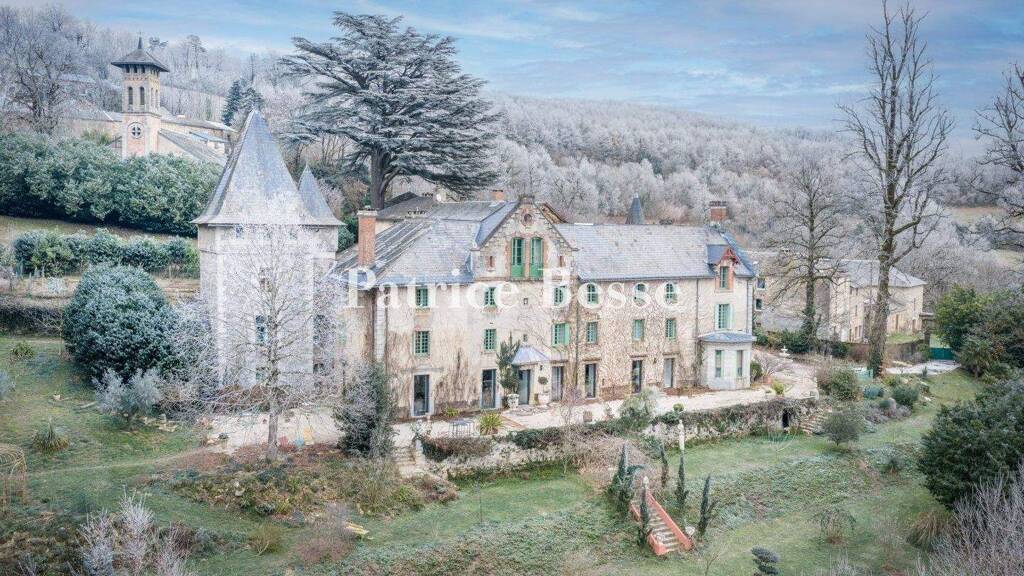
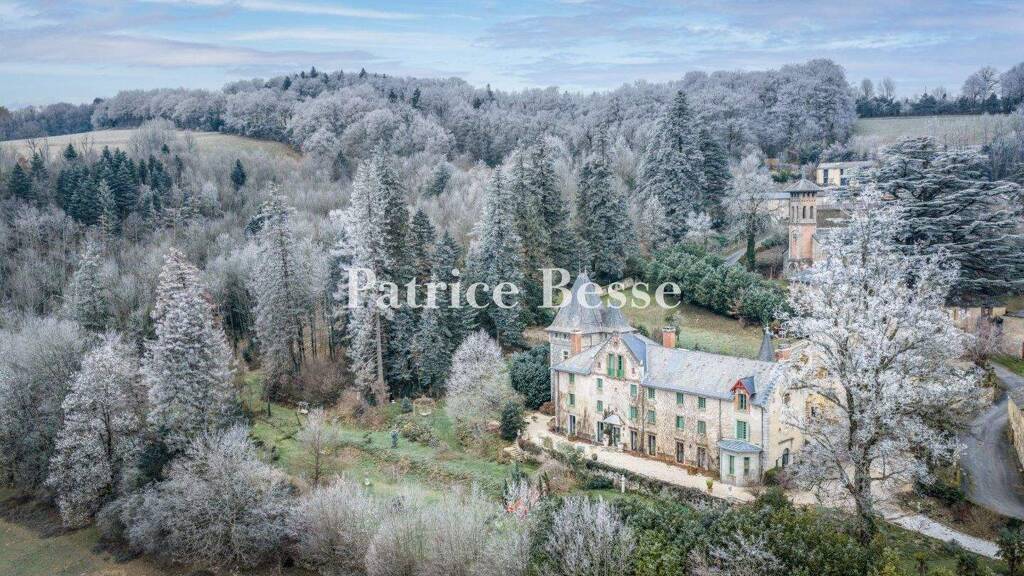
Located in a quiet hamlet, whose architectural makeup has preserved a strong rural character over the years, the chateau was restored in the 19th century over older foundations in order to provide it with its current appearance: that of an eclectic-style chateau, combining many features from the Elizabethan, medieval and Renaissance architectural vocabulary. Perched up in the heights of the valley, the central structure, facing southwest, provides unobstructed views of the countryside, made up of gently rolling hills and swaths of uninterrupted forestland.
In front of the main façade, an immense patio overlooks the terraced gardens planted with a wide variety of vegetation, whereas woods filled with tall trees extend to the west. Spanning approximately 3.7 hectares, the property is accessible via a gate that leads to a back courtyard, with a three-tiered fountain, while an outbuilding closes off the courtyard to the east.
The ChateauAccessible via its northeast exterior, the chateau, organised around a central structure extended by a right-angle wing to the northeast, which creates a narrow entrance courtyard, includes a ground floor, two upper floors and a converted attic level.
As for its main façade, it is organised into eight asymmetrical bays, while its central axis, featuring a large pediment, includes three vertical rows of windows crowned with straight lintels, the attic portion of which boasts low-arched geminated windows, as well as a small bull's-eye window.
In addition, the door located directly below the pediment is decorated with a moulded surround as well as a keystone displaying a coat-of-arms, whereas a second coat-of-arms, more detailed and with the same motto - Fayre Pla Layssa Dire - is located above an entablature. As for the last vertical row of windows, it features a bay window on the ground floor and a single dormer window on the second, while ashlar stone or a combination of brick/stone surround all of the chateau's windows/doors.
To the southeast, its gable end stands out thanks to finely carved ashlar stone highlighting its corners and roof edges, whereas a single bay includes a door surrounded by rusticated stonework, a carved coat-of-arms and an inscription carved into the apron wall of an arched window, the whole topped with a brick chimney, which adds the finishing touches to this eye-catching composition.
Featuring a main entrance with a wide, low-arched contemporary door, which is then topped with 18th-century coat-of-arms, as well as those of the de Carayon family from the 19th century, located between two windows, the chateau also boasts a round tower integrated into the back of the building, three arched windows forming a triptych on the second floor, as well as original plaster-coated rubble stone exteriors, whereas, to the north, a square tower is ...