An 18th-century manor with outbuildings in a 2000-m² enclosed garden in the Finistère area, in the centre of a coastal town, near to the beaches - ref
An 18th-century manor with outbuildings in a 2000-m² enclosed garden in the Finistère area, in the centre of a coastal town, near to the beaches.
This property is located in a small coastal town in the north of the Finistère area and is renowned for its wealth of heritage. It is located 20 minutes from Morlaix and its railway station, from where high-speed TGV trains put Paris within a little over 3 hours' reach. Brest-Guipavas airport, from which domestic and international flights can be taken, is 40 minutes away. Regular ferries to England, Ireland and Spain can be taken from Roscoff, which can be reached in 10 minutes. The beaches, sailing club and marina with anchorages are merely within a few minutes' distance. Primary, junior high and senior high schools as well as shops and services are also all very close.
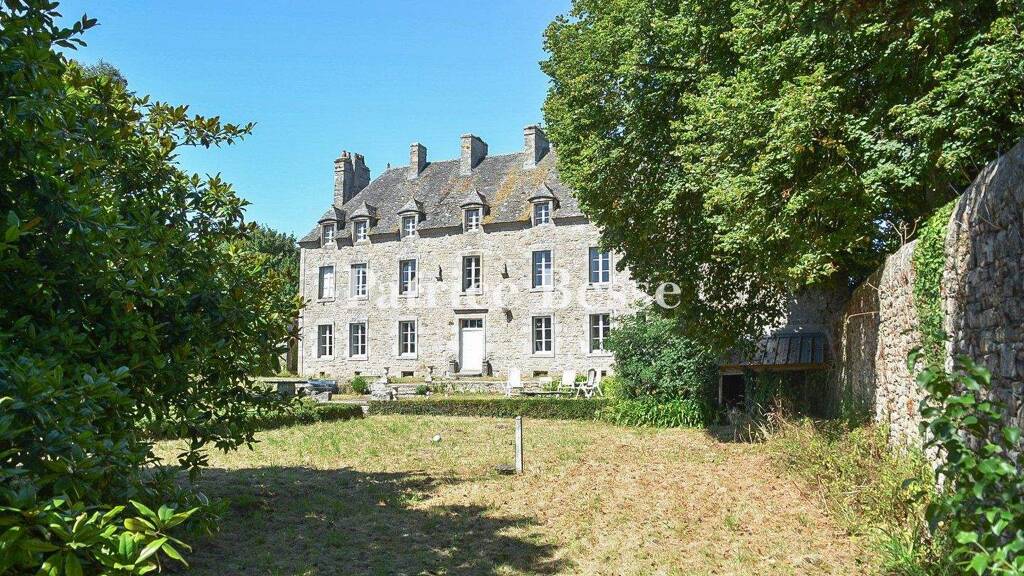
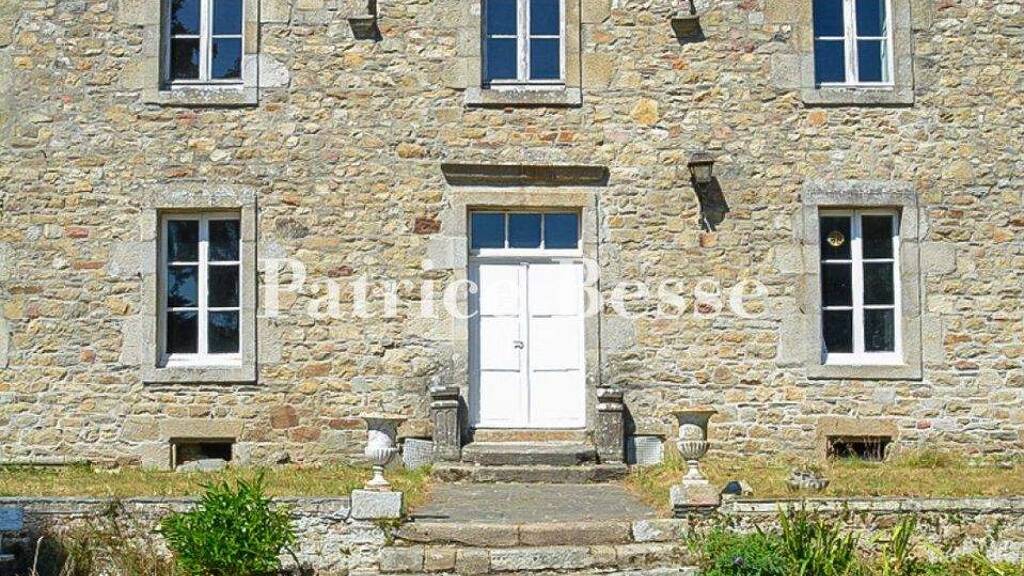
This residence was built around 1728 on the site of an older construction and is one of the municipality's emblematic edifices. Its past is linked to many historical events that have marked the Pays de Léon area. A gate in the high walls opens onto a courtyard, while a pedestrian gate leads through the wall into the garden. In the southern part of the garden, the wall is topped by wrought iron railings. The property is made up of a central residence and perpendicular outbuildings. The main residence is made of rough-hewn blocks of granite with a hipped roof made of slate from the Monts-d'Arrée, topped with tall chimneys and punctuated by seven dormers. The three-storey façade is either rendered or in rough-hewn blocks of granite, dotted with many windows and two doors, one to the north and the second to the south. To the south, several flights of steps lead to a terraced garden. It is partially wooded and embellished with beds of trimmed boxwood. It also boasts a well, is enclosed by high walls and is sheltered from wind as well as prying eyes.
The manor
The ground floor
From the courtyard and garden, two doors open into a large hall which leads, on one side, to a lounge and a dining room, while on the other it leads to a kitchen and large room towards the north wing. The hall plays host to a vast wooden staircase which climbs up to the two upper floors. A double-leaf glazed door marks the separation with the hall. Light streams into the dining room, via a window facing south into the garden, which is entirely wood panelled and boasts wood stripped flooring. The lounge is bathed in light with windows on either side. It possesses wood stripped flooring and the walls are partially wood panelled. On the rear wall, a wooden door opens into to a corridor that leads back to the hall.
The first floor
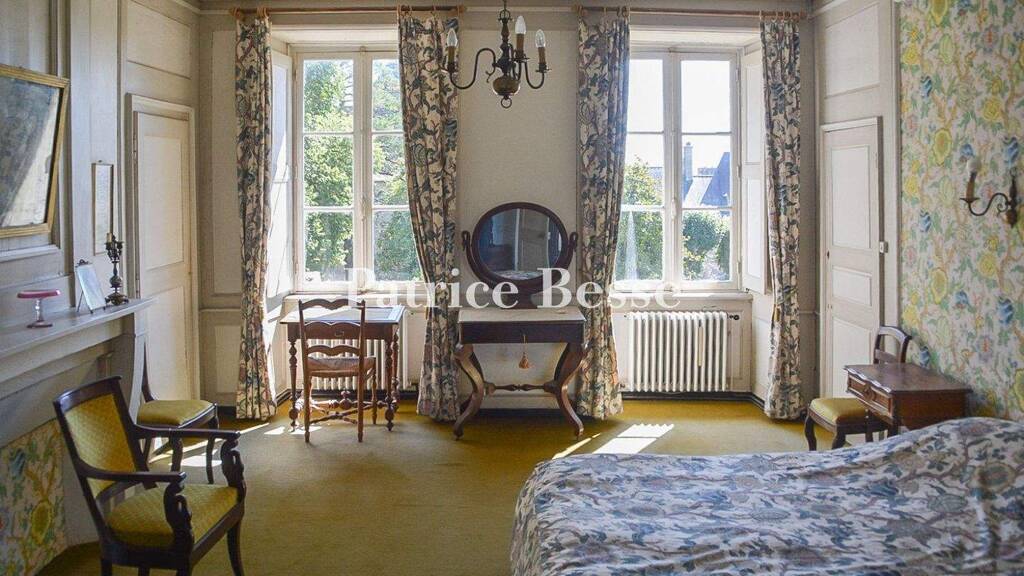
A landing leads to an office in the centre and two bedrooms on one side. A corridor leads to an open-plan kitchen and a bedroom. Next to it, a door opens into the first floor of the north wing, where there is a bathroom. Each room is south-facing and overlooks the garden.
The second floor
This level can be found in the attic space. A corridor leads on one side to two bedrooms and a large loft, while on the other two bedrooms are linked by a corridor, with a shower room at its end. Light streams into the three bedrooms through windows facing south and overlooking the garden. The corridor is bathed in light via skylights. The loft, in which the beams and roof frames are exposed, is in the attic space.
The basement
This level can be reached via a staircase behind a door in the hall. It is divided into four cellars, into which light filters via basement windows. One of them houses a boiler. According to the house's history, an underground passage previously led to the cathedral. Today, this passage is no longer in use.The manor's wingThis wing perpendicular to the main residence and situated to the north ...