A 48-hectare estate with a large house, a pool, a guesthouse and a cluster of buildings to restore, tucked away in woods in France's Périgord area - r
A 48-hectare estate with a large house, a pool, a guesthouse and a cluster of buildings to restore, tucked away in woods in France's Périgord area.
The Périgord Noir area, between the River Dordogne and the River Vézère, is one of the best-kept secrets of south-west France. The property lies near the town of Villefranche-du-Périgord. It is tucked away in the hollows of wooded hills that road maps barely mention. Sarlat-la-Canéda was the medieval capital of France's Périgord area. This large town is only around 30 kilometres away. The city of Périgueux, the administrative centre of France's Dordogne department, is less than an hour away. By car, you can also reach the city of Bordeaux in two hours and the city of Toulouse in two and a half hours. From the train station in the local town of Souillac, 40 minutes away, you can get to central Paris in around three hours by rail. Brive Dordogne Valley airport, 100 kilometres away, offers regular flights to Paris and European cities. You reach the main house via a private drive that runs through the woods.
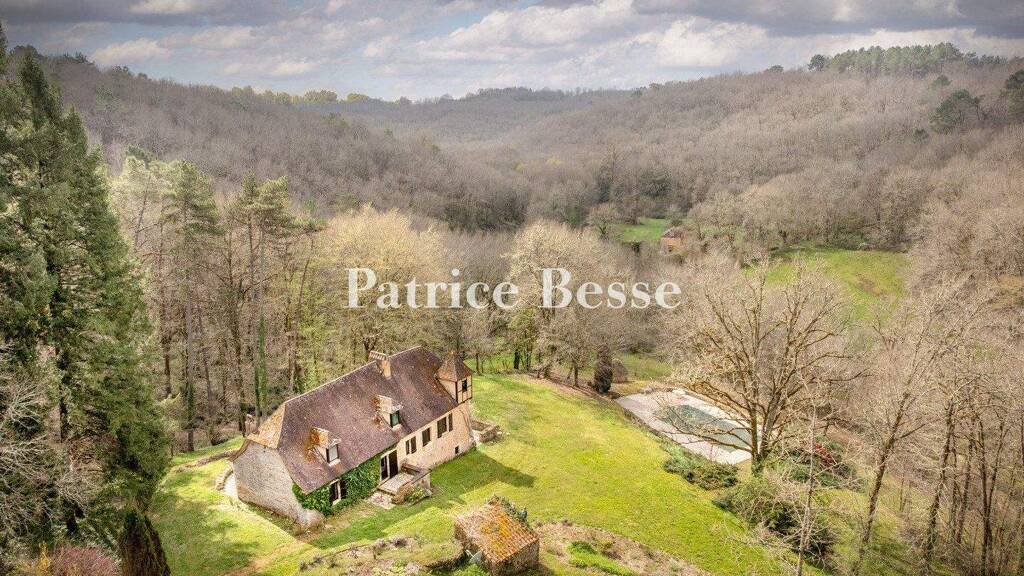
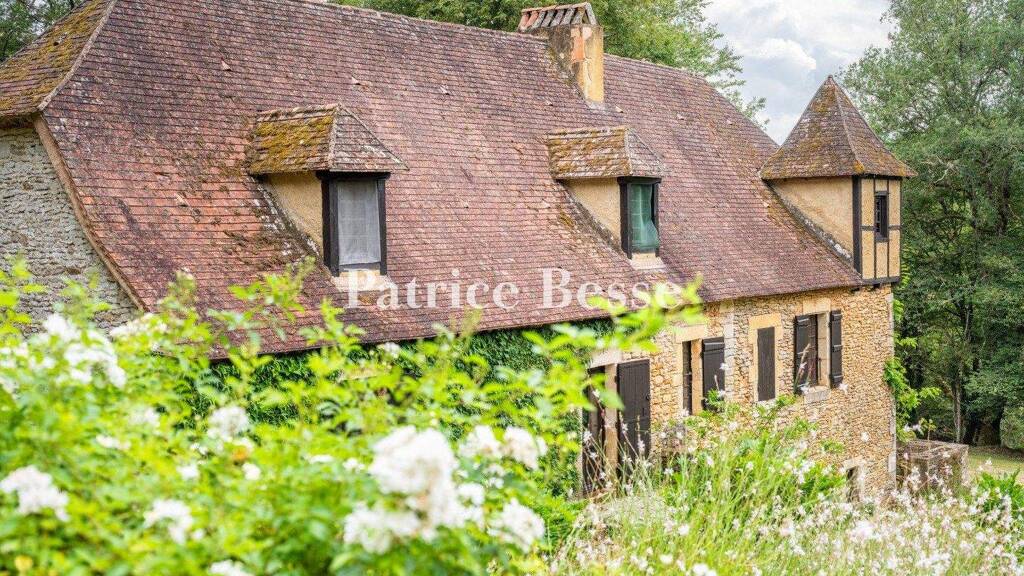
From a bird's-eye view, this property looks like an old map. The most extensive section of its 48 hectares of unbroken land is a forest of oaks and chestnuts. The rest of the estate is made up of natural meadows. A fence designed to protect the homely space from wildlife demarcates a three-hectare plot around the buildings. A private lane lined with vegetation leads to this plot. The traditional design of the main house is typical of the Périgord style. It offers a 220m² floor area, spread out over a garden-level floor, a ground floor and a first floor in the roof space. Its facade of local stone faces south and leads out to a series of stone terraces that follow the slope of the land. The house is crowned with a steeply sloped roof of flat tiles. A square tower with a pyramidal roof recalls grand historical houses. This tower was added to give the house's first owners a higher status. The ground floor has two lounges and a bedroom. The top floor has a bathroom and two bedrooms with sloping attic ceilings. On the garden-level floor, there is a kitchen with a door that leads straight out to a terrace, a little further down from which a swimming pool lies. A heating oil boiler heats up the house. The windows are single-glazed. A flower-dotted garden, which has been well maintained, extends around the buildings. Further down, there is a swimming pool set in a stone terrace. Its technical installations room is housed inside an old dry-stone hut crowned with a roof of stone tiles. Further up on the plot, there is a stone barn with a floor area of around 100m². It has an upstairs level too. This structure only has three elevations. Its fourth side is open, like a viewpoint that draws your gaze out over the surrounding countryside. Higher up, there is a stone guesthouse with a floor area of around 100m². Its interior has been converted like an open-plan apartment. A fireplace stands against one wall. A garage for two vehicles adjoins the house. Its doors face the private lane. On the east side, in the woods, there is a cluster of five stone buildings, arranged around a well. This cluster of buildings represents the other dimension of the property. The cluster is a former farm complex that needs to be renovated entirely. Until relatively recently, the main house in this cluster was still inhabited. However, the barns and outbuildings here have lacked roofs for a long time.
The large houseThe main house has a garden-level floor, a ground floor and a first floor in the roof space. Its shape is well proportioned. Its facade is symmetrical in design. In the middle of it, an entrance door at the top of a flight of steps leads inside. This front door is framed between tall, small-paned windows with wooden shutters. Window surrounds of dressed stone punctuate the ...