A discreet, renovated 13th-century dwelling with six bedrooms, a court, a garden, a pool and a converted storehouse, nestled in a small town 20 minute
A discreet, renovated 13th-century dwelling with six bedrooms, a court, a garden, a pool and a converted storehouse, nestled in a small town 20 minutes from the city of Avignon.
The property lies in the historical centre of a town in France's beautiful Gard department. This town has fewer than 4,000 inhabitants. It offers a wealth of built heritage, including four listed monuments: a chateau, a church, a grand townhouse and, near the property, a former Knights Templar commandery. The well-preserved town also has a remarkable natural backdrop, with a Natura 2000 conservation zone (Costières nîmoises) and two natural zones listed for their ecological, faunistic and floristic interest. The famous winegrowing areas of Lirac and Tavel, with their protected designation of origin accreditations, are nearby too. The Mediterranean Sea is less than 40 minutes away by car. And the high-speed train stations in the local cities of Avignon and Nîmes are less than 25 minutes from the property. Lastly, there are airports in the cites of Nîmes, Montpellier et Marseille, all a short distance from the property.
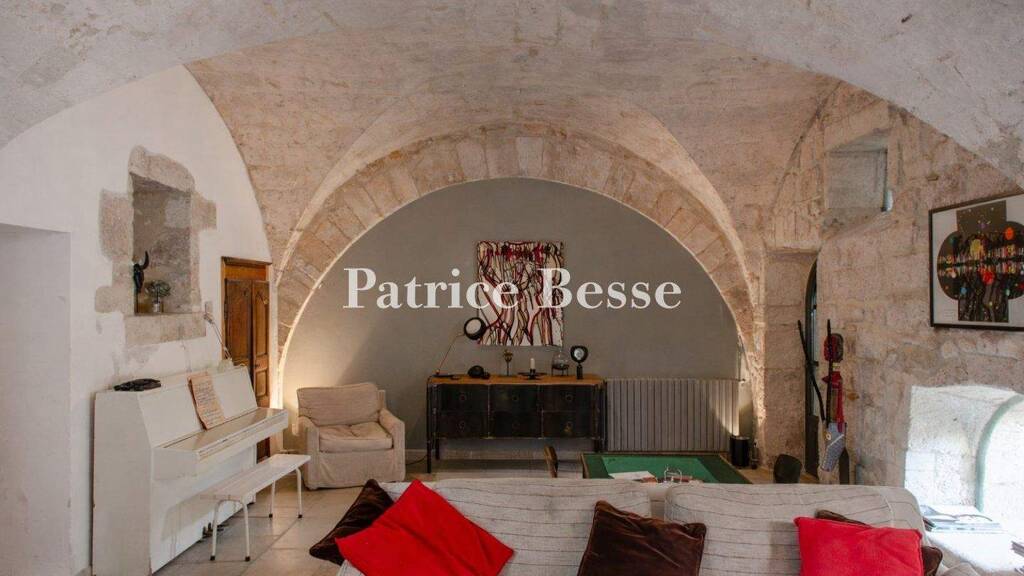
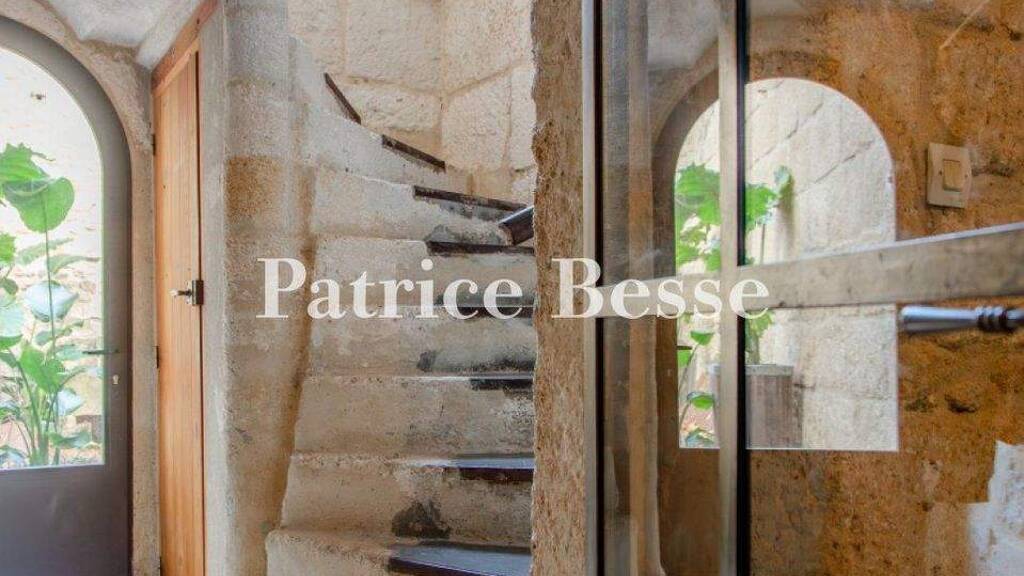
The house stands on an enclosed plot that covers around 500m². You reach it from one of the calmest streets in the town centre. The property has its own garage. There is a main house and, at a right angle to it, a former straw storehouse, with a separate door leading out into the entrance court. Part of this old storehouse was recently transformed into a vast self-contained apartment with two bedrooms. The buildings offer a total floor area of almost 360m². A court on the south side and a garden on the north side frame this enclosed plot, which enjoys absolute privacy. A tall tree stands in the entrance court, which has a cobblestone path of local pebbles. This court provides the perfect buffer between the street and the dwelling. A raised walkway, added later, looks down at the terrace. This raised walkway is edged with a plainly designed wrought-iron balustrade. On the north side, the house leads out into a garden with a discreet swimming pool set in a raised section at the top of broad steps. These broad steps, which recall the terraced seating of an amphitheatre, separate a tree-dotted section from the paved terrace lower down. The house was probably built in the late 13th century or early 14th century, where old outbuildings belonging to the Montfrin Knights Templar commandery once stood. The Templars settled here in 1169 and stayed here until the Order of the Knights Templar was disbanded in 1312. The commandery and its annexes were then transferred to the Order of the Knights Hospitaller. On these remnants, which have escaped history's twists of fate, including possible Saracen forays, a dwelling was built at the end of the 18th century, upon the medieval ground-floor rooms and the tunnel-like vaulted cellar. The property has kept the scale of the Knights Templar structure, as well as many remarkable architectural features, including fragments of stone-mullioned windows, the vaults of the lower rooms and medieval lintel keystones. To ensure comfort and insulation, modern wrought-iron window frames, crafted finely, have tastefully replaced old ones here and there. The windows are fitted with traditional wooden shutters that are painted red, which is a widespread tradition here in France's Languedoc province.
The main houseThe house has been fully restored since 2020 with respect for its rich past and many remarkable historical features. It has a vaulted basement, a ground floor, a first floor and a second floor. It forms an S shape on a plot of around 500m². It is centred upon a main section, which is flanked with two short sections that protrude at a right angle: one on the court side on the south-west side and one on the garden side on the north-east side. It offers a total floor area of around 250m². ...