A barn transformed into a loft with a verdant interior courtyard, 25 minutes to the north of Narbonne, in a village within the greater Aude department
A barn transformed into a loft with a verdant interior courtyard, 25 minutes to the north of Narbonne, in a village within the greater Aude department.
Within the Occitanie region, at the base of the foothills that skirt the northern edge of the Narbonne plain, the dwelling is located in the middle of a village located along the border of the Hérault department, while the Canal du Midi makes a loop to the east of the village, where a port was created for summer holidaymakers' watercraft. Featuring a Mediterranean climate, the village also boasts a remarkable natural heritage made up of two natural zones of faunal and floristic interest.
As for its 2,000 inhabitants, they enjoy several local shops and a green market every Saturday, the stalls of which are shaded by the plane trees of its Promenade, whereas Narbonne, Béziers, Carcassonne, Montpellier and Toulouse are located 20, 25, 50, 100 and 140 kilometres away, respectively, and are accessible via the A9 and A61 motorways, high-speed rail stations as well as international airports in all of the aforementioned cities except for Narbonne.
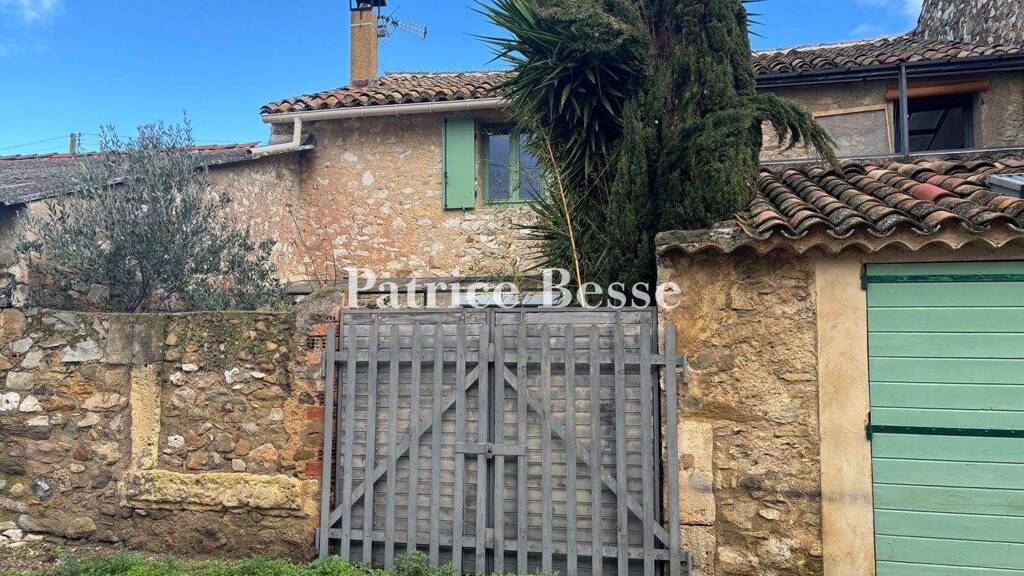
From the street, the only visible part of this former agricultural building, constructed in the 19th century, and recently renovated by an architect, is its rounded barn door, surrounded by ashlar stone, which was preserved and is today used as the main entrance, concealing the dwelling's interior from view.
Topped with a rectangular, metal-framed picture window, which contrasts with the historical details of its understated façade, built out of pointed rubble stone and facing east, this door is not the dwelling's only entrance: behind the house, on a no-through road, a wood slatted gate provides direct access to the verdant courtyard, of approximately 40 m².
To the right of this gate is a garage, whose roof has been turned into a terrace overlooking the patio, while the two-storey dwelling, of approximately 210 m², features a barrel tile roof cadenced in several places by skylights, which provide plenty of natural light for its interior.
The Dwelling
The ground floor
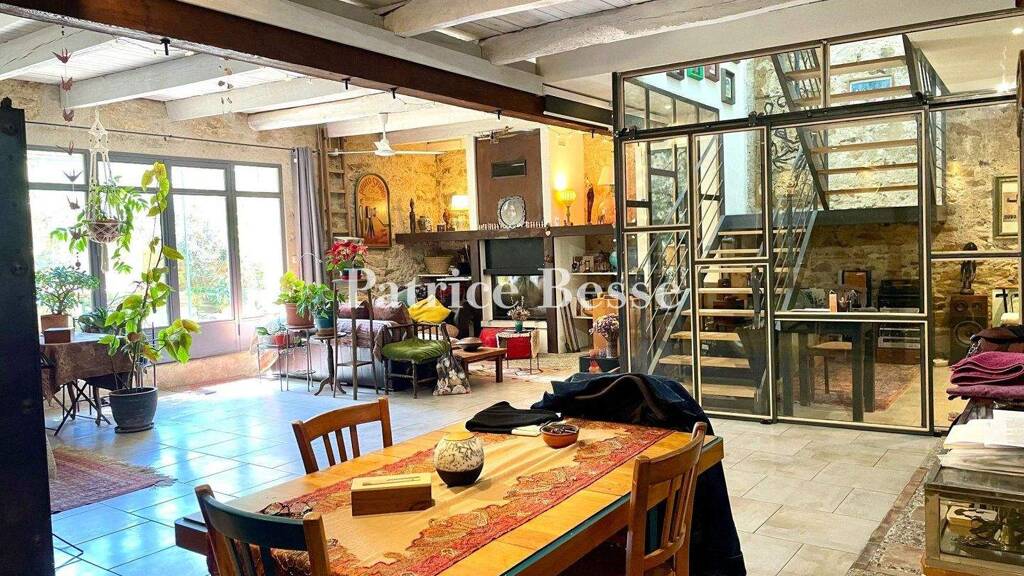
A painted wooden door, integrated within the larger barn door, opens on to a covered patio, which has been turned into a glassed-enclosed entryway, providing views of the main room's interior. Designed like a loft, and divided up into different areas thanks to metal-framed atelier windows, the ground floor features a sizeable living space with off-white flagstones, which includes, on the left, a dining area and an open kitchen, from where a door provides access to the garage giving on to the rear no-through road, while a lavatory and a room used as a storeroom and utility room, both with white floor tiles, are located in a corner to the left of the entryway.
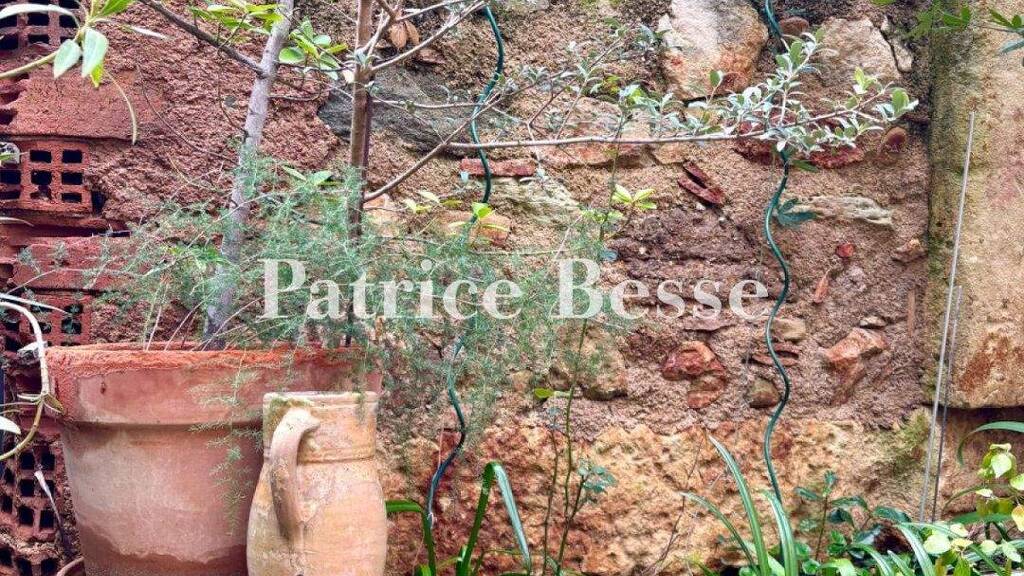
Directly opposite and to the right of the entrance, a living room features a closed fireplace and a large metal-frame picture window, looking out on to the terracotta and calade stone courtyard, the latter of which, reasonable in size, is ideal for summer al-fresco meals under the shade of its Mediterranean trees and shrubs, such as an olive, a cypress, a yucca as well as climbing bougainvillea festooning its exterior.
Next to the entrance on the right, a study is bathed in sunlight thanks to a glass wall, which gives on to the entryway, whereas its visible ceiling beams, some of which are whitewashed, pointed stone walls and off-white flagstones add to this room's overall semi-industrial look.
Lastly, to the right of the entrance, the stairwell, completely surrounded by glass and steel, provide access to the upstairs via a floating metal staircase with wooden steps.
The upstairs
The staircase leads to a landing with a high skylight, which provides access, on the left, to two sunny bedrooms, one of which has its own wardrobe, with similar skylights and an atelier window overlooking the ...