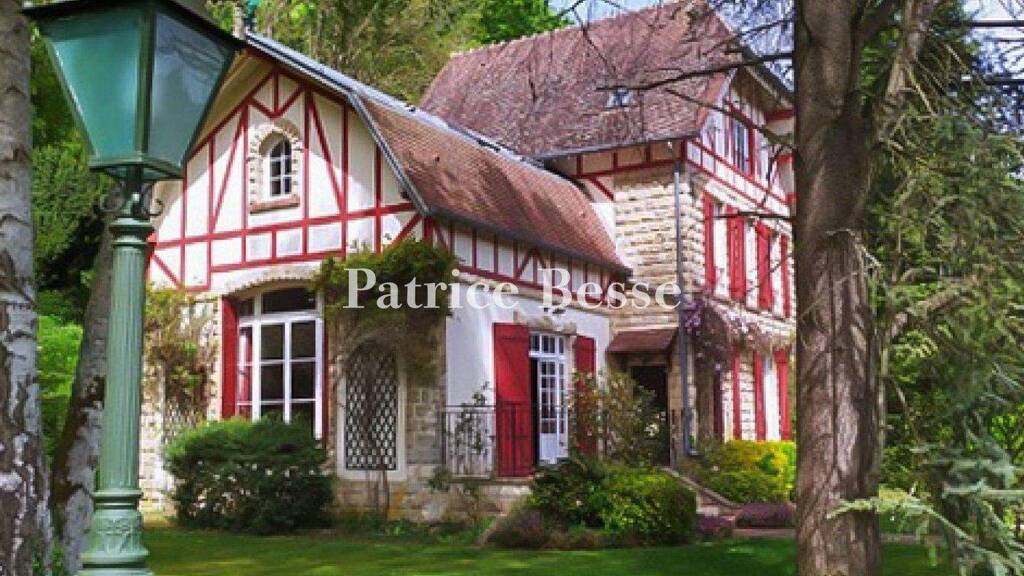
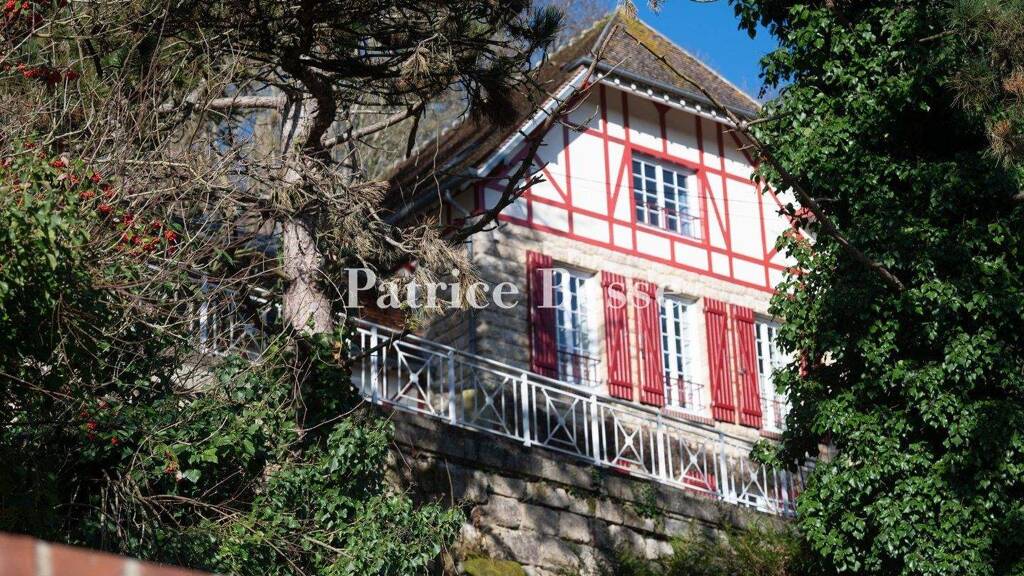
A grand neo-Norman house with absolute privacy in a calm, bucolic backdrop, between the towns of L'Isle-Adam and Auvers-sur-Oise, just north of Paris
A grand neo-Norman house with absolute privacy in a calm, bucolic backdrop, between the towns of L'Isle-Adam and Auvers-sur-Oise, just north of Paris.
The home lies in France's Vexin province in the River Oise valley, between L'Isle-Adam and Auvers-sur-Oise in a region known for built heritage. Its calm residential area is near the historical sites of France's Val-d'Oise department. Paths run through the woods. You can practise water sports on the river and stroll along its banks. Paris is around 30 kilometres away. You can get there via a motorway. Trains get you to central Paris in 45 minutes. The local station is a 10-minute walk away, so you can get around the region via public transport. Shops, amenities and schools - a primary school in the town and secondary schools nearby - form a convenient area and add to the quality of life here. The local towns of Auvers-sur-Oise, tied to impressionism, and L'Isle-Adam, known for its vibrancy and holiday charm, underline the appeal of this part of the Vexin province.
Beside the road, an enclosing stone wall edges the plot. A gate, framed between two pillars crowned with decorative features, leads onto the main driveway. Immediately next to this spot, there is a garage in which two vehicles can be parked. A first flight of steps leads up to an intermediate terrace with an old-style greenhouse. Then a second flight of steps leads up to the house, which stands in a commanding position yet is set back in absolute privacy. The grand house was built in 1905 as part of a trend of neo-Norman-style dwellings that appeared in the River Oise valley at the start of the 20th century when holiday homes first emerged. Its architecture combines timber framing with stonework and steep roof slopes. The roof is crowned at one end with a finial in the form of a dragon. The facade and soffits were recently renovated. The house offers a 220m² floor area and stands on a tree-dotted plot that covers around 8,000m² and is embellished with different shrubs. This plot is terraced and follows the natural slope of the land. A lawn that covers around 1,000m², in front of the house, forms a viewpoint that faces the valley. Indeed, the clear vista that you can admire here, in absolute privacy, is one of the property's major assets. In the upper section, an excavated stone cave, integrated into the garden, is used as a wine cellar.
The ground floorSteps lead up to a front terrace beside the lounge. Here you step through the entrance door. The hall connects to all the rooms and to a lavatory. A door here leads down to the cellar. Stairs lead up to the first floor. On one side, there is a high-ceilinged lounge with exposed beams. Its pale stone flooring has a patina of time. The lounge has large windows that face the garden. There are bookshelves and a fireplace. The fireplace's hearth of brick is set in a wood-panelled mantel with a broad, plain timber shelf. This design recalls the interwar style. The bookshelves frame the fireplace, forming a continuous wall of storage, designed as a feature of interior architecture. Beyond the entrance hall, a dining room connects to a kitchen. A partition separates the two spaces and could be opened up, depending on the use you seek here. The kitchen leads straight outside.The upper floorsThis level has wood floors. The stairs lead to a bright landing, extended with a second landing leading to two bedrooms, a bathroom and an office. Steps lead to a corridor connecting to a second bathroom and a bedroom with sloping ceilings. A door opposite leads to stairs to the top floor. Each room has a plain fireplace with a stone or marble mantel - an early-20th-century style. One room has kept remarkable historical features, with wood panels with mouldings, decorative painted panels ...