A former 19th-century food-producing estate turned into a vast family home, with enclosed, wooded grounds, truffle and olive groves and a swimming poo
A former 19th-century food-producing estate turned into a vast family home, with enclosed, wooded grounds, truffle and olive groves and a swimming pool in Uzès.
In the Provencal Gard, at the foot of the ducal city of Uzès, close to the National Stud and its famous Driving School. In a highly sought-after region renowned worldwide for its architectural treasures, historical and prehistoric heritage, and top-quality gastronomy with wine, olive and truffle production. The town of Uzès has many shops, as well as a famous market that has been held on the Place aux Herbes for 800 years. Specializing in confectionery, Uzès is also the birthplace of liquorice production, with a famous multinational sweet company based here. 5 minutes from the Duchy of Uzès, 30 minutes from Nîmes TGV station, 45 minutes from Avignon TGV station, 80 minutes from Montpellier International airport and 30 minutes from the A9 motorway.
A typical example of a farmhouse from the end of the 18th century, probably built under the Directoire or First Empire period, and whose owners very quickly decided that it absolutely had to be much more than just a farmhouse. Throughout the 19th century, alterations were carried out until the main buildings became a noble-looking architectural ensemble, just a few strides away from the National Stud. In the 20th century, transformations and extensions continued to make it more adapted to family life, resulting in a group of several outbuildings, all of which complemented each other intelligently. Today, the estate, which includes a truffle and olive grove, is home to a vast, aristocratic-style family home, "La Roseraie", which has been converted into a comfortable holiday home with bedrooms and suites, and outbuildings that can all be lived in. A boxwood labyrinth, a common feature of 19th-century Provencal gardens, once greeted visitors in the south garden before being razed by a previous owner. It is now ready for a new lease of life. The farmhouse has also preserved a "pouzarenque", a fully restored bucket wheel, a rare sight in Uzège, where these waterwheels have disappeared with the motorization of water pumps. The original entrance, which opened directly onto the grounds from the road leading to the national stud farm, was completely enclosed by dry stone walls, but has been replaced by a new gate and a slightly more northerly entrance to free up the grounds. The entrance is now a driveway lined with olive trees.
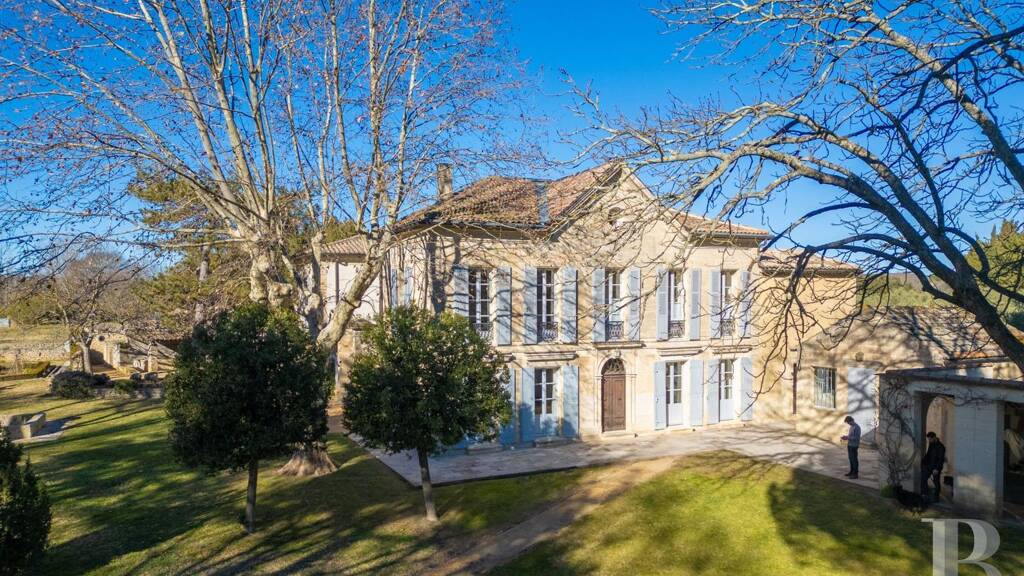
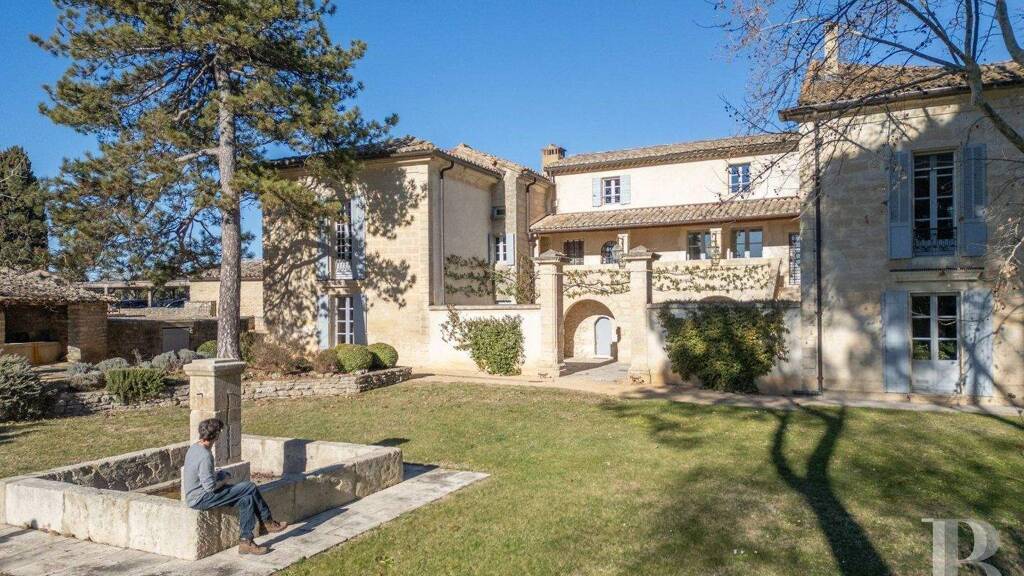
La RoseraieAccessible via the east terrace, the noble facade is in limestone from the Uzès quarries. It features a pediment décor with a triumphal crown, very characteristic of the antique modenations in vogue during the Directoire and Empire periods. The pyramid-shaped crown that gives this residence its noble status is reinforced by other facade modillions with arabesque, flower and fruit motifs, set into each lintel. This noble, single-storey facade is linked to the terrace by a wooden entrance door with a fanlight transom. It has a resolutely classical balance, with four symmetrically placed French windows on either side of the front door, each with a wooden storm shutters. Upstairs, five tall windows with wrought-iron railings are also flanked by louvered shutters. To the south, the house has a very different "U"-shaped structure, flanking the central body with two wings set at right-angles, each a storey high, forming a semi-open courtyard. The central body itself is enhanced by an attic floor, which softens the facade. Finally, an external gallery on the upper storey facade, accessed via an external side staircase, links the two wings, evoking certain Renaissance structures. The ancient Roman-tiled roof features a slightly curved soffit, rather than a genoise roof. The south-facing courtyard opens onto a meadow featuring a square pool with a central fountain in the same ...