A villa designed by André Stern in the 6th arrondissement of Marseille, opposite Notre-Dame-de-la-Garde, with a panoramic view of the city and its bay
A villa designed by André Stern in the 6th arrondissement of Marseille, opposite Notre-Dame-de-la-Garde, with a panoramic view of the city and its bay.
Overlooking the entire city of Marseille and separated from the Bonne Mère basilica by the Trouée de Vauban, the villa is located in the western part of the city, on the border of the 6th and 7th arrondissements, on a beautifully calm street. The property is just a few minutes' walk from the first shops and renowned schools, and a further five minutes' walk from the Old Port and the lively city centre.
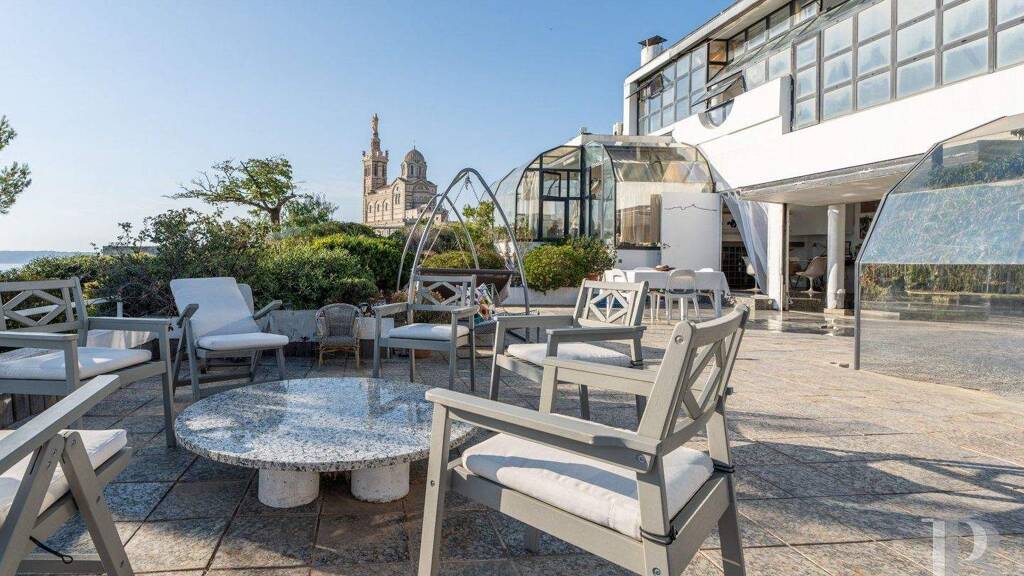
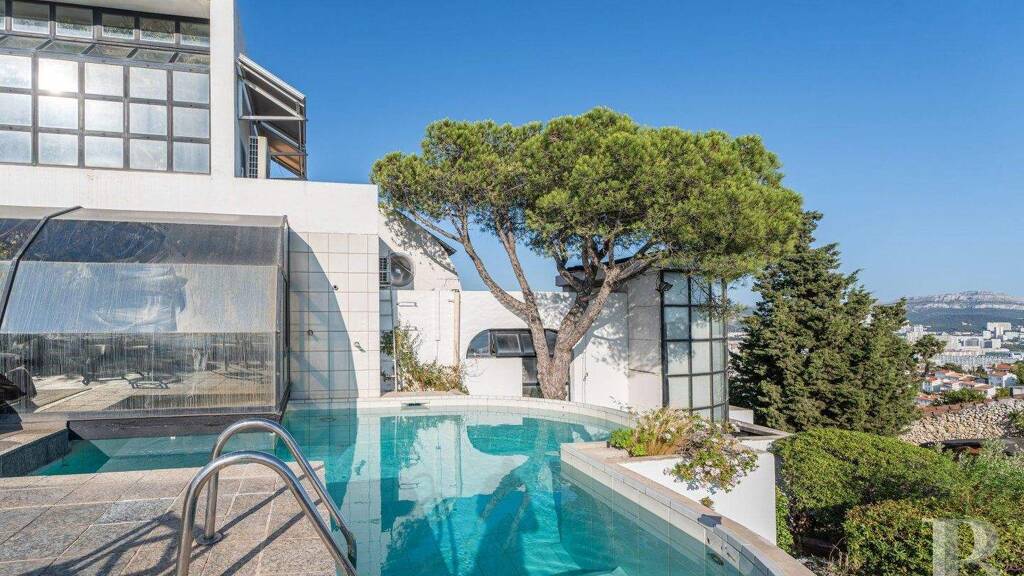
Situated on a rocky headland, the villa that its designer and first occupant christened "The Eagle's Nest" certainly lives up to its name, taken from the name of the vegetable garden which it was built on. After climbing the steps of a typical Marseille street, once you have gone through the front door, a flight of brick steps framed by exotic vegetation such as a Japanese pagoda tree, cycas and ice plants runs along the rear facade and leads to the house entrance, which looks almost suspended above a limestone fault. The tone is set before you enter the vast premises: a huge patio door gives you a view of the character and architectural style of the curved building. More than 400 m² of living space has been designed to fit in with the landscape and environment, with a vast terrace and terraced garden that look out over the Mediterranean Sea. The architect, town planner and scenographer André Stern, a disciple of Le Corbusier, had this unusual house built for his family between 1984 and 1987, based on a 16th century Indian mandala design. The building's architecture is unique, both in terms of its appearance and the materials used. It has an inverted half-shell roof with glulam beams, large round windows, a concrete and aerated concrete structure, geometric features repeated in rhythm, and even reflected in the shape of the swimming pool.
The villa
The ground floor
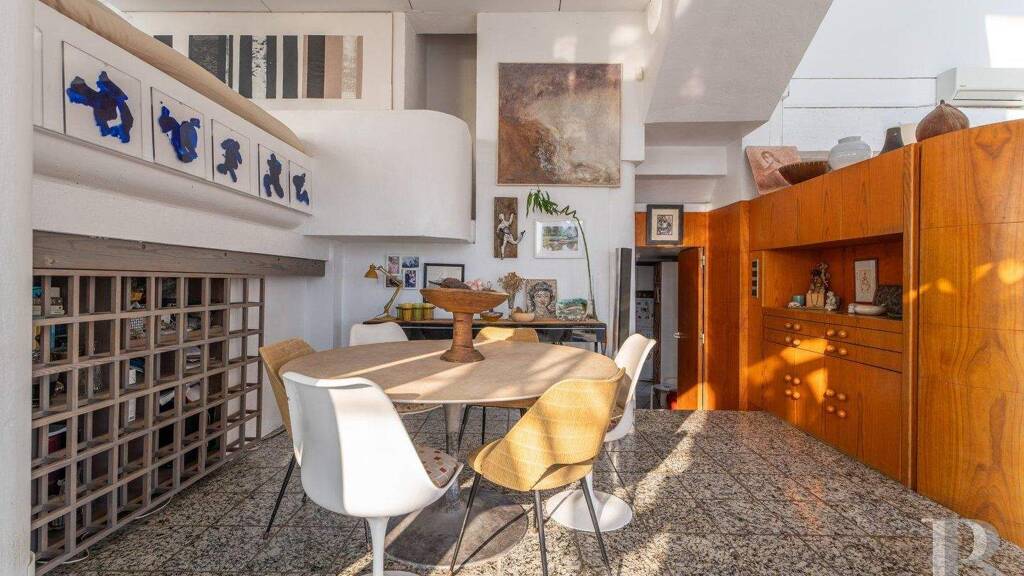
The black entrance door opens onto the house's central room: a large cathedral-like hall which extends on the right into a dining room and a conservatory. Light floods in through the patio doors and a section of wall that opens entirely out onto the terrace, thanks to an ingenious electrical system. The floor is granite, and concrete beams sculpt the space with their arches and columns. Slightly off-centre on the east side, there is a striking metal staircase. This is the real backbone of the villa. Both monumental and soaring, it "participates vertically in the light, which can pass through it in such a way that there are no areas where the light doesn't penetrate", said André Stern. A ficus which was planted there over 20 years before, directly in the ground, accompanies the upward movement of the stairwell from the lower floor to the upper floor. Like an indoor lake, the pool flows into the house right up to the foot of the metal steps. From the central room, past the dining room, a few steps lead up to the west-facing conservatory, whose cross-shaped floor plan is centred around a square, open fireplace. Rounded patio doors open out onto the sea and "La Bonne Mere", which can be seen here in a completely unique light, in a perfect balance between land and sky. A kitchen and utility room are accessed from the dining room by going down a few steps, giving the impression that you are descending into a ship's cabin. The worktop echoes the granite on the floor, combined with wood, like the framework and the large bespoke cabinet in the dining room. From the kitchen, a French window opens onto a tiled terrace covered by an arbour, sheltered by a Virginia creeper that provides pleasant shade in the heat of summer. Finally, on the east side, the living-dining room leads onto a study, which overlooks a large library which is currently used as a yoga room. A large porthole provides an ...