A part-listed Renaissance chateau remodelled over time, with eight hectares of tree-dotted grounds by the city of Moulins in France's Allier departmen
A part-listed Renaissance chateau remodelled over time, with eight hectares of tree-dotted grounds by the city of Moulins in France's Allier department.
The city of Moulins has 65,000 inhabitants and is the administrative centre of France's Allier department. It offers all types of shops and amenities and includes a hospital and train station. Indeed, you can live very comfortably here for your day-to-day needs. From easy-to-reach slip roads onto the N7 trunk road and A79 motorway, you can get to the Paris region in 3 hours, Geneva in 3 hours and 20 minutes, and Lyon in 2 hours and 30 minutes by car. The historical Bourbonnais province, where the property lies, has a rich past. It evokes the lineage of the Dukes of Bourbon - a line of descent from which kings of France from Henry IV to Charles X came.
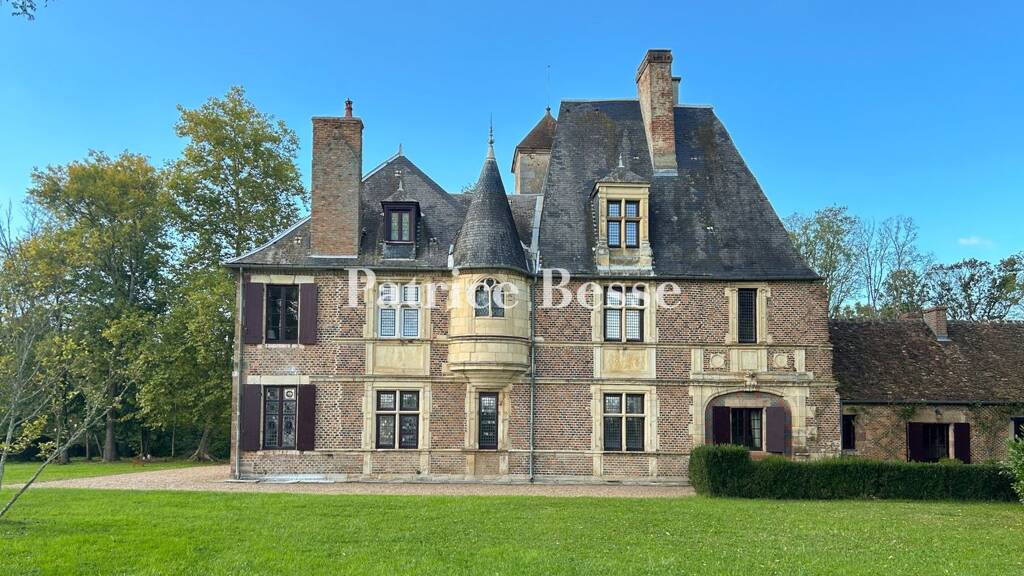
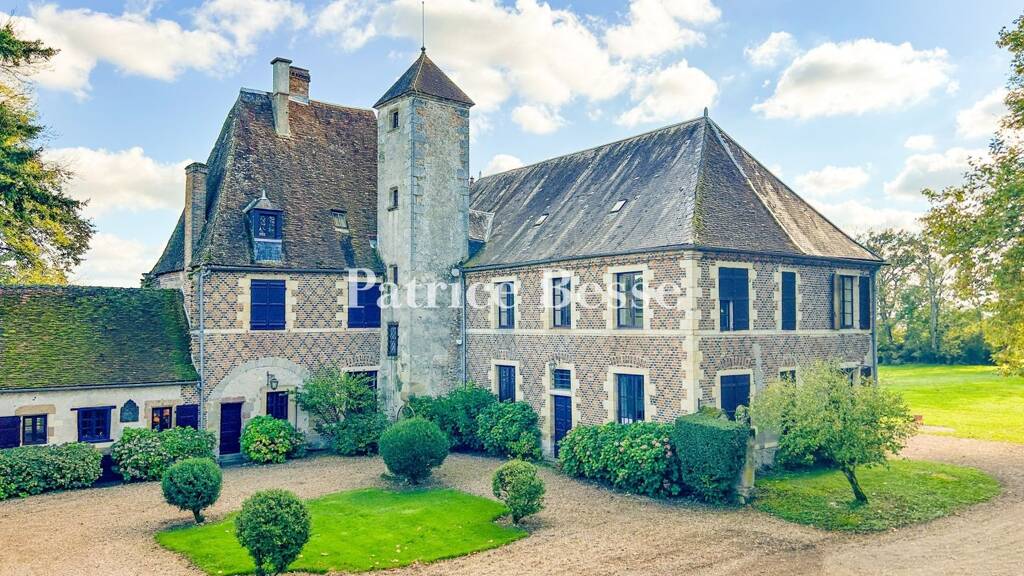
The chateau stands in the heart of vast, tree-dotted grounds that cover over eight hectares. This estate is set back from the city of Moulins and is surrounded by meadows. A country lane takes you to the property. A wrought-iron gate framed between two stone pillars leads onto a long driveway that runs through the grounds. The majestic shape of the chateau then comes into view. The edifice is made up of two wings that form an L shape. It looks out southwards at the grounds and northwards at a gravel courtyard edged with brick outbuildings.
The chateauThe chateau displays an eclectic range of successive construction periods, from the 15th century to the 19th century. Yet the whole edifice has kept perfect harmony. Back in the 15th century, the Petitdé family - lords of the estate and financiers for John II Duke of Bourbon - ordered construction of the original dwelling here, as well as a tall tower housing a spiral staircase. Then, in the early 16th century, during the French Renaissance, the facade was embellished with fine floral ornamentation of pale beige limestone, as well as a corbelled turret. The stone-mullioned windows and medallions - representing King Francis I of France and the Constable of France - were crafted during the French Revolution. A classical-style wing was later added, probably in the 18th century, at a right angle on the south-west corner. And during the 19th century, the whole edifice was remodelled and decorated. On the east side, a wing that is lower in height houses storerooms and technical installations rooms. Cellars lie beneath parts of the building, which has a ground floor, a first floor and a second floor in the roof space. The elevations display lattice-patterned brickwork of different colours. The roofs are covered with flat tiles and slate tiles. Some of the roofing needs to be renovated.
The ground floor
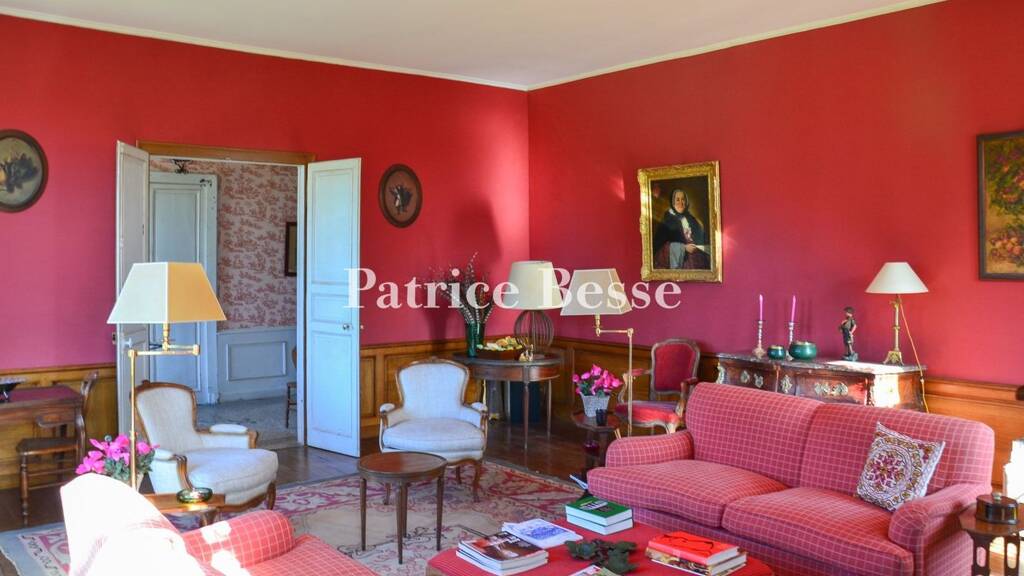
Four different entrance doors lead into the house, where two hallways - one in each wing - connect to all the rooms, which look out at the grounds eastwards, southwards and westwards. Most of the windows have been given double glazing and oak window frames with old wrought-iron Cremona bolts. From the courtyard, you step into a spacious hallway with a mosaic-patterned tiled floor, wooden dado panelling and exposed ceiling beams. This hall connects to the reception rooms. There is a large, renovated lounge with a 40m² floor area, red tones, wooden dado panelling, oak strip flooring, a wooden fireplace with glazed tiles, and stained-glass windows, which include a representation of Anne of Brittany - Duchess of Brittany and Queen of France - who stayed in the chateau in 1495. A hallway with a mosaic-patterned tiled floor looks out at the grounds and leads to the dining room, which has oak strip flooring, an oak fireplace and a French-style beamed ceiling. A spacious bedroom with a stone fireplace and French-style beamed ceiling and a bathroom with a lavatory complete this wing. In the original section, a corridor connects to a lounge with a Louis XVI ...