A 19th century farmhouse and its outbuildings in parkland of more than 4 hectares between Toulouse and Montauban, on the banks of the Tarn, in the Occ
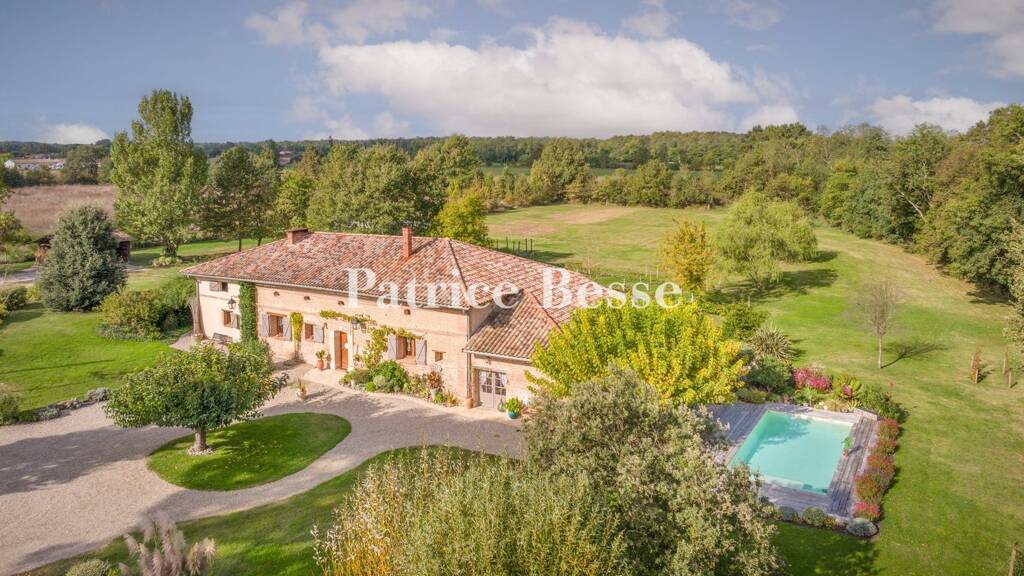
A 19th century farmhouse and its outbuildings in parkland of more than 4 hectares between Toulouse and Montauban, on the banks of the Tarn, in the Occitanie region.
In the heart of the Tarn-et-Garonne region, just a stone's throw from Montauban and Toulouse, the farmhouse is set in a commune bordered by the Tarn and crossed by several streams, in undulating countryside with a mix of farmland, copses and grasslands. The peaceful atmosphere and mild climate offer a privileged, authentic living environment, as do the traditional buildings, which consist of mud brick and terracotta brick houses. All essential services, shops and amenities are nearby. The village of Fronton is 5 minutes away by car, Bressols, on the future Bordeaux / Toulouse TGV train line, is 12 minutes away, Montauban is 15 minutes and Toulouse 40 minutes away.
Accessed via a driveway that leads to its entrance gate, the property is set in landscaped parkland planted with trees, grasslands, shrubbery and flower beds, as well as a spring that flows down to the banks of the River Tarn. At the end of a wide, curved gravelled driveway, behind a wooded area, the façade of the farm's main building is revealed. It is made up of three single-storey buildings: a shed housing a vast garage, a dovecote and the main dwelling. The date when the farmhouse was built is engraved on an attic wall: 1854. The buildings are traditional constructions, made with bricks, wood and canal tiles, with two- or four-sloped roofs; the decor is subdued and the windows are straight or with low arches. A complete renovation of the buildings has been carried out according to the rules of the trade: particular attention has been paid to preserving and enhancing the old features, using noble, environmentally-friendly materials and modern equipment and technologies such as salt water treatment for the swimming pool and double-glazing for the windows. The various buildings are linked by the gravel path, which also leads to the swimming pool. Opposite them, an oak forest leads to the spring and pond in the parkland.
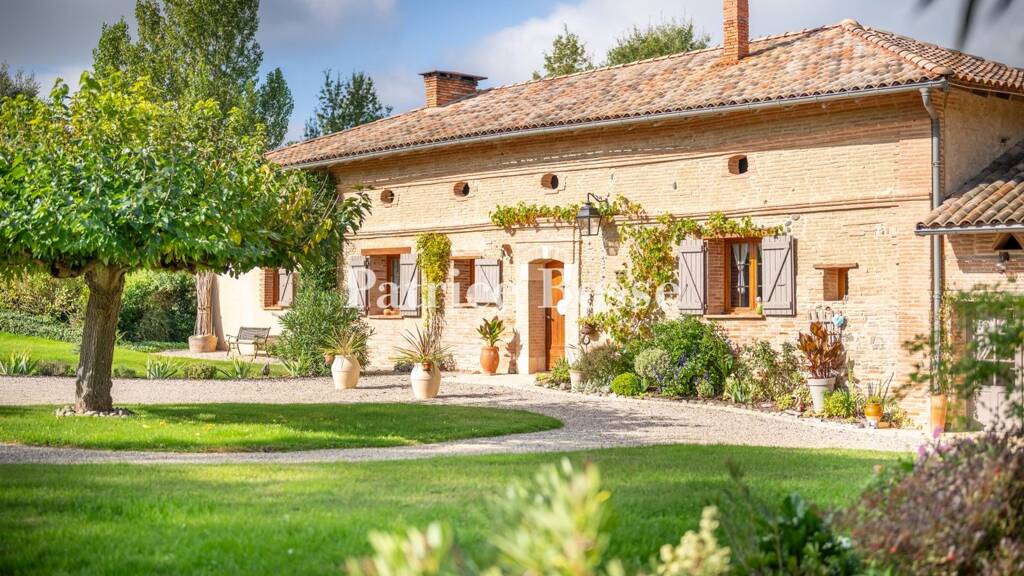
The main houseThe farm's façade is revealed at the end of a wide, curved, gravelled driveway, behind wooded areas. The house, which has been jointed by hand, features warmly-coloured exposed brickwork and a roof with matching tiles. The windows and doors are topped with brick lintels and the grey-painted wooden shutters blend in harmoniously. Small round oculi, designed to ventilate the attic, emphasise the horizontal features of the façade with their regular alignment, adding an aesthetic note to the building. The overall effect is warm and rustic, enhanced by the light-coloured gravel in front of the house and the shrubs and ornamental plants that embellish the façade.
The garden-level floor
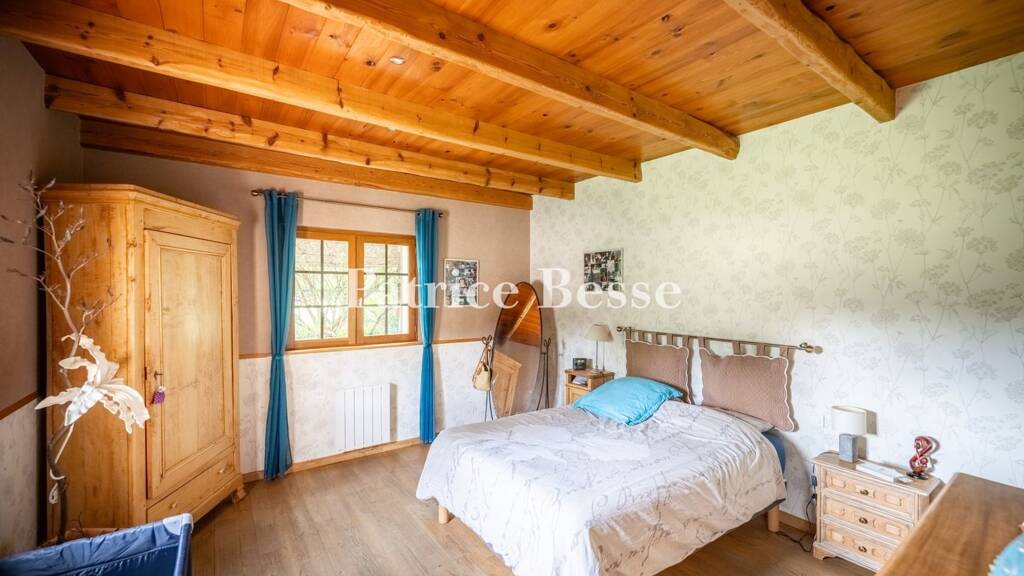
Directly in the centre of the façade, the wooden entrance door is offset by an exposed brick frame and dressed stone at the base of the arch. The lintel, also in brick, forms a slightly raised arch underlined by a stone keystone. Once through the door, the hallway, with its square tiled floor, houses the half-turn wooden staircase leading to the attic. On either side, arched openings lead to the adjoining rooms and ensure fluid circulation. The living room is to the left of the entrance hall, with a brick fireplace and a thick wooden mantle. The floor is covered in terracotta tiles, with wide poplar beams running across the ceiling. Off the living room, two doors lead to the two main bedrooms, and a corridor leads to a shower room, a toilet and a third sleeping area. On the right, the entrance hall leads to the large kitchen where wood, stone and brick combine. Oak beams support the terracotta bricks on the ceiling. The double combustion cooker heats a large part of the house. A brick archway links the kitchen to an office area and a storeroom. A glass door ...