An imposing 16th century manor house with listed as a historic monument and outbuildings in the middle of almost 24 hectares of rolling countryside, 5
An imposing 16th century manor house with listed as a historic monument and outbuildings in the middle of almost 24 hectares of rolling countryside, 5 km from Lisieux.
In a region renowned for its architecture and emblematic landscapes, the property is situated 200 km from Paris on the A13 and 30 km from the towns of the Côte Fleurie. The property is 5 km from Lisieux, the sub-prefecture of Calvados, and its railway station, which provides a 1-hour 45-minute journey to Paris. The monument stands in the broad valley of the Touques.
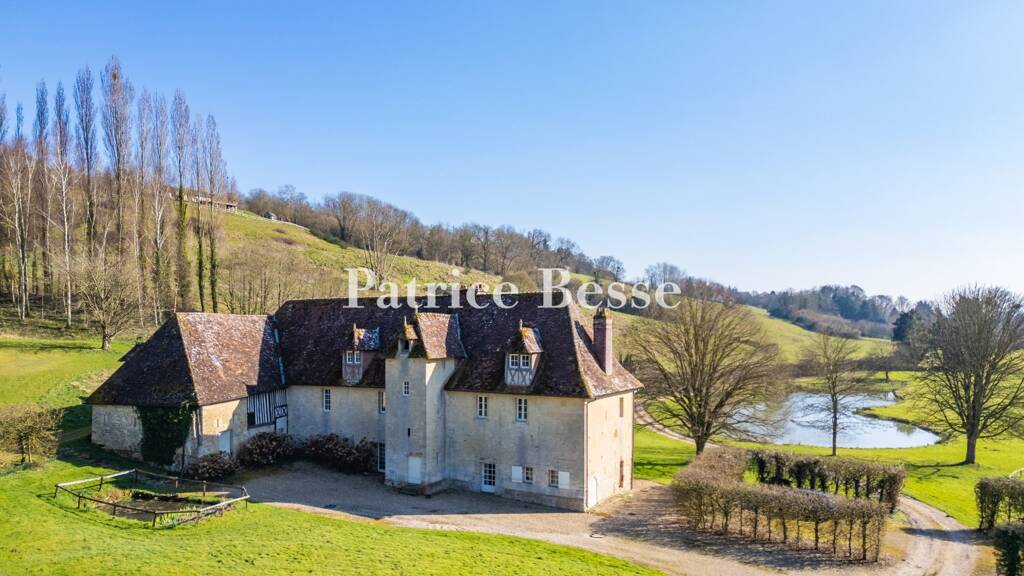
Situated at the end of a cul-de-sac, the property is accessed via a wooden gate. A hillside path leads to the buildings. The manor house appears in the foreground. The outbuildings: guest house, two 18th and 19th century barns and a stable, are to the rear. Opposite, on the hillside, there is a bread oven, followed by the swimming pool and pool house. There are pastures and a pond to the front. There are more pastures and bridleways to the rear.
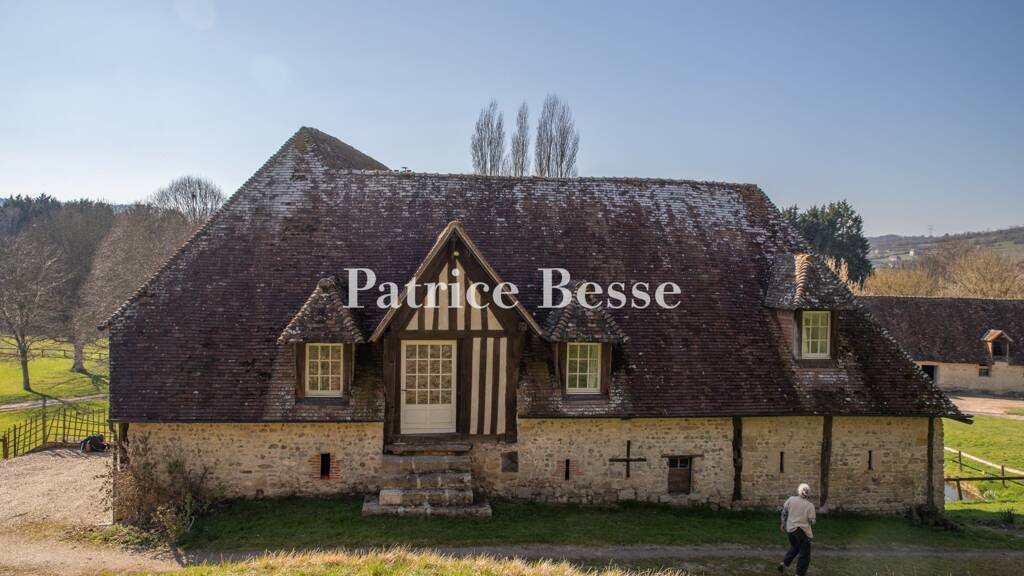
The manor houseBuilt in the early 16th century, it was one of the manor houses of the bishops of Lisieux and was once owned by President Sadi Carnot. Built entirely of ashlar in a simple rectangular shape, it has two stories topped by attic space and has preserved a number of period features. Its high walls are covered by a large flat tile roof. Two half-timbered dormer windows with overhanging hips frame the top of the tower and its watchtower chamber, which was once used to keep watch over the lower Touques valley. Their spandrels form a double Saint Andrew's cross and their hoardings are made of lime and tiles. The stone façades are pierced with varying sized windows, reflecting the different eras. Some of the windows on the first floor have retained their stone mouldings and are typical of the Renaissance period. The main building is extended by a perpendicular wing housing the wine press. The walls contain a number of loopholes, a reminder of the need for defence in an uncertain era. Access to the apple loft was facilitated by the slope of the land and was almost on a level at the rear of the manor house. This manor house is made up of two separate, self-contained living areas, one on each level.
The ground floor
Access is via the staircase tower, glass doors in the reception rooms and from one of the bedrooms. It has a French-style ceiling with long beams and exposed joists, floors of square terracotta tiles or straight oak floorboards. The lounge and dining room are separated by two monumental ashlar fireplaces. The dining room leads to a bedroom with a large stone fireplace and bathroom with toilet, and the kitchen. A flight of stone steps leads up to the spiral staircase in the tower. From the living room, one door opens into a bedroom with an en suite shower room and a toilet, and another into a storage area.
The upstairs
From the stair tower, a door opens into a very large reception room with generous light flooding in through tall windows on either side. Next to the monumental fireplace, which is virtually identical to those on the ground floor, there is an opening leading to the dining room with a twin fireplace. Openwork panels provide a glimpse of the kitchen. Towards the back, there is a bedroom and its large bathroom with a toilet. The decorative features are still preserved: French-style ceilings and floors tiled with old terracotta tiles. Opposite the fireplace, concealed in a wall entirely covered with old wooden partitions, a door opens onto the wine press and then onto the outside, on the same level thanks to the slope of the hillside. A second flight of steps leads up to the converted attic of the wine press. There are four bedrooms, two of which have en-suite bathrooms, a separate bathroom and a toilet. A glass door opens onto the rear gable of the manor house
The attic
This can ...