55 minutes from Toulouse, a Basque inspired 19th-century manor house, with ornamental grounds, outbuildings and 15 hectares of land - ref 325169
55 minutes from Toulouse, a Basque inspired 19th-century manor house, with ornamental grounds, outbuildings and 15 hectares of land.
This property is located at the gateway to a sacred asylum founded in the 12th century by the monks of Moissac, in the western reaches of the Tarn-et-Garonne area, in a part of the Occitanie region combining, undulating landscape, medieval memories and a gentle way of life. The village, which is preserved thanks to three Natura 2000 areas and as many natural zones of interest in ecological, wildlife and plant-life terms, is a lively one that perpetuates the spirit of Gascony fortified villages, while also offering modern amenities: convenience stores, medical services, schools, a multi-media library and a museum, which all pay witness to how dynamic it is. The surrounding towns can be easily reached by TER regional express trains from a station 15 minutes away. Montauban plus Toulouse and its international airport can be reached in 35 and 55 minutes respectively by road. The motorway 17 minutes away further adds to the property's excellent accessibility.
Within the valleys and terraces of France's own Tuscany, the property stretches over around fifteen hectares. A long drive lined with hundred-year-old plane trees descends gently to a double-leaf gate marking the entrance to the estate.
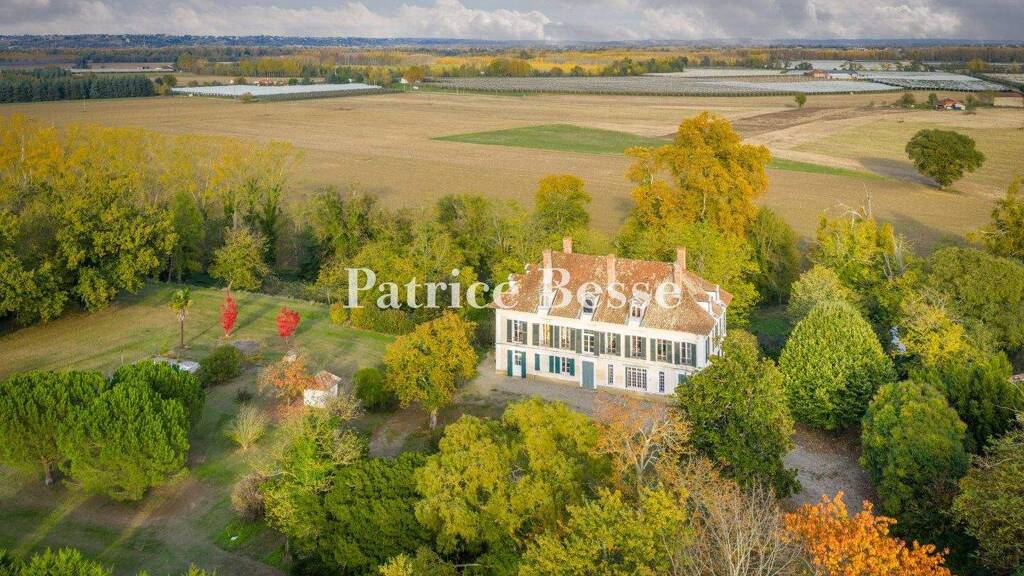
A gravelled drive then leads to the manor house whose origins date back to the 17th century. It was a farm at the time and already belonged to the current owners' family. In the 19th century, an ancestor decided to renovate the edifice in the Basque style that she was very keen on. The east-west oriented, three-storey edifice was built overlooking the former bed of the River Garonne, benefiting from views over the surrounding fields.
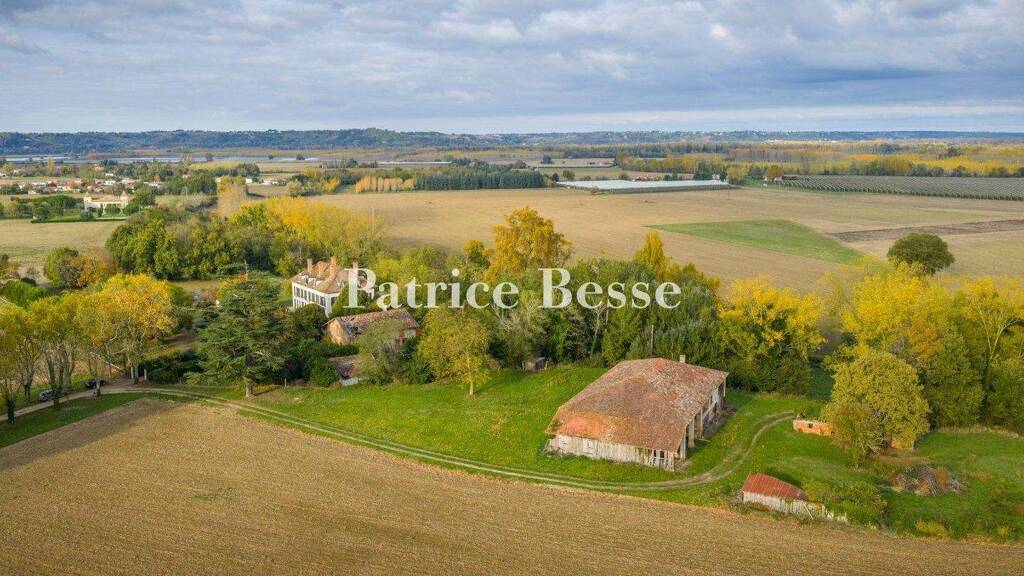
The estate keeper's house is set back slightly, as is an enclosure and outbuildings, while an agricultural storage building stands to the south, partially converted into accommodation for the tenant farmers. All the buildings, made of terracotta bricks, adobe bricks and river pebbles, topped by roofs of flat interlocking tiles or barrel tiles, are spread harmoniously between the garden, meadows and agricultural land. Lastly, the garden is adorned with a spring flowing into a pond, a swimming pool and a tennis court.
While the original volumes and period features have been duly respected, the buildings now require complete renovation to be carried out to render them habitable and comfortable. Its geographical location, extent and the diversity of its various indoor and outdoor spaces provide it with potential for plenty of purposes.
The manor houseIt is spread over three storeys and approximately 720 m². Its architecture is classical, with regular rendered facades punctuated by rectangular windows fitted with green-painted wooden shutters. Beautiful light streams into the upper floors throughout the day. The window and door surrounds, stringcourses and quoins stand out thanks to white rendering. Its hipped roof made of interlocking tiles is topped by five pink brick chimney stacks, while ten dormers allow light to stream into the loft.
To the east, the views over the meadows and fields in the lower part of the estate can be enjoyed from a patio. The grounds stretch out around the house's three other elevations.
The ground floor
A flight of steps climbs up to the main entrance through a double-leaf door set slightly to the right of the centre. It opens into a hall illuminated by a four-leaf window and adorned, from floor to ceiling, with chessboard patterned black and white cement tiles bordered by a frieze of fleur-de-lys and scrolls, white and light yellow geometrically patterned wainscotting and exposed joists painted white.
To the left, the hall leads to a study, into which gentle light filters from the west through two single leaf and one ...