A converted presbytery with a curate's garden, rear courtyard, and swimming pool, in a peaceful, small village near the upper Quercy and Corèze areas
A converted presbytery with a curate's garden, rear courtyard, and swimming pool, in a peaceful, small village near the upper Quercy and Corèze areas.
To the north of the Lot area, on the edge of the upper Quercy sector and Corèze area, the territory around Cavagnac is made up of gentle raised plateaux and open meadows overlooking the Dordogne Valley. The environment, which is 10 minutes from Martel, 15 minutes from Turenne and 20 minutes from Brive, has remained rural and well-preserved, dotted with old houses scattered in hamlets, Romanesque churches and former farm estates that are a throwback to the local viscontal history, in a peaceful setting with broad horizons. The nearest shops and services are only a few minutes away. Thanks to a nearby railway station, regional airport and easy access to the A20 motorway (in 15 minutes), by car it is possible to reach Paris, Bordeaux, Toulouse, Clermont-Ferrand and Limoges in respectively 5 hours, 2 and a half hours, 2 hours, 2 hours and 1 hour 15 minutes, offering an appreciable balance between the great outdoors and good transport links.
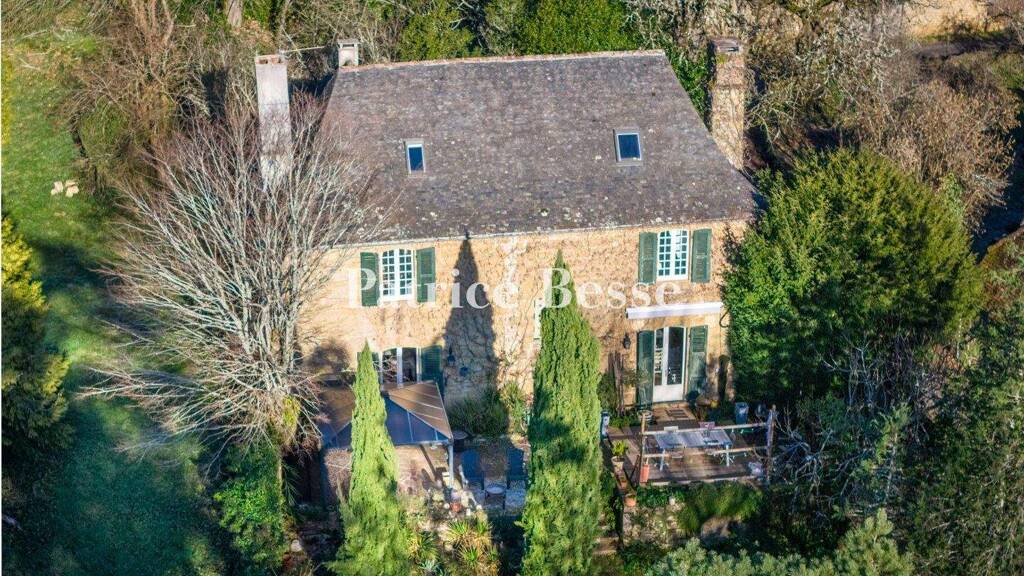
This former presbytery is tucked away from view, enjoying privacy behind a stone wall, between the Romanesque church and castle, in the old part of the hamlet, inherited from medieval settlements linked to the Viscounty of Turenne. From the narrow street, a double-leaf, wrought-iron gate opens into a closed, cobbled courtyard with parking space for one vehicle. In the corner of this courtyard, next to the barn, a pond discretely adorns the space. The main entrance, the door to the cellar and the French windows opening into the living room, whose wide lintel sculpted with an accolade pays witness to the place's history, can be reached from the courtyard.
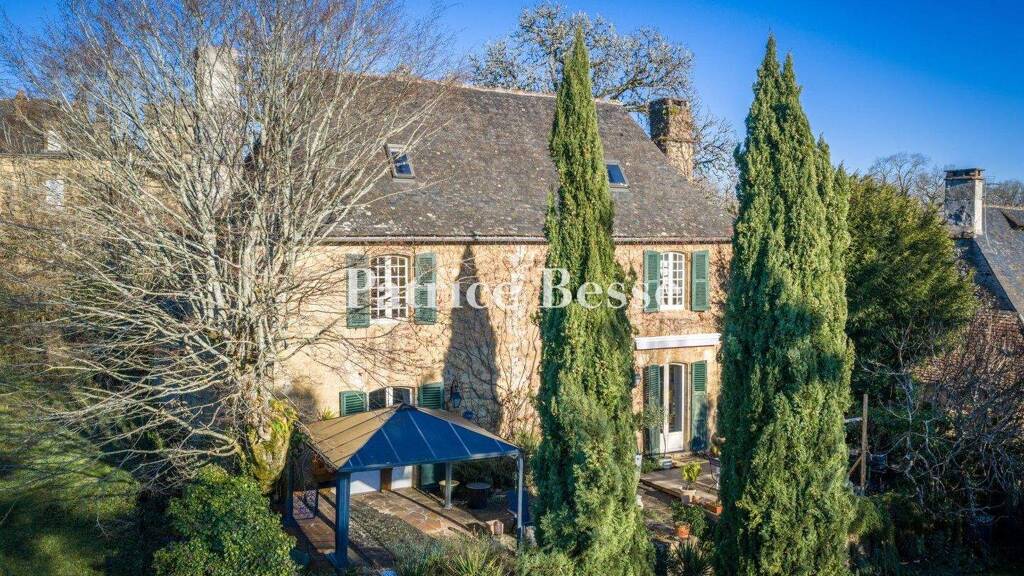
The current residence is thought to date from the late 19th century. It boasts three storeys, including a converted loft, and stands above a vaulted cellar. Its light-yellow stone elevations, partially covered by Virginia creeper, have retained the sobriety of ecclesiastic houses of yesteryear. A perpendicularly situated barn prolongs the property's edifices and adds structure to the surroundings of the courtyard. Light filters into the staircase via a window, which is embellished with a stained glass-style painted motif fixed to a pewter frame. The main section has a hipped roof while the barn has a gabled roof, creating a balanced silhouette in the surrounding landscape.
To the south, the house opens onto a densely tree-filled garden, providing coolness and privacy on sunny days. A patio and a pergola provide outdoor living spaces, while, further away, the swimming pool and its wooden decking discretely take their place among the vegetation, enhancing the private nature of the property.
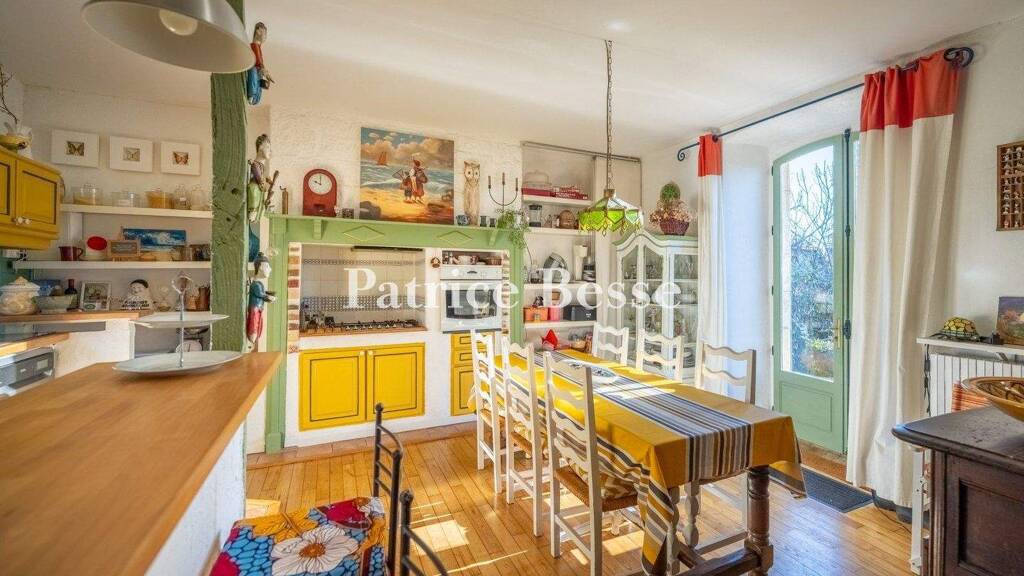
The presbyteryThe house is immediately habitable without any work, having been carefully restored and maintained over the years, with respect for its authenticity, borne out in the choice of sober decoration faithful to the simplicity that characterised the presbytery in bygone days. It boasts the welcoming ambiance of a family home, bathed in light, possessing impressively sized reception rooms, a pleasant kitchen and spacious bedrooms. The place's preserved character is displayed by the presence of old parquet flooring, exposed beams, stone walls and period fireplaces. The broad French windows in the kitchen and lounge open onto the patio, giving a genuine impression of continuity between the living spaces and outside.
The interior layout offers plenty of flexibility: the former barn, which today forms part of the home, could easily be transformed into an independent space, suitable for holiday let accommodation or for welcoming visiting guests.
The ground floor
The entrance door leads into a hall set around a wooden quarter-turn staircase adorned with balusters and a ...