A traditional 19th century Gard farmhouse and vast farm outbuildings, 20 minutes from Nîmes - ref 879031
A traditional 19th century Gard farmhouse and vast farm outbuildings, 20 minutes from Nîmes.
Located in the east of the Occitanie region, approximately 20 minutes north-west of Nîmes, between the foothills of the Cévennes mountains and the Gard plain, the village where the property is situated is a privileged location. Its well-preserved old town centre boasts a discreet but remarkable heritage, with medieval alleyways, a Romanesque church and a clock tower that testify to the town's history, marked in particular by the Reformation. Set in the heart of a natural environment typical of the southern Gard region - garrigue, hills and farmland - the village is part of the Gorges du Gardon Biosphere Reserve. With easy access to a TER station and the A9 motorway very nearby, it combines good quality of life, accessibility and an unspoilt Mediterranean setting.
On the north-east side of a rectangular plot of more than 3 000 m², enclosed by stone walls and fences, there stands a vast old building with a strong rural character. The buildings are laid out in a U-shape, closed on three sides, typical of traditional southern farmhouses. This architectural arrangement, designed to provide protection from the prevailing winds and offer a private, yet functional space, is reminiscent of the farmhouses that once dotted the Gard countryside. The property is entered from the west via a wide carriage entrance flanked by former stone stables. The entrance marks the threshold to a quiet, enclosed world, far removed from any hustle and bustle.
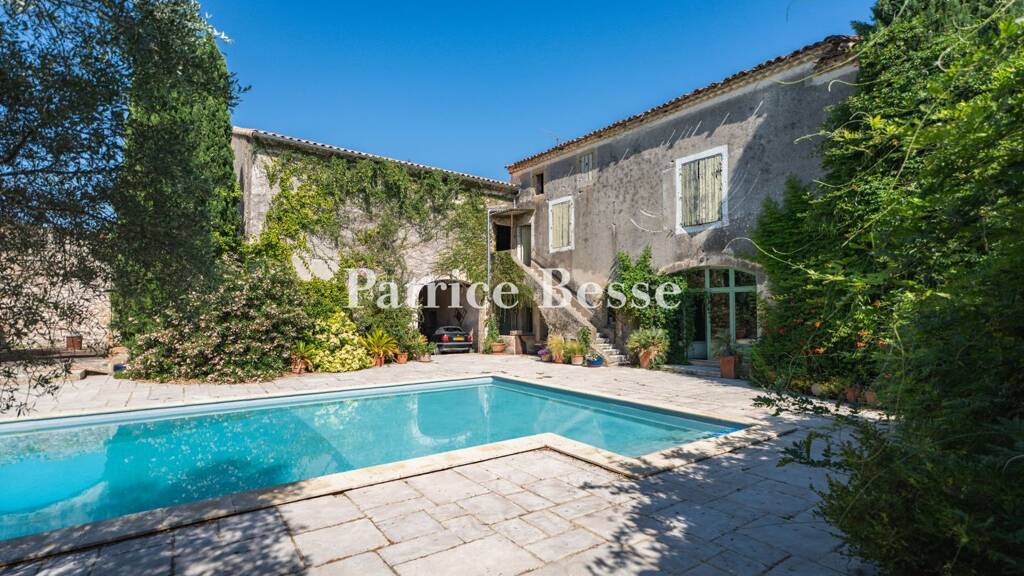
Behind the discreet entrance there is a vast, light-filled central courtyard, bordered by the three wings of the house. The walls, made of local stone and rubble with a patina finish, reveal the building's age - probably before the 19th century. Most of the windows are straight; some of them are wide and high, with pointed or basket-handle arches on the garden level. They are surrounded with ashlar. The roofs are covered with canal tiles on double-sloped wooden frames and bordered by a double cornice. They feature recesses that testify to the successive extensions and changes to the building complex over the generations.
The courtyard, enhanced by the recent addition of a swimming pool, highlights the former productive function of the site while showing its transformation into an elegant living space. In the wings, which were once attics or agricultural outbuildings, a few windows let in light and mean that they can be used for other purposes. Facing due south, the main building, which captures the warmth and light of the Mediterranean, provides wide views over the interior of the property through its many windows.
The house
The garden-level floor
The main living area is dominated by a south-facing round-headed window that opens directly onto the main living space. It consists of a large, open-plan volume, structured into two successive zones, partially separated visually and physically, by an imposing stone arch, the central load-bearer. This light-filled space is completely open-plan, with large windows opening onto a large paved courtyard. The walls are of exposed stone, carefully repointed, and the floor is covered with terracotta tiles that add ochre tones to the room. On the ceiling, exposed beams and brick vaults form segmental arches. Extending on from the main room, a vast terracotta-tiled kitchen opens onto a dining area. With its large south-facing window, it enjoys an appreciable amount of natural light, enhanced by the light saffron-coloured textured-effect renderings on the walls. From the central area, a corridor leads north to a laundry room, a bedroom with an en suite shower room and a huge room which has now been converted into a games room. This is connected to the former wine storehouse, whose monumental appearance is emphasised by a large ...