An 18th-century country house with a pool, tennis court, outbuildings and four hectares of grounds, nestled by a historical village 30 minutes south-e
An 18th-century country house with a pool, tennis court, outbuildings and four hectares of grounds, nestled by a historical village 30 minutes south-east of Fontainebleau near Paris.
The property lies between France's Brie and Gâtinais provinces, just outside a historical village centred on a 12th-century church. You can reach shops and amenities in just 10 minutes on foot. The town of Fontainebleau is a 30-minute drive away. Paris is just over an hour away by road or by rail from the train station in Montereau-Fault-Yonne, which is 14 kilometres away.
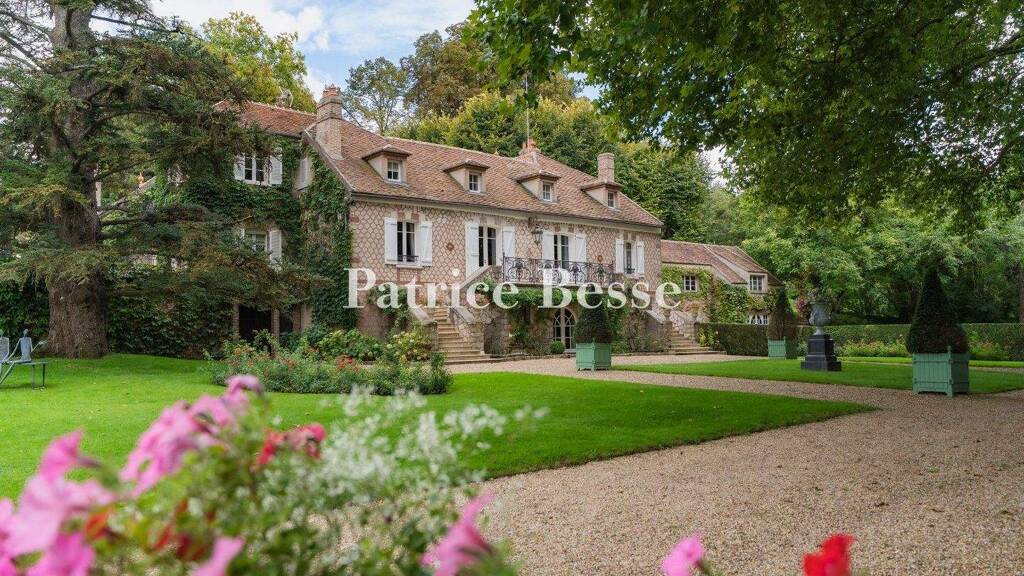
A broad electric gate and a small pedestrian gate, flanked with stone pillars, leads into the property, which covers almost four hectares. Around two hectares of the grounds are taken up by buildings, gardens, lawns and areas for sport and relaxation. The two other hectares are wooded. To the right of the entrance, there is a caretaker's house and driveways that lead to a gravel court where the main house stands. Lawns embellished with clusters of flowering plants, a Spanish fir and a row of age-old plane trees line the edges. Next, there is a former fruit storehouse. Two dovecotes stand on the other side of the main house, in addition to a swimming pool, a tennis court and an orchard. The property's southern part is taken up by woods.
The country houseThe house faces east on the garden side and west on the court side. On the garden side, the central section is framed between two square pavilions that protrude slightly. At one end, it is extended with a small wing that houses a garage for two vehicles. A perpendicular extension, lower in height, adjoins this wing. At the end of this extension, there is a dovecote with a hipped roof. This dovecote stands opposite a second dovecote. The whole complex is positioned around a court with a perfectly symmetrical design that includes a terrace and a small garden of box hedges and rose bushes. Two flights of steps, one stone and the other brick, face each other and lead to the main floor. There is a terrace on the roof of the adjacent wing, which serves as a garage. On the court side, lower down, a double flight of steps leads to the main floor. In the middle of the facade, an arched door leads into the garden-level floor. You can also reach this floor from one of the end walls, via a door of solid oak framed between stained glass windows. And you can reach it from the other end wall too, via a door that leads to a former fruit storeroom. The elevations have pointing that forms a geometric pattern on the western elevation. The roof has multiple slopes, some of which are half-hipped. They are covered with local tiles, except for the house's garden-facing central slope, which has slate tiles. The brick window surrounds are slightly arched. All the windows are double-glazed and fitted with white wooden shutters.
The ground floor
The ground floor has a spacious entrance hall, which is also a living room. On its right side, it leads to a large lounge and then to an office. On its left side, it leads to a small lounge with a dining area and to the kitchen, as well as a little room known as the "Volière" (literally the "Aviary"). White stone tiles patterned with black square inserts cover the floor of the entrance hall and living room. Solid oak herringbone parquet extends across the other rooms, except in the kitchen and adjoining entrance hall, which have floors of hexagonal terracotta tiles. Two large 18th-century fireplaces - one made of white marble in the large lounge, the other made of white stone in the kitchen - heat up the rooms. Mouldings, wooden panelling, painted doors, wallpaper with foliage motifs and harmonious wall colours create a welcoming atmosphere throughout the home, yet one that keeps the personalised identities of each room. The kitchen, a triple-aspect space, offers a 30m² floor ...